

Introduction
You passed the bar. You survived the associate grind. And at some point, you realized: this isn't what you want.
That realization hits more lawyers than the profession lets on. According to NALP data, the attorney attrition rate reached 23% in 2021 — up sharply from roughly 16% in prior years. And 89.3% of associates reported burnout had a moderate to significant impact on their job satisfaction.
Feeling trapped isn't a personal failing. It's a structural problem with how legal careers are built.
The good news: a JD is not a life sentence to legal practice. It's a credential that signals analytical rigor, persuasive communication, and regulatory fluency — skills that transfer directly across business, government, technology, compliance, and consulting.
This article covers why lawyers leave, which career paths make the most sense for JDs, and how to make the transition without starting from zero.
Key Takeaways
- A JD builds high-demand skills — analytical thinking, negotiation, risk assessment — that transfer across dozens of nonlegal industries
- Business and finance, government and policy, legal tech, compliance, and consulting offer the strongest landing spots for departing lawyers
- Your JD investment follows you — it opens doors across dozens of nonlegal fields
- Successful transitions start with self-assessment, then require repositioning your skills and targeting the right roles
Why More Lawyers Are Leaving the Law
The legal profession has a retention problem — and it predates the pandemic.
NALP's burnout research found that 37.4% of lawyers who felt undervalued by their employer considered leaving the profession due to mental health concerns, burnout, or stress. Nearly 90% of associates said burnout meaningfully affected their job satisfaction, with unmanageable workload cited as the top cause.
The reasons lawyers cite most often for wanting out:
- Billable hour pressure that turns every personal moment into an opportunity cost
- Adversarial dynamics that feel corrosive over time
- Misalignment with personal values, particularly for lawyers who entered the profession to make an impact
- Limited autonomy over their practice, clients, and daily decisions
It's More Common Than It Looks
Lawyers who want to leave often feel isolated — as though everyone else has adapted and only they are struggling. That's not accurate.
Ex Judicata co-founder Neil Handwerker left practice after three months. He knew immediately it wasn't the right fit — and built a career in business, legal recruiting, and eventually co-founded the only end-to-end platform for JDs transitioning out of law. The platform reached 500,000 unique users in January 2026.
That number reflects real demand. Across finance, tech, compliance, and corporate strategy, organizations are now actively recruiting JD-trained talent for nonlegal roles — not as a workaround, but as a deliberate hiring strategy. The rest of this guide covers where those roles are, what they require, and how to position yourself for them.
What Makes a JD Uniquely Valuable Outside Legal Practice
Most lawyers underestimate how much their training is worth outside a courtroom.
NALP defines JD Advantage roles as positions where the JD provides a demonstrable advantage in obtaining or performing the job — no bar admission or active licensure required. In the Class of 2024, these roles represented 47% of all business-sector jobs taken by JD graduates and 50.8% of education jobs. The median starting salary was $82,000, with an average of $92,500.
The Transferable Skills Employers Actually Want
Legal training sharpens a specific combination of cognitive and professional skills that are genuinely hard to find:
- Rapid evaluation of complex, ambiguous information and reaching defensible conclusions (analytical reasoning)
- Structuring arguments and writing clearly under pressure — skills most non-lawyers can't match
- Catching errors and inconsistencies that others routinely miss
- Navigating multi-stakeholder disputes toward workable outcomes
- Comfort with legal frameworks, compliance requirements, and regulatory gray areas
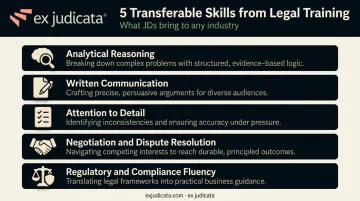
Beyond doctrine, lawyers routinely manage client relationships, lead projects under pressure, distill dense information for non-expert audiences, and make high-stakes judgment calls. Those competencies transfer directly into roles in management, compliance, policy, and strategy.
Reframing Your Skills for a Business Audience
The translation matters. On a legal resume, "drafted and negotiated contracts" describes a task. On a business resume, the same experience reads differently:
| Legal Resume Language | Business Resume Language |
|---|---|
| Drafted and negotiated contracts | Managed complex multi-party agreements to protect organizational risk and drive deal outcomes |
| Conducted due diligence | Evaluated operational and financial exposure across high-stakes transactions |
| Advised clients on regulatory matters | Guided stakeholders through compliance frameworks to reduce legal and reputational risk |
This isn't spin — it's accuracy. Legal jargon signals a specialist when you're applying to generalist roles. Employers like Marsh McLennan and Lockton recruit specifically for the JD skillset in nonlegal positions because they understand what's behind the credential. Your job is to make that value legible.
Top Alternative Career Paths for Lawyers
Business, Finance, and Corporate Roles
This is the largest landing zone for transitioning attorneys, and for good reason — legal training overlaps heavily with the analytical and regulatory demands of business operations.
Roles with strong JD alignment:
- Compliance officer — Median salary of $78,420 as of May 2024; Compliance Manager - Legal roles reach $93,000–$136,000 nationally per Robert Half's 2026 Salary Guide
- Contract manager/analyst — Deep knowledge of agreement structure is the core job requirement
- Risk analyst — Probabilistic thinking lawyers use in case evaluation applies directly
- Financial examiner — Median salary $90,400; projected 19% employment growth through 2034
- Business development manager — Relationship management and persuasion transfer naturally
- Financial risk specialist — Median $110,220 for specialists in this category
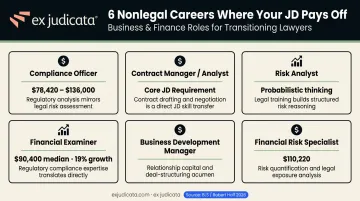
Financial services and insurance are strong destinations for lawyers with transactional or regulatory backgrounds. Roles like regulatory affairs manager, claims investigator, and financial services compliance lead frequently appear on the Ex Judicata Job Board — a platform built specifically for JDs seeking nonlegal opportunities.
Government, Policy, and Nonprofit Work
For lawyers who entered the profession with a social mission — and left private practice feeling constrained — government and policy work often realigns purpose with career.
Federal agencies (DOJ, SEC, FTC, Congressional offices), state regulatory bodies, and think tanks regularly seek JD-trained candidates. These roles tap directly into legal fluency without requiring active practice.
Nonprofit compliance is an underrated destination: many organizations need someone who can navigate grant compliance, employment regulations, and regulatory filings without paying outside counsel rates. For lawyers motivated by mission over margin, the fit is often immediate.
Legal Technology, Operations, and Compliance
This is one of the fastest-growing sectors for transitioning lawyers — and one where the JD background creates a clear hiring advantage.
High-demand roles:
- Legal operations specialist — Bridges legal knowledge and business systems; grew into a recognized corporate function after CLOC formalized the role in 2015
- Legal product manager — Requires fluency in both legal workflows and software development cycles
- Legal tech implementation advisor — Combines legal fluency with change management
- Data privacy and compliance — As of mid-2025, 19 U.S. states had passed comprehensive privacy laws, with significant amendments continuing into 2025; demand for privacy-credentialed professionals is accelerating
The compensation upside is real. In technology-sector legal and compliance roles, the 2025 median salary reached $205,000, according to IAPP's Salary and Jobs Report. Professionals working across both privacy and AI governance earned more than $169,700 at the median.

Compliance more broadly remains one of the most accessible and well-compensated transition paths. Director-level compliance roles reach $111,250–$168,000 nationally, which is competitive with or superior to mid-level associate compensation at many firms.
Consulting, Entrepreneurship, and Independent Paths
Management consulting is a natural fit for lawyers who want to apply analytical skills across industries without committing to one organization. McKinsey, Bain, and BCG all explicitly recruit JD candidates — Bain even runs a dedicated ADvantage program for advanced-degree holders. Among Class of 2024 JD graduates who took business roles, consulting represented 11.3% of JD Advantage positions.
For lawyers drawn to more self-directed paths, other viable options include:
- Entrepreneurship — Legal-focused startups, compliance software, or contract tools
- Legal journalism and content — Analysis and commentary for legal publications and platforms
- Executive coaching and training — Drawing on courtroom and client experience
- Legal academia — Adjunct or full-time faculty, often with practitioner-track positions
- Legal and executive search — A natural extension for lawyers with strong networks (and the path Neil Handwerker took before co-founding Ex Judicata)
These paths require more self-direction but offer the autonomy and creative latitude that structured roles often don't.
How to Transition From Law to a Nonlegal Career
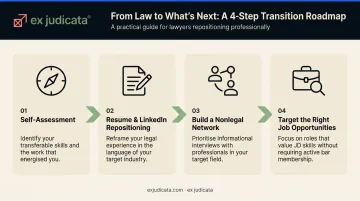
Step 1: Start With Self-Assessment
Before you target roles, get clear on what you actually want. Ask yourself:
- What do I want more of? (Creativity, autonomy, collaboration, mission, stability)
- What do I want less of? (Adversarial dynamics, billable pressure, narrow specialization)
This isn't a soft exercise — it's the foundation for targeting the right roles rather than just escaping the wrong ones. Ex Judicata offers the EXJ Career Diagnostic, a PhD-validated assessment designed specifically for lawyers exploring business careers — the first tool of its kind built for this audience.
Step 2: Reposition Your Resume and LinkedIn Profile
Your legal resume will not get you hired in a nonlegal role without translation. Specific changes to make:
- Replace legal accomplishments with business outcomes ("reduced regulatory exposure" vs. "drafted compliance policy")
- Remove practice-area jargon that means nothing outside law
- Write a professional summary that speaks to business problems you solve — not legal ones you've handled
- Optimize LinkedIn to reflect the professional you're becoming, not the lawyer you're leaving
If you want hands-on help, Ex Judicata's Career Corner connects you with specialists in resume writing, LinkedIn positioning, and personal branding — all experienced working with JD candidates making this exact move.
Step 3: Build a Network Outside of Law
Repositioning your materials only gets you so far — your legal network, strong as it may be, won't get you hired in a new industry. You need to build outside connections deliberately.
Start here:
- Reach out to JDs already working in your target industries (roughly 600,000 non-practicing lawyers in the US have already made this move)
- Attend industry-specific events rather than legal conferences
- Join communities built for transitioning and non-practicing lawyers
The EXJ Community is a peer-to-peer network for non-practicing lawyers — the first of its kind in the US — with a member directory and access to JDs who've navigated the transition you're considering.
Step 4: Find the Right Job Opportunities
Standard job boards aren't built for this search. Most listings don't signal that JD candidates are welcome, and attorneys with legal titles often don't show up in keyword searches for business roles.
Seek out organizations and job boards that explicitly recruit for the JD skillset. The Ex Judicata Job Board is built specifically for this purpose — every role listed is nonlegal, and every employer posting has opted in to recruit JD candidates.
Frequently Asked Questions
What are the alternative career paths for lawyers?
The main categories are business and finance (compliance, contract management, risk, financial services), government and policy, legal technology and operations, and consulting or entrepreneurship. The right path depends on your skills, interests, and what kind of work environment you're looking for.
What should I do if I don't want to be a lawyer anymore?
Start with self-assessment to clarify what is and isn't working — not just what you're escaping. Then connect with platforms and communities like Ex Judicata that offer job listings, career resources, and peer support specifically designed for JDs navigating this transition.
Is a JD degree useful outside of law?
Yes — a JD signals analytical rigor, persuasive communication, and regulatory literacy. A growing number of companies actively recruit JD holders for business, compliance, policy, and strategy roles precisely because those skills are difficult to develop outside of legal training.
Do I need additional credentials or certifications to change careers?
Rarely. The JD itself is the credential. That said, targeted certifications — such as the CIPP/US for data privacy or the PMP for project management — can help signal interest and close perceived skill gaps in specific fields without requiring years of additional schooling.
How do employers outside of law view JD candidates for nonlegal roles?
Generally favorably — but how you position yourself matters. Employers outside law aren't looking for a lawyer; they want someone who can analyze ambiguous problems, communicate clearly, and manage risk. Leading with those transferable skills, rather than your practice area, tends to resonate more in interviews.
What are the highest-paying nonlegal career options for lawyers?
Data privacy and AI governance roles in tech reached a median of $205,000 in 2025. Corporate compliance leadership and financial management roles median between $161,700–$168,000. Management consulting analysts average around $101,190, with strong projected growth across all three areas.