

The answer isn't personal weakness. Lawyer unhappiness is a documented, systemic crisis—and understanding why it happens is the first step toward doing something about it.
Key Takeaways
- Lawyer job satisfaction is at a five-year low, with burnout and depression rates far exceeding those of the general workforce
- The root causes are structural—billable hour models, adversarial culture, and low autonomy—not individual failure
- High compensation doesn't equal high satisfaction; well-paid BigLaw associates report misery at the same rates as their lower-paid peers
- Student debt and sunk cost psychology create a "golden handcuffs" trap that keeps lawyers stuck even when they're miserable
- Chronic unhappiness often signals deeper career misalignment; lateral moves alone rarely fix it
How Widespread Is Lawyer Unhappiness?
The numbers are worse than most people outside the profession realize.
Recent data puts the scale of the problem in sharp relief:
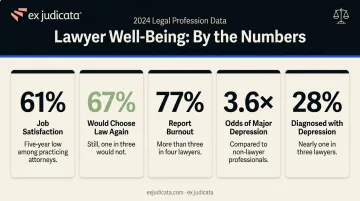
- Law360 Pulse's 2025 Lawyer Satisfaction Survey found only 61% of lawyers were satisfied or very satisfied with their jobs — the lowest in the survey's five-year history
- Just 67% said they'd choose to be a lawyer again, also the lowest since 2021
- A Massachusetts well-being study found 77% of lawyers reported burnout, with 40% having considered leaving the profession entirely in the prior three years
- A landmark Johns Hopkins study found lawyers had an odds ratio of 3.6 for major depressive disorder compared to the general working population — one of the highest of any occupation studied
- A large-scale ABA/Hazelden survey of over 12,000 licensed attorneys found 28% reported depression, 19% anxiety, and 20.6% screened positive for problematic alcohol use
Does Money Fix It?
No — and that's a finding worth sitting with.
Researchers Krieger and Sheldon, in their 2015 study of over 6,200 lawyers, found that income had only a modest relationship with well-being, while autonomy, relatedness, and competence were the strongest predictors of satisfaction. Firm size increased income while well-being declined.
The Law360 data makes that tradeoff concrete: 64% of lawyers at firms with more than 1,000 attorneys worked more than 50 hours per week, yet only 51% felt anything other than stressed most of the time.
The problem is not economic. It's structural.
The Daily Grind: Why Legal Work Itself Creates Discontent
Many lawyers entered the profession expecting intellectual challenge and meaningful impact. The daily reality often looks nothing like that.
Document review. Brief drafting. Interrogatories. Conference calls managing a client's contract dispute. Repeating variations of the same argument across dozens of similar matters. For lawyers who imagined themselves solving genuinely novel problems, the gap between expectation and reality is stark—and it hits early.
Billable Hours and the Time Trap
The billable hour model is the engine of law firm culture, and it creates a perverse incentive structure that most lawyers never fully escape.
At large firms, NALP data shows average billable hour requirements of 1,930 per year, with 26% of firms requiring 2,000+. Actual hours worked average higher—over 2,100 at the largest firms. That translates to roughly 55-hour weeks when you factor in non-billable tasks: firm meetings, professional development, business development, and administration.
The psychological damage is specific:
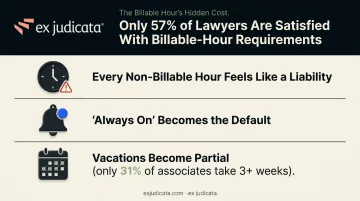
- Every non-billable hour feels like a liability. Time spent exercising, sleeping, or being present at dinner is time not logged.
- "Always on" becomes the default. The New York State Bar Association specifically identified lack of "down time" as a major well-being concern, recommending a cap of 1,800 annual billable hours.
- Vacations become partial. Law360 found only 31% of associates expected to take three or more weeks of vacation, versus 53% of equity partners—a gap that reflects years of earned relief, not cultural permission.
The Law360 survey found only 57% of lawyers were satisfied with their billable-hours requirement—the lowest reading in the survey period.
High Stakes for Small Mistakes
Law is one of the few professions where a clerical error can end a client's case and a lawyer's career simultaneously.
A missed filing deadline, an unsigned document, or a miscalendared statute of limitations can constitute malpractice. Administrative errors account for nearly 20% of legal malpractice claims, according to ABA data. This creates a chronic state of hyper-vigilance. A study of 131 U.S. attorneys found 42% identified workload and deadlines as their primary source of stress—and 9% described a self-reinforcing loop in which stress caused mistakes, which caused more stress.
In legal practice, perfection is the baseline—not the goal. And the consequences of falling short don't stay in the office. That pressure bleeds directly into how lawyers experience everything else about their work, including whose problems they're actually solving.
Serving Others' Conflicts—Without Agency
There's a particular kind of fatigue that comes from spending a career managing other people's disputes. Most lawyers—especially in litigation—are permanent third parties. They navigate someone else's conflict, toward an outcome they don't control, for a client they may have met twice.
Over time, many describe a sense of purposelessness that has nothing to do with competence. They're skilled. The work is just never really theirs.
Law Firm Culture: Isolation, Competition, and Constant Pressure
Law firms are not designed to make lawyers happy. They're designed to bill hours and win cases. The culture that emerges from that design is competitive by default and adversarial by training. In practice, it's also deeply isolating.
Associates compete with each other for partner attention, staffing on high-profile matters, and advancement. Opposing counsel is adversarial by design. Law school spent three years rewarding the ability to identify weaknesses in arguments and people—a skill set that doesn't turn off at 6 p.m.
The Isolation Problem
Junior associates spend most of their time doing heads-down research and document work. Many go days without meaningful client contact. Co-workers are simultaneously colleagues and competitors. Firm culture often values hours over collaboration.
Law360 data shows satisfaction with collegiality and collaboration fell to 68% in 2025, down from 77% in 2024—a nine-point drop in a single year. That's a measurable erosion of the social fabric inside firms, not just a bad week.
Good work is rarely praised. Mistakes are consistently scrutinized. It's an environment built to generate anxiety, not belonging. That same lack of control extends beyond the social — it shapes how lawyers experience their work itself.
The Absence of Autonomy
Research by Manon Nickum and Pascale Desrumaux found that burnout among lawyers decreased directly with decision latitude—the degree of control over how work gets done. Junior and mid-level associates have almost none. They don't choose their cases, their schedules, their deadlines, or often even their teams.
Krieger and Sheldon's research found autonomy was one of the strongest correlates of lawyer well-being, with a correlation coefficient around .66. Most associates report having little autonomy — and the longer they stay in firm structures, the more entrenched the deficit becomes.
Unlike most professional careers, legal seniority within a firm doesn't always translate into marketable options outside of it.
The Psychological and Physical Toll on Lawyers
The mental health crisis in the legal profession is not new—it's been documented since at least 1990—but its scale is still underappreciated.
The ABA/Hazelden study found 11.5% of lawyers had experienced suicidal thoughts during their career, 2.9% reported self-injurious behaviors, and the problematic drinking rate among junior associates was 31.1%—the highest of any career stage.
Perhaps most troubling: 50.6% of lawyers struggling with mental health concerns said they didn't seek help because they didn't want others to find out. The stigma is structural, reinforced by a profession that treats vulnerability as a liability.
The Pessimism Problem
Legal training deliberately cultivates a pessimistic lens. Spotting every way a deal can fall apart, every argument the other side might make, every risk in a proposed course of action—this is exactly what clients pay for.
Research by Satterfield and Monahan found that law students with a pessimistic explanatory style outperformed more optimistic peers on GPA and law journal performance — pessimism pays dividends early in a legal career.
The problem is that it doesn't stay in the office. The same orientation that makes a lawyer good at anticipating bad outcomes makes them prone to depression, anxiety, and chronic negative self-evaluation in their personal lives. The professional asset becomes a personal liability.
Lawyer depression and anxiety are most often caused by the job environment. A study of attorney stress found that the conditions lawyers endure would affect anyone. These are structural problems, not character flaws.
Why Unhappy Lawyers Stay: The Golden Handcuffs Trap
Knowing you're miserable and leaving are two very different things. Most unhappy lawyers stay, and for reasons that are genuinely hard to dismiss.
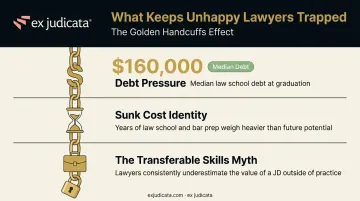
Three forces keep most unhappy lawyers in place:
- Debt pressure. The ABA puts average law school debt at $108,000, with median cumulative debt for borrowers around $160,000. Add a mortgage and family obligations, and leaving a high salary—even for something better suited—feels financially reckless.
- Sunk cost identity. Three years of law school, bar prep, and years of practice represent an enormous investment of time and self. Leaving doesn't just mean changing jobs—it means reframing what all of that was for.
- The transferable skills myth. Many lawyers genuinely believe their JD only qualifies them for legal work. It doesn't. Legal training builds analytical thinking, persuasion, risk assessment, written communication, and client management—skills in direct demand across compliance, consulting, policy, business development, and finance.
That skills reality matters more than most lawyers realize. Yet despite these barriers, NALP Foundation data shows 83% of associates who departed firms in 2025 left within five years of hire—meaning when lawyers do leave, they're leaving early, before the golden handcuffs fully close.
Recognizing When Unhappiness Is a Signal to Move On
Not all lawyer unhappiness is the same, and the distinction matters.
Situational unhappiness looks like: a toxic partner, a soul-crushing practice group, a firm culture that doesn't fit. This may improve with a lateral move or a shift to in-house work.
Systemic misalignment looks like: the work itself doesn't match how you're wired to contribute. No amount of lateral moves resolves this, because the problem isn't the firm—it's the nature of legal practice.
If the dissatisfaction follows you from job to job, if it persists despite salary increases and new titles, if it shows up on Sunday nights regardless of what Monday holds—that's worth taking seriously rather than waiting for it to pass.
Ex Judicata was built for lawyers at exactly this crossroads. Co-founder Neil Handwerker left law after three months, recognizing early what many lawyers spend years trying to ignore, and built the platform he wished had existed.
For lawyers who aren't ready to jump but want to understand their options, Ex Judicata offers:
- A job board with 100% nonlegal roles
- The EXJ Career Diagnostic, which maps attorney traits to specific business careers
- Career coaching through the Career Corner
- A peer community of non-practicing lawyers who've made successful transitions
If leaving law feels like starting over, these resources exist to show you it doesn't have to be.
Frequently Asked Questions
Are most lawyers actually unhappy with their careers?
Research consistently shows widespread dissatisfaction. The 2025 Law360 survey found only 61% of lawyers satisfied—a five-year low—while 77% reported burnout in Massachusetts's well-being study. Numbers like these point to structural problems in the profession, not personal failings of the lawyers experiencing them.
Why do so many lawyers regret going to law school?
Law school cultivates expectations of intellectually stimulating, high-impact work. Many lawyers encounter a reality of repetitive tasks, adversarial culture, and billable hour pressure that bears little resemblance to that vision.
Is lawyer unhappiness connected to the type of law practiced?
Practice area matters, but research by Krieger and Sheldon found the strongest predictor of satisfaction is alignment between a lawyer's motivations and their work environment, not the specific field. Some lawyers carry that misalignment with them regardless of where they practice.
Can switching firms or practice areas fix lawyer dissatisfaction?
Sometimes. If the problem is cultural—a toxic firm or a poor fit with a specific practice group—a change of environment can genuinely help. If the dissatisfaction is with the fundamental nature of legal work itself, switching firms typically provides temporary relief at best.
What mental health risks are associated with practicing law?
The ABA/Hazelden study documented depression rates of 28%, problematic drinking in over 20% of attorneys, and suicidal thoughts in 11.5%. These outcomes are driven by structural demands—not the character or resilience of the lawyers experiencing them.
What options do unhappy lawyers have if they want to leave the profession?
JDs possess genuinely transferable skills—analytical thinking, persuasion, risk assessment, and client management—that translate directly to business, compliance, consulting, and more. Platforms like Ex Judicata offer job boards, career diagnostics, coaching, and peer community resources built specifically for lawyers making this transition.