

Here's what matters most right now: this is not the end of your career. For many attorneys, being let go from Big Law turns out to be the inflection point that leads somewhere far better.
This guide covers what you need to know — why Big Law firings are more common than most people admit, what to do in the critical first 72 hours, how to protect yourself legally, and how to decide whether your next move is another firm or something else entirely.
Key Takeaways
- NALP Foundation data shows 19% annual associate attrition in 2025 — Big Law exits are structural, not personal
- Don't sign any severance agreement without legal review; some terms are negotiable
- Protect your references before you lose firm access
- Keep billing through any grace period — billing gaps show up on lateral hiring questionnaires
- A nonlegal career is a real option — compliance, consulting, and finance all actively recruit JDs
Why Big Law Firings Happen More Often Than You Think
Most people who join Big Law don't make partner. The numbers bear that out.
According to the NALP Foundation, overall associate attrition at large firms was 19% in 2025, down slightly from 20% in 2024. Among associates who departed in 2025, 83% left within five years of hire. The up-or-out model isn't a flaw in the system — it is the system.
The Common Reasons Associates Are Let Go
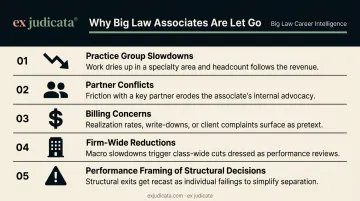
Being fired from Big Law usually comes down to one or more of these:
- Practice group slowdowns — demand drops in a sector (tech M&A, real estate, leveraged finance) and junior attorneys become excess headcount
- Partner conflicts — personality or working-style mismatches that have little to do with legal ability
- Billing concerns — disputes over hours, write-downs, or client feedback
- Firm-wide reductions — Cooley cut 150 positions in 2022 during the tech slowdown; Dechert eliminated 55 lawyers and 43 staff in 2023; Reed Smith reduced its global workforce by about 50 the same year
- Performance framing of structural decisions — Bloomberg Law has reported that some firms time cuts around review cycles to minimize recruiting backlash, presenting economic layoffs as individual performance failures
The "Quiet Cutting" Problem
Some firms label structural reductions as performance-based departures. If you were told your work wasn't up to standard during a period when your entire practice group was losing business, treat that framing skeptically — it may reflect firm economics far more than your actual ability. Being let go doesn't mean you weren't good at the work.
The First 72 Hours: What to Do Immediately After Being Let Go
The wrong move in the first 72 hours can cost you severance, references, or legal claims you didn't know you had. Here's what actually matters right now.
Don't Sign Anything Right Away
Severance agreements frequently include:
- Releases of legal claims, including potential discrimination or retaliation claims
- Non-disparagement provisions that restrict what you can say about the firm
- Reference to non-compete language (though ABA Model Rule 5.6 sharply limits enforceable non-competes for attorneys)
Take time to review the documents. Consult an employment attorney before signing anything. Many work on contingency for employment matters, so cost isn't necessarily a barrier.
The EEOC is clear: even if you sign a release, you generally cannot be prevented from filing an EEOC charge. Understand what you're waiving before you waive it.
Understand Your Severance Situation
How the firm frames your departure shapes what comes next. Some firms offer a grace period of continued payroll; others terminate with no severance, particularly where the departure is framed as for-cause. Above the Law reported in early 2024 that Reed Smith let go of multiple associates over alleged billing errors with nothing offered.
If the terms feel one-sided, they may be negotiable. Three areas worth discussing:
- Grace period length — especially if the stated reason for termination is something you dispute
- Non-disparagement scope — what you can and cannot say publicly about the firm
- Reference handling — who speaks for you and what they're permitted to say
Secure Your References Before You Lose Access
Many large firms now have blanket policies confirming only dates of employment. Off-the-record references from partners or senior colleagues who know your work can be invaluable, but you need to reach out before your firm email goes dark.
Identify two or three people who can speak to your work specifically and contact them personally now.
Take Stock of What You're Walking Away With
You're not leaving empty-handed. Make a quick inventory:
- Your bar admission status
- Portable work samples (subject to confidentiality obligations)
- Client relationships you've built (subject to ethics rules)
- Professional contacts across firms, clients, and opposing counsel
Each of these travels with you — and each can open doors in a nonlegal career search.
Give Yourself 48–72 Hours Before Making Public Moves
Don't update LinkedIn or post anything about your departure until you understand any confidentiality obligations and have at least the outline of a plan. The legal world is smaller than it looks.
Making the Most of Your Grace Period
If you have a grace period, treat it like a job — even on the days it doesn't feel like one.
Keep Billing
New employers frequently request hours-to-date data on lateral hiring questionnaires. A sudden drop in billable hours mid-year is a visible signal about the circumstances of your departure. Staying engaged professionally also keeps relationships intact and demonstrates good faith.
Search Strategically, Not Frantically
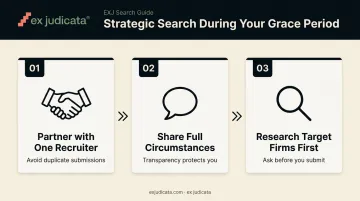
Resist the impulse to submit your resume everywhere at once through every recruiter who calls. Firms notice duplicate submissions, and they're damaging. A better approach:
- Work with one experienced, committed legal recruiter who genuinely understands your situation and can advocate for you
- Be transparent with that recruiter about the circumstances of your departure — they need to know the full picture to protect you
- Ask what they know about the firms you're targeting before you submit
Prepare Your Narrative
You will be asked why you left. Your answer needs to be honest, concise, and forward-looking — not defensive. Effective framing sounds like:
"The group's workload shifted significantly, and I decided to use that moment to pursue a practice environment more aligned with my long-term goals."
What doesn't work: detailed accounts of internal disputes, criticism of the firm, or answers that make the interviewer wonder what you're not saying. Practice this answer until it feels natural.
Protect Every Relationship
Even with partners who played a role in your departure, professional behavior matters. The legal community is tighter than it appears — people from your current firm will surface as references, opposing counsel, or future clients. Leave every interaction in good standing, because you genuinely don't know which one will matter most.
Know Your Rights: When a Big Law Firing May Be Unlawful
Not every firing is legally clean. Know the triggers that could make yours actionable.
Key Legal Red Flags
- Timing relative to protected activity — fired shortly after disclosing a disability, requesting an accommodation, reporting harassment, or raising a compliance concern
- Discrimination — terminations based on gender, race, age, religion, or other protected characteristics
- Retaliation — being let go after engaging in protected conduct like whistleblowing
A pending case illustrates how these scenarios arise: in Steefel v. Ballard Spahr LLP, filed in April 2025, an attorney alleges she was terminated 11 days after disclosing an epilepsy diagnosis, asserting ADA violations. The case is pending; no final outcome has been reached. If the timeline and circumstances of your termination resemble that pattern, it's worth a conversation with an employment attorney before assuming the firing was routine.
The WARN Act
Individual discrimination claims aren't the only legal avenue worth examining. If multiple attorneys were let go simultaneously with no advance notice, ask whether the firm had WARN Act obligations — a separate statutory question from whether the termination was discriminatory. The federal WARN Act generally applies to employers with 100 or more employees and requires 60 days' advance notice for covered mass layoffs. A mass layoff involving fewer than 500 workers can trigger coverage if it affects at least 33% of the workforce at a site.
Act Quickly on EEOC Deadlines
EEOC charges must generally be filed within 180 days of the discriminatory act — extended to 300 days if a state or local agency enforces a similar law. That clock starts immediately. If you suspect your firing was discriminatory or retaliatory, consult an employment attorney before that window closes — 180 days moves faster than it sounds when you're focused on landing your next role.
Should You Return to Law or Pivot to a New Career?
This is worth treating as a genuine choice, not a default.
Ask Yourself an Honest Question
Many attorneys who are let go from Big Law assume the only next step is another firm. Before accepting that assumption, ask: were you fulfilled by the work itself, or by the salary, the prestige, and the identity? If the honest answer is the latter, being let go may be an opportunity to course-correct — and to move toward work that actually fits.
What JD Skills Are Actually Worth in Business
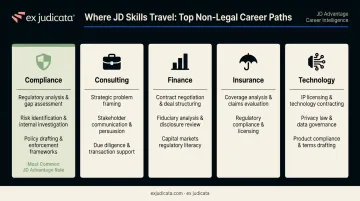
Your training translates directly into demand in non-legal roles. Employers in compliance, consulting, finance, insurance, and technology actively seek people who can:
- Analyze complex documents and identify risk
- Negotiate and draft contracts
- Navigate regulatory frameworks
- Write persuasively under pressure
- Exercise judgment in ambiguous situations
NALP data shows that compliance positions were the most common JD Advantage business jobs for the Class of 2024 — nearly one in six JD Advantage business roles. That's a well-worn path with real demand behind it.
Documented Paths Out of Big Law
The transitions are real. John Scannell started at Skadden and Cadwalader, then helped build Hildene Capital Management into a multi-billion dollar hedge fund where he served as COO, GC, and CCO. Mike Votto practiced at Goodwin Procter and Schulte Roth & Zabel before eventually co-founding Votto Vines Importing, which grew to $50M+ in annual revenue and landed on the Inc. 500. The skill set traveled.
Where Ex Judicata Fits
For attorneys seriously considering a non-legal path, Ex Judicata is the only platform built specifically for this transition. The resources are practical:
- A Job Board with 100% non-legal roles — every listing is relevant, none require you to stay in practice
- An EXJ Career Diagnostic ($25.95, PhD-validated) that maps your attorney traits to 25 specific business career paths
- 44+ Interview Series profiles from JDs who made the transition, covering what they did, what they earn, and what they'd do differently
- An EXJ Community connecting you to a peer network of non-practicing lawyers, with a member directory and member-only opportunities
The decision doesn't have to be permanent. Some attorneys spend several years in a business role and return to law with stronger credentials. Others find they belong outside it entirely. Either way, that's a conclusion worth reaching on purpose — starting with an honest look at what you actually want next.
Frequently Asked Questions
What is the attrition rate for Big Law?
The NALP Foundation reported 19% overall associate attrition in 2025, with 83% of departing associates leaving within five years of hire. Annual attrition has hovered around 18–20% for over a decade, meaning most associates who join large firms ultimately leave before reaching partnership.
Can you be fired from Big Law without severance?
Yes. When a departure is framed as for-cause — billing errors, performance failures — firms sometimes offer no severance. Economic layoffs more commonly include some form of continued payroll or transition period, though that's firm-specific, not a universal rule — and the terms are often negotiable, especially when termination grounds are disputed.
How do you explain being fired from Big Law in a job interview?
Keep it brief, neutral, and forward-facing. Focus on practice group changes, firm economics, or fit — not internal conflict. Something like "the group's workload shifted and I decided to find a better long-term fit" is more effective than any detailed account of what actually happened.
Is being fired from Big Law the end of your legal career?
No. Many attorneys who leave Big Law involuntarily go on to strong careers at mid-size firms, in-house, in government, or in business roles. The credential and the experience remain valuable.
Should I try to negotiate my severance package after being let go from Big Law?
Yes, especially before signing. The duration of any grace period, the scope of non-disparagement language, and how references are handled are all potentially negotiable. Consulting an employment attorney before signing can make a meaningful difference.
Can I get a non-legal job after being fired from Big Law?
Yes — and often, it opens doors attorneys hadn't considered before. Compliance, consulting, finance, insurance, and technology companies actively recruit JDs for business roles. Being let go from Big Law is painful, but it doesn't close those paths.