

Introduction
Lawyers are trained to solve complex problems for others. Yet when it comes to navigating their own exit from practice, most find themselves without a roadmap — and without anyone specifically equipped to help them build one.
Law school, bar admission, and years of practice fuse professional identity with personal identity in ways that make departure feel like failure. High salaries — NALP's 2025 data shows median first-year pay of $215,000 at large firms — create financial floors that make career changes feel economically irrational, even when staying is personally costly.
And most career resources simply weren't built for lawyers.
This post covers what a career transition specialist for lawyers actually does, how they differ from generic coaches, what signs indicate you need one, and where to find support built specifically for JDs — including the vetted specialists and tools available through Ex Judicata.
Key Takeaways
- Leaving law involves identity, financial, and professional barriers that general career coaches aren't equipped to address
- Lawyer-specific specialists translate JD experience into language that resonates with non-legal employers
- Compliance, risk, legal operations, and consulting are the most verified destinations for non-practicing JDs
- A structured, end-to-end support system outperforms one-on-one coaching alone for lawyers in transition
- Ex Judicata combines job access, diagnostics, coaching, courses, and peer community in one platform built specifically for JDs
Why Leaving Law Is Harder Than It Looks
Most professionals can pivot by reframing their resume. Lawyers can't — not easily, anyway.
The JD isn't just a credential. Law school, bar admission, and years inside a firm or legal department reinforce a specific professional identity. Leaving can feel like abandoning the investment, the prestige, and the professional self that colleagues, family, and clients have come to know.
The Financial Floor Problem
The money makes it worse. When your salary is in the top few percent of all professionals, every alternative looks like a step down. According to NALP's 2025 salary survey, median first-year base pay at firms with over 700 lawyers is $215,000, with $225,000 being the most frequently reported figure at those firms.
That figure functions as a psychological anchor. Any career change requiring a compensation reset feels economically irrational in the short term, even when the long-term case is clear.
The Burnout Reality
The other side of that equation: staying carries real costs too. A Bloomberg Law survey of 614 lawyers found they experienced burnout 52% of the time, with 46% reporting worsening well-being. Among those with declining well-being, average job satisfaction was 4.1 out of 10. Lawyers cited inability to disconnect (79%) and heavier workloads (78%) as the primary contributors.
Why General Resources Fall Short
Most career coaches, job boards, and transition frameworks weren't built for this audience. They don't account for:
- How employers outside law actually read a JD credential
- Which industries actively seek non-practicing lawyers (NPLs)
- The specific cultural exit that leaving a firm or legal department requires
- The emotional weight of walking away from years of professional investment
Specialists who work exclusively with JDs understand all four of those dynamics — and build their process around them.
What Makes a Lawyer-Specific Career Transition Specialist Different
A generalist career coach can help with resume formatting and interview confidence. What they can't do is tell you how your litigation background reads to a fintech compliance team, or whether your M&A experience maps more naturally to private equity or consulting.
Lawyer-specific specialists bring three things generalists don't.
They Know the Legal Credential Landscape
They understand how BigLaw differs from in-house practice, what practice areas signal to different employers, and how to translate the JD from a question mark into a differentiator — rather than treating it as a liability or a mystery.
They Know Where JD Talent Is Actually Hired
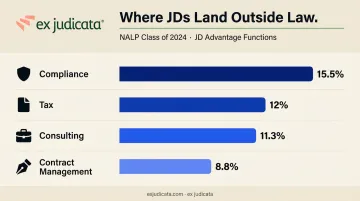
NALP's data for the Class of 2024 identified 2,615 JD Advantage positions — roles where legal training provides a demonstrable edge without requiring bar admission or active practice. The leading functions: compliance (15.5%), tax (12%), consulting (11.3%), and contract management (8.8%). Lawyer-specific specialists know this landscape because they've spent time in or around it.
They Recognize the Emotional Weight
Imposter syndrome in nonlegal settings. Fear of starting over after a decade of investment in the profession. Social pressure from peers tracking the partnership track. These aren't generic career-change anxieties — they're specific to lawyers. Specialists who've worked inside or alongside the legal profession recognize them without explanation.
What the Best Specialist Ecosystems Include
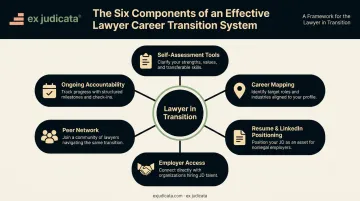
Those three things matter — but specialist expertise alone doesn't complete the picture. The most effective support combines:
- Structured self-assessment tools built for lawyers (not repurposed personality tests)
- Career mapping to verified nonlegal destinations
- Resume and LinkedIn positioning expertise
- Access to employers actively hiring JDs for nonlegal roles
- Peer networks of lawyers who've already made the transition
- Ongoing accountability across a process that takes months, not weeks
Ex Judicata's Career Corner, for example, offers access to 10 vetted specialists covering CV writing, LinkedIn optimization, personal branding, interview prep, coaching, and reverse recruiting — with complimentary discovery consultations before any financial commitment.
What a Career Transition Specialist Actually Does for You
Self-Assessment and Direction-Setting
Most lawyers arrive without a clear target , which is exactly the right starting point. Specialists begin with structured self-assessment: values clarification, transferable skills mapping, and work-environment preferences. The goal is matching career options to who you are — your personality and priorities, not only your practice history.
Generic personality tests don't do this well. Tools built specifically for lawyers (such as the EXJ Career Diagnostic, which maps eight attorney traits to 25 business career paths) start from the right baseline and generate more accurate direction.
Career Mapping to Real Targets
Once direction emerges, specialists help lawyers research specific roles: required qualifications, realistic salary ranges, and how legal experience is perceived in that sector. This replaces the experience of navigating blind : applying to roles without knowing whether your background reads as relevant or irrelevant.
Resume and Professional Branding
Legal experience described in legal language doesn't land with non-legal employers. Specialists reframe that experience using vocabulary and narrative structures that resonate outside the profession.
Specialists reframe all client-facing materials:
- Resume and CV positioning
- LinkedIn profile and headline
- Cover letter framing
- Executive bio for senior roles
The result: a JD that reads as a credential signaling analytical rigor, communication skill, and sound judgment — qualities non-legal employers genuinely value.
Network Access and Job Connection
Many specialists connect lawyers to employers looking for JD talent, to recruiters who specialize in placing non-practicing lawyers, and to peer communities where introductions happen organically. Ex Judicata's Job Board, for instance, features 100% nonlegal roles and draws employers specifically seeking candidates with legal backgrounds.
Ongoing Accountability
Career change for lawyers rarely happens in a straight line. A good specialist provides structured check-ins, milestone-setting, and honest feedback across a process that can span months — helping lawyers maintain momentum when uncertainty peaks.
Key Signs You Should Work With a Transition Specialist
Some lawyers make the exit successfully on their own. Others hit a wall — not from lack of information, but from lack of structure. These four patterns suggest a specialist is worth the investment:
- You've been dissatisfied for six months or more and haven't taken a concrete step. At that point, more research won't move you. A structured process and an external accountability partner will.
- You've read "alternative careers for lawyers" lists and still don't know which direction fits you. Those lists weren't built around your background. A specialist replaces abstract options with a personalized plan through structured self-assessment.
- You've applied to nonlegal roles and gotten no traction. This almost always means your resume and positioning aren't translating to non-legal hiring managers. A specialist who understands how employers read JD backgrounds can identify and close that gap fast.
- You're experiencing burnout but feel financially trapped. The financial and emotional pressures compound each other here. A specialist who understands both the compensation reset and the identity shift can help you find a path that actually holds up under scrutiny.
What to Look for When Choosing a Lawyer Career Transition Specialist
Choosing the right specialist matters as much as choosing to work with one. Here's what separates high-quality options from generic alternatives:
- Demonstrated experience with lawyers specifically — not just "professionals in transition." Ask whether the specialist has worked across multiple practice areas and seniority levels. Experience with BigLaw associates differs from experience with in-house senior counsel, and the best specialists know both.
- A structured diagnostic process built for lawyers. The rigor of the self-assessment phase signals how personalized the guidance will be. Look for tools grounded in the legal professional's actual skill set, not repurposed corporate assessments.
- Network reach beyond coaching. A specialist who can only offer advice is limited. Look for access to employers who actively hire JDs for nonlegal roles and connections to communities of non-practicing lawyers where referrals happen naturally.
- Layered support, not a single service. Lawyers in transition need coaching, job access, peer community, and professional branding simultaneously. Ex Judicata's Career Corner offers this combination through specialists with distinct areas of focus: ATS keyword optimization (Lisa Carman), board placement prep (Donna Hamlin, PhD), and reverse recruiting where the specialist markets you directly to employers (Arno Markus).
Career Paths Specialists Commonly Help Lawyers Explore
Specialists help lawyers evaluate four broad categories, with the right fit depending entirely on individual self-assessment — not a generic list:
| Category | Representative Roles | JD Advantage |
|---|---|---|
| Business and finance | Compliance, risk, legal ops, consulting, M&A advisory, BD | High — JD is often a differentiator |
| Government and policy | Regulatory agencies, legislative staff, policy leadership | High — legal training maps directly |
| Nonprofit and mission-driven | Executive director, GC-equivalent, advocacy leadership | Moderate — depends on sector |
| Academia | Law school administration, clinical programs, legal writing | Varies by role and institution |

Practice area matters more than lawyers typically expect. M&A backgrounds translate naturally to private equity or transaction advisory roles. Regulatory litigators often move into government or compliance leadership. Lawyers with employment law backgrounds have a direct path to senior HR roles — a pattern reflected in Ex Judicata placement examples, including a JD who became CHRO at a major corporation.
Some roles specifically require a JD: legal operations, legal technology, legal recruiting, legal publishing. Others make the JD a differentiator without requiring it. That distinction matters — a specialist can show you which path demands less repositioning and which one offers stronger long-term growth for your specific background.
Frequently Asked Questions
What exactly does a career transition specialist for lawyers do?
They combine structured self-assessment, career mapping to nonlegal roles, resume and LinkedIn positioning, employer network access, and accountability coaching, all built around lawyers' specific backgrounds and challenges. The process typically spans several months and adapts as the target role becomes clearer.
How is a lawyer-focused career coach different from a general career coach?
Lawyer-specific specialists understand how the JD credential reads to non-legal employers, which industries actively seek JD talent, and the financial and emotional barriers unique to lawyers. A generalist career coach typically lacks that context; without it, advice on resume framing and target roles is often off-base.
Do I need to know what I want to do before working with a transition specialist?
No. The self-assessment and career mapping phases exist for lawyers who don't yet have a direction. Arriving without a clear plan is the most common starting point. Specialists treat it as exactly that: a starting point.
How long does it typically take to transition out of law with a specialist's help?
Timelines vary depending on the clarity of the target role, financial runway, and market conditions. Structured support tends to shorten the process by helping lawyers avoid common positioning mistakes and focus their effort earlier. Most lawyers working with a specialist reach a clear direction within three to six months.
Is there a resource specifically built for lawyers who want to leave practice?
Ex Judicata is the only platform built exclusively for this purpose. It offers a job board with 100% nonlegal roles, the Career Corner coaching marketplace, the EXJ Career Diagnostic, peer community through the EXJ Community, executive search through EXJ Search, and courses — all built specifically for JDs pursuing nonlegal careers.
Can a transition specialist help me even if I've been practicing for many years?
Experienced lawyers are often strong candidates for senior nonlegal roles — CCO, CRO, Chief of Staff, ESG leadership, board positions. Specialists help translate decades of practice into executive-level positioning, and Ex Judicata's EXJ Search practice places JDs into exactly these roles.