

Introduction
Most personal branding advice for lawyers is built around one goal: attracting clients. Build a website, post thought leadership, showcase case results. That playbook works if you're growing a practice — but it points the wrong direction if you're planning to leave law.
Lawyers transitioning to nonlegal careers face a fundamentally different challenge. The audience shifts from prospective clients to hiring managers, business executives, and industry peers who evaluate you on business acumen, not courtroom credentials.
That shift carries real anxiety: fear of looking like you "failed" at law, uncertainty about which skills transfer, and not knowing how to talk about yourself to a completely new audience.
Here's what the data actually shows: a JD is genuinely valuable outside law. According to NALP's 2025 JD Advantage Career Guide, employers across compliance, consulting, corporate strategy, HR, and risk management actively seek JD-trained professionals — not despite their legal background, but because of it.
What follows is a practical guide to repositioning yourself — defining a new professional identity, speaking the language of business, and building visibility in your target industry before you hand in your notice.
Key Takeaways
- Transition branding targets hiring managers, not clients — the strategy is fundamentally different
- Define a specific target role or industry before building any public-facing brand
- Translate legal accomplishments into business-outcome language across every platform
- Build nonlegal visibility at least 6–12 months before your exit
- Lead with where you're going, never with why you're leaving law
Why Personal Branding for Leaving Law Is Different
Standard lawyer branding — polished website, LinkedIn articles about recent rulings, bar association involvement — signals one thing clearly: I am a lawyer seeking legal work. That's exactly the wrong signal when your audience is a CFO scanning candidates for a risk management role or an HR leader hiring for compliance.
Nonlegal hiring managers often default to viewing a JD candidate as overqualified, too specialized, or likely to drift back to practice once the legal job market improves. A personal brand built intentionally for this transition counters those assumptions before an interview even happens.
The timing distinction matters too:
- Client-development branding builds gradually over years through referrals, publications, and reputation
- Transition branding needs to signal a clear, deliberate pivot — and it needs to start before you formally leave practice
The 2025 Law360 Pulse survey found that 51% of attorneys were stressed most or all of the time, and 33% would not choose to become a lawyer again — so the motivation to leave is widespread. What's less common is a transition brand that actually communicates business value to nonlegal employers. Closing that gap means repositioning your JD as a business asset — not a legal credential in the wrong room.
Define Your New Professional Identity Before You Rebrand
Rebranding without a destination is the most common mistake transitioning lawyers make. "I'm a lawyer exploring other options" is not a brand — it's a question. Nonlegal employers want answers.
Start With a Career Audit
Before touching your LinkedIn profile or resume, audit your legal career for patterns:
- Which practice areas or client types energized you most?
- Where did you do your best work — in the room, at the desk, or in negotiations?
- What nonlegal business problems did your work touch (risk, deals, regulation, people)?
Those patterns map directly to nonlegal functions. A transactional lawyer drawn to deal-making may brand toward corporate strategy or M&A advisory. A regulatory attorney who loved client counseling may find a natural fit in compliance leadership or government affairs.
Build a One-Sentence Brand Statement
Your transition brand statement should name who you are, what nonlegal value you bring, and who you serve. For example:
"I help financial services firms navigate regulatory complexity through a decade of securities law experience and deep industry relationships."
That sentence does three things: it names a function (regulatory navigation), identifies an industry (financial services), and signals relevant credentials without leading with a title.
Keep Your Brand Grounded in Real Experience
A brand built on a persona you don't actually have collapses in interviews. Lean into your real experience — the deals you worked, the regulators you engaged, the industries you served. Incongruence between brand and person is apparent in the first ten minutes of a real conversation.
If you're not sure which nonlegal roles fit your actual experience, Ex Judicata's EXJ Career Diagnostic maps eight attorney traits to 25 specific business career paths — so you're building a brand around where you genuinely fit, not where you hope to land.
Reframe Your Legal Experience as a Business Asset
The core task of transition branding is translation. Legal accomplishments, described in legal language, are nearly invisible to nonlegal employers. Business-outcome language makes them legible.
The Translation Framework
Replace case-centric descriptions with results-oriented framing:
| Legal Language | Business Language |
|---|---|
| "Drafted merger agreements" | "Led due diligence and risk assessment for 9-figure acquisitions" |
| "Represented clients in regulatory proceedings" | "Navigated complex agency enforcement actions, achieving favorable outcomes under regulatory pressure" |
| "Managed discovery in complex litigation" | "Coordinated cross-functional teams across 12-month high-stakes projects with significant financial exposure" |
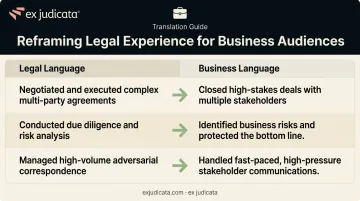
The substance is identical. The framing determines whether a nonlegal hiring manager sees a lawyer — or a strategic asset.
Transferable Skills Worth Highlighting
According to NALP's competency framework for JD-advantage roles, the skills nonlegal employers most consistently value in JD candidates include:
- Analytical reasoning — evaluating complex information and forming clear conclusions
- Negotiation — resolving disputes and reaching agreements with regulators, counterparties, and stakeholders
- Regulatory fluency — understanding rules, monitoring changes, and advising on compliance
- Risk assessment — identifying business and legal exposure and recommending mitigation
- Complex communication — translating technical material for non-expert audiences
Each of these maps directly to high-demand functions: compliance, consulting, corporate strategy, risk management, and business development.
Don't Hide the JD
The credential itself is worth keeping visible. Firms like McKinsey and Bain explicitly recruit JD candidates for consulting roles alongside MBAs and PhDs, treating the JD as evidence of analytical and professional rigor. Insurance, finance, compliance, and government affairs functions do the same — and Ex Judicata's own placement history confirms demand for JD-trained professionals in senior nonlegal roles at companies like Marsh McLennan and Lockton.
Build Your Impact Stories
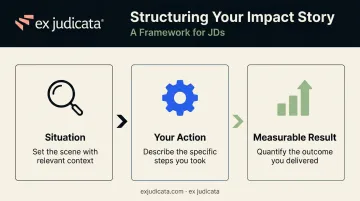
Identify 2–3 achievements from legal practice that map directly to your target role. Shape each into a brief impact story usable across LinkedIn, your resume, networking conversations, and cover letters. Keep the structure simple:
- Situation — the context or challenge you faced
- Your action — what you specifically did to address it
- Measurable result — the outcome, ideally quantified
Rebuild Your LinkedIn Profile for a Nonlegal Audience
LinkedIn is the first stop for nonlegal recruiters evaluating candidates. A 2024 survey of North American talent acquisition leaders found 71% currently used or planned to use LinkedIn for recruiting — making your profile a live first impression, not a static resume supplement.
Rethink Your Headline Immediately
Most transitioning lawyers leave their headline as "Associate at [Firm]" or "Attorney." To a nonlegal employer, that signals law is your primary identity and you may not be serious about the pivot.
Instead, build a headline around your target function:
- ❌ "Senior Associate | Regulatory Attorney | Jones Day"
- ✅ "Regulatory Strategy & Risk Management | Former SEC Attorney | Open to Compliance and Policy Roles"
The revised version signals intentionality — that you know where you're headed and have credentials that back it up.
Use the "About" Section as Your Transition Narrative
This is where your story lives. Write it in first person, conversational but professional. Cover three things:
- What draws you to the new direction (not what's wrong with law)
- What specific value your legal background brings to that new context
- What kind of opportunities you're seeking
Avoid a formal legal biography tone. It reads like a firm website, and nonlegal employers will notice the difference.
Build Nonlegal Connections Actively
Passive scrolling won't move the needle. Active participation signals genuine interest and expands your reach in ways lurking never will. Start with three concrete habits:
- Follow thought leaders and executives in your target industry
- Join LinkedIn groups relevant to your destination function
- Comment substantively on posts in your target field (not just "great post")
Grow Visibility in Your Target Industry Before You Leave
Waiting until after you leave practice to build industry visibility puts you months behind. The transition moves faster and feels more credible when nonlegal employers have already encountered your name before you formally enter their candidate pool.
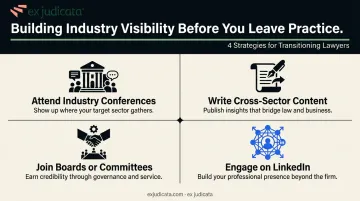
Practical Ways to Build Cross-Industry Presence While Still Practicing
- Attend industry conferences in your target sector — not legal CLE, actual business events
- Write short-form content about the intersection of law and your target industry (e.g., "What companies consistently get wrong about regulatory risk")
- Join a nonprofit board, startup advisory group, or trade association committee in a business capacity
- Engage on LinkedIn with executives and thought leaders in the field you're entering
The 2025 Edelman-LinkedIn B2B Thought Leadership Report found that 64% of business decision-makers trust thought leadership more than marketing materials when assessing a professional's capabilities. That's a strong case for writing publicly about where your legal expertise meets the industry you're targeting.
Use the EXJ Community to Expand Your Network Early
Public visibility is only half the equation. The right peer network handles the private side — and building both simultaneously is what separates a credible transition from a cold one.
The EXJ Community (Ex Judicata's peer network for non-practicing lawyers) connects JDs who have already made the transition into various industries. For a lawyer still in practice, it offers:
- Practical guidance on breaking into specific industries
- Warm introductions to nonlegal professionals
- A realistic picture of what different paths actually look like — before the formal exit
The EXJ Interview Series — over 44 first-person transition stories — features lawyers who moved into roles at Marsh McLennan, financial services companies, and legal technology startups. Those accounts are useful for mapping what a credible brand pivot looks like in specific sectors.
Personal Branding Mistakes Lawyers Make During Career Transitions
The Apologetic Pivot
The most common mistake: leading with what you're leaving rather than where you're going. "I've realized law isn't the right fit for me" is a conversation-ender. Nonlegal employers respond to forward-facing narratives. "I'm bringing a decade of securities law experience to bear on regulatory risk challenges in financial services" is a conversation-starter.
Inconsistency Across Platforms
If your LinkedIn signals a business transition but your firm bio still reads as a client-development profile and your resume still leads with litigation wins, the mixed messaging creates real confusion. Hiring managers check multiple sources, and inconsistency reads as a lack of commitment to the pivot.
Audit every public-facing asset for alignment:
- LinkedIn headline and About section
- Resume summary and work descriptions
- Personal website bio (if applicable)
- Your verbal introduction in networking settings
Continuing to Post Legal Content After Declaring a Pivot
After signaling a transition, saturating your network with case updates, court decisions, and bar association news undermines the message. Your content strategy should shift to reflect your target industry. Demonstrating fluency in that new world matters more than continued allegiance to the old one.
Your legal background stays part of the story. What changes is the lens — showing nonlegal audiences that you think about their problems, read their publications, and understand their priorities. That's what makes a pivot credible.
Frequently Asked Questions
How do I explain on LinkedIn that I'm leaving legal practice without looking like I failed?
Lead with where you're going, not what you're leaving. Frame your pivot around the value your legal background brings to a specific business function — not around dissatisfaction with law. "Drawing on 10 years of M&A work to move into corporate strategy and transaction advisory" reads as purposeful. Explaining why law didn't work out reads as damage control.
Should I keep "JD" or "Esq." in my personal brand when transitioning to a nonlegal career?
Keep the JD — it signals analytical training and rigor that nonlegal employers recognize. Drop "Esq." — it implies active practice and can confuse audiences about your current role. New York State Bar Association Ethics Opinion 1264 permits both designations in nonlegal contexts if not misleading, but "JD" is the cleaner signal for a business audience.
What transferable skills from law should I highlight when rebranding for a nonlegal role?
Focus on analytical reasoning, negotiation, regulatory fluency, risk assessment, and translating complex material for non-expert audiences. These map directly to what compliance, consulting, corporate strategy, and risk management employers hire for.
Can I start building a nonlegal personal brand while I'm still practicing?
Yes — and you should. Updating LinkedIn, attending industry events, writing cross-sector content, and connecting with nonlegal professionals before you leave practice makes the transition faster and far more credible. Starting 6–12 months before your intended exit date gives you the best foundation.
Do I need a completely new resume for nonlegal applications?
A full rewrite is usually necessary — not to erase your legal experience, but to translate it into business outcomes. Lead with the skills most relevant to your target role and move legal titles into supporting context. Yale Law School's career guidance supports reordering resume sections (placing Experience before Education) when work history outweighs the credential.
How long does it typically take to build a personal brand strong enough to support a nonlegal career transition?
Starting 6–12 months before your exit gives you time to build LinkedIn presence, establish nonlegal connections, and publish content that positions you credibly in the new field. Lawyers who begin earlier tend to field stronger inbound interest — recruiters and hiring managers respond to consistent signals over time, not a profile updated during the final weeks of notice.