

Introduction
The skills that carried you through law school and years of practice are genuinely valuable beyond the courtroom. Compliance management is one of the clearest examples.
Most JDs face a translation problem, not a skills gap. Legal training maps almost perfectly onto what compliance managers do every day — but the path from a law firm or legal department to a compliance title isn't always obvious. Employers don't advertise for "former litigators." Job descriptions use different language.
Without a roadmap, even well-qualified JDs underestimate how competitive they are.
This article provides that roadmap. You'll learn exactly what compliance managers do, why a JD is a genuine advantage in this field, the concrete steps to make the transition, which certifications are worth your time, and where the salary opportunities are strongest.
Key Takeaways
- Compliance managers apply legal knowledge operationally: no bar license required, no courtroom, no clients.
- JDs are disproportionately represented at senior compliance levels: 24% of cross-industry CCOs hold a JD, per SCCE's 2024 survey
- JDs at the CCO level report average total compensation of $232,361 versus $174,117 for bachelor's-degree holders
- Your practice area is your industry signal: securities law points to financial services compliance; healthcare law points to healthcare compliance
- The CCO is a C-suite role—compliance is a genuine leadership track with executive upside
What Does a Compliance Manager Do?
Compliance managers are the professionals responsible for ensuring an organization operates within applicable laws, regulations, and internal policies. The role is operational, not advisory—compliance managers don't represent clients or provide formal legal counsel. They build and run the systems that keep an organization on the right side of its regulators, its board, and the law.
Core Day-to-Day Responsibilities
According to the Bureau of Labor Statistics, compliance officers typically:
- Monitor changes in laws and regulations affecting the organization
- Develop, implement, and enforce internal policies and procedures
- Conduct audits and risk assessments
- Investigate potential violations
- Train employees on compliance requirements
- Document findings and report metrics to senior leadership and the board
The BLS reports a $78,420 median annual wage for compliance officers as of May 2024, with 3% projected employment growth from 2024 to 2034 and approximately 33,300 openings per year. Those numbers reflect steady demand—but they don't capture how much the role itself has changed.
Why the Role Has More Strategic Weight Than It Used To
Regulatory pressure has grown. Thomson Reuters' 2023 Cost of Compliance research found that 73% of respondents expected regulatory activity to increase—and that expectation has translated into compliance functions that sit much closer to the C-suite than they did a decade ago.
The DOJ's 2024 compliance program evaluation framework now asks whether compliance leaders have sufficient seniority, funding, data access, and direct access to the board. Compliance managers aren't managing a checkbox function anymore. They're influencing major business decisions.
Why Your JD Is a Strategic Advantage in Compliance
Law school doesn't just teach doctrine. It trains you to read statutes, identify risk, structure arguments, communicate to non-lawyers, and reason through ethical problems. Those competencies are exactly what compliance work demands—they just need to be redirected.
The JD-to-Compliance Skill Translation
| Legal Skill | Compliance Application |
|---|---|
| Legal research and regulatory analysis | Monitoring and applying evolving regulations |
| Contract review and drafting | Policy writing and internal procedure development |
| Risk assessment in litigation | Enterprise risk assessment and mitigation planning |
| Client counseling | Cross-functional stakeholder communication and training |
| Professional responsibility / ethics | Compliance ethics program design |
What the Data Shows
SCCE's 2024 cross-industry salary survey found that JD representation rises with seniority in compliance:
| Compliance Level | JD Representation |
|---|---|
| CCO | 24% of respondents |
| Director | 18% of respondents |
| Manager | 11% of respondents |
| Assistant/Specialist | 6% of respondents |
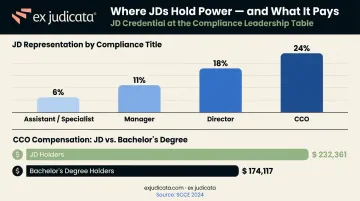
The survey doesn't track individual career trajectories, so it can't confirm that a JD accelerates promotion. What it does show is that legal training is distinctly valued at senior levels. JDs at the CCO level in that same survey reported average total compensation of $232,361, compared to $174,117 for bachelor's-degree holders at the same level.
Practice Area = Industry Expertise
JDs who've practiced in specific regulatory areas don't just bring transferable skills—they bring deep subject-matter knowledge that compliance teams recruit for:
- Securities/banking law → financial services compliance (AML, BSA, SEC regulations)
- Healthcare law → HIPAA compliance, fraud and abuse, CMS requirements
- Employment law → HR compliance, EEOC, wage and hour regulations
- Privacy/tech law → data protection compliance, AI governance frameworks
- Environmental law → EPA compliance, ESG reporting
Practitioners entering compliance from these backgrounds arrive knowing the regulators, the enforcement priorities, and the vocabulary—advantages that take generalist candidates years to develop.
How to Transition from Legal Practice to Compliance Manager
Step 1: Identify Your Target Industry
Start with what you already know. Your practice area is the clearest signal of where you'll be most competitive. A corporate transactional attorney is naturally positioned for financial services compliance. A healthcare attorney for hospital or health system compliance. An employment attorney for HR compliance or labor regulatory roles.
If your practice area is less specialized, consider the industries where regulatory complexity is highest—financial services, healthcare, and technology are the three most demanding environments and the ones most likely to pay a premium for legal fluency.
Step 2: Reframe Your Resume for a Compliance Audience
This is where many JDs get stuck. Legal resumes are written for legal audiences. Compliance hiring managers think in operational and business terms.
Translate your experience accordingly:
- "Advised clients on SEC reporting requirements" → "Monitored regulatory developments and developed compliance frameworks for public company clients"
- "Drafted and negotiated commercial contracts" → "Developed and implemented contractual compliance procedures across business units"
- "Represented clients in EEOC investigations" → "Managed regulatory investigation responses and remediation strategies"
The substance is identical. The framing changes everything.
Step 3: Add a Certification Strategically
A JD is a strong credential. A JD plus a recognized compliance certification is stronger—particularly when competing against candidates who have compliance-specific operational experience you may not yet have. (More on certifications in the next section.)
Step 4: Network With JDs Already in Compliance
The fastest way to understand what the transition looks like is to talk to people who've made it. Non-practicing lawyers (NPLs) working in compliance are your best source of practical intelligence: what titles to target, which employers are JD-friendly, how to frame the conversation in interviews.
Ex Judicata's EXJ Community is built for exactly this. It's a peer-to-peer network for the hundreds of thousands of JDs already working in nonlegal careers, with resources including:
- A member directory of non-practicing lawyers across industries
- A Job Board with 100% nonlegal roles, including compliance titles
- EXJ Search, which places JDs into senior nonlegal roles up to CCO level
David Greenberg — a JD/MBA, former Arnold & Porter partner, and two-decade compliance leader at Altria Group — has been featured in Ex Judicata's platform content as a concrete example of where this path leads.
Step 5: Target the Right Entry Points
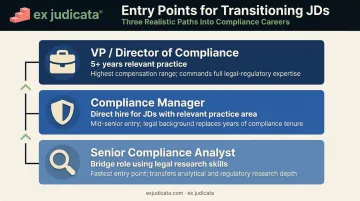
JDs generally don't need to start at the bottom. Realistic first roles for a transitioning JD include:
- Senior Compliance Analyst – a common bridge role that uses legal research skills operationally
- Compliance Manager – direct hire is achievable, particularly for JDs with relevant practice area experience
- VP, Compliance / Director of Compliance – realistic for JDs with 5+ years of practice in a relevant area
Once you know what you're targeting, filter job postings for phrases like "JD preferred," "regulatory background," "legal background a plus," or "law degree preferred." Filter by industry verticals that match your practice area. Pay attention to whether the role reports to the General Counsel (likely a legal hybrid) or to the CEO/COO/board (a true operational compliance function).
Certifications That Complement a JD in Compliance
Certifications aren't required, but in a field where practitioners arrive from wildly different backgrounds, they serve as a credibility signal. A JD tells employers you can think like a lawyer. A certification signals you're committed to the compliance function specifically.
Here are the three most widely recognized credentials and how they fit a JD's background:
Certified Compliance and Ethics Professional (CCEP)
Best for: JDs targeting general corporate compliance across industries.
- Eligibility: One year of full-time compliance work or 1,500 hours of direct compliance duties in the prior two years, plus 20 CCB continuing education units (at least 10 live) in the prior 12 months
- Exam: 115 questions (100 scored), 2-hour time limit
- Renewal: 40 CEUs every 2 years, at least 20 live
- JD note: No JD-specific waiver exists; the experience requirement still applies
Certified Regulatory Compliance Manager (CRCM)
Best for: JDs from financial regulatory, securities, or banking law backgrounds targeting financial services compliance.
- Eligibility: Either 3+ years of U.S. compliance experience plus two ABA-listed training options in the prior five years, or 6+ years of U.S. compliance experience including 3 years in the prior five; all experience must involve U.S. consumer-banking laws
- Exam: 200 multiple-choice questions, 4-hour time limit
- Renewal: 60 CE credits every 3 years
Certified Fraud Examiner (CFE)
Best for: JDs whose practice touched financial misconduct, white-collar litigation, or regulatory investigations.
- Eligibility: 40 points to sit for the exam; 50 points plus at least 2 years of fraud-related experience to receive the credential (ACFE uses a point-based system)
- Exam (effective June 2026): Three sections — two at 120 questions/2.5 hours each, one at 70 questions/1.5 hours
- Renewal: 20 CPE credits annually, including at least 10 fraud-related and 2 ethics credits
SCCE's 2024 data shows CCEP holders at the manager level report average total compensation of $132,278, versus $119,926 for managers with no certification. That's a meaningful gap, though the survey doesn't establish causation.
Industries and Salary Outlook for JDs in Compliance
Compliance roles exist across virtually every regulated industry. Your practice area shapes both where you'll fit and how much you can earn.
Salary Benchmarks by Sector
| Sector | Role Benchmark | Compensation Figure |
|---|---|---|
| Financial services | CCO average total compensation | $321,000 |
| Financial services | All-staff average total compensation | $100,751 |
| Healthcare | CCO median base salary | $150,000 |
| Healthcare | Manager median base salary | $105,000 |
| Government | Manager average total compensation | $107,328 |
| Cross-industry | Manager average total compensation | $127,053 |
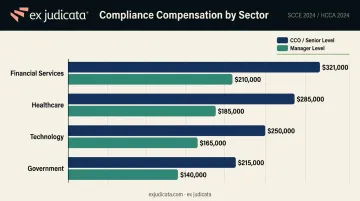
Source: SCCE 2024 Cross-Industry Salary Survey and HCCA 2024 Healthcare Salary Survey
Industry-by-Industry Fit
Where you land depends heavily on your legal background:
- Financial services — the highest-paying sector; AML, BSA, and SEC/FINRA functions place a premium on legal fluency. Natural fit for JDs from securities, banking, or insurance regulatory work.
- Healthcare — one of the most complex regulatory environments in the country (HIPAA, False Claims Act, Stark Law, OIG, CMS). JDs from healthcare law are immediately competitive at health systems, insurers, and pharma companies.
- Technology — fast-growing demand, especially in privacy (GDPR, CCPA, state laws) and AI governance. Legal training is increasingly valued as data and AI regulatory frameworks expand.
- Government and public administration — strong job security; well-suited for JDs with regulatory agency or public interest backgrounds. Compensation trails financial services but aligns with cross-industry benchmarks.
The Career Ceiling Is a C-Suite Title
The Chief Compliance Officer is a C-suite role. In SCCE's 2024 survey, JDs represented 24% of CCO respondents across industries—a significantly higher proportion than at the manager level (11%). JDs don't just enter compliance—they advance further and faster than most. If you're building toward a CCO role, the data suggests your credential is an advantage, not a detour.
Frequently Asked Questions
Do you need a law degree to be a compliance manager?
No. The BLS lists a bachelor's degree as the typical entry credential for compliance officers. JDs hold a competitive advantage—particularly in highly regulated industries like financial services and healthcare—because legal training maps directly onto the analytical and regulatory demands of the role.
How long does it take to become a compliance manager?
There's no single timeline, and no reliable average has been published for JD-specific transitions. With relevant practice area experience, some JDs move directly into compliance manager titles; others spend a year or two in a senior analyst role first. Either way, the path is typically shorter than for candidates building regulatory fluency from scratch.
How is being a compliance manager different from practicing law?
Compliance managers apply legal knowledge to build and enforce internal systems within a single organization, rather than advising external clients or appearing in legal proceedings. The work is operational and cross-functional: audits, training programs, policy development, and board reporting.
What compliance certifications are most valuable for JDs?
The CCEP is the most broadly applicable starting point for JDs entering general corporate compliance. The CRCM is the go-to credential for those targeting financial services. The CFE is most relevant for JDs whose practice involved fraud, white-collar matters, or financial misconduct investigations.
What industries value a JD background most in compliance?
Financial services, healthcare, and technology are the sectors where a JD is most distinctly advantageous. All three operate under complex, evolving regulatory frameworks where employers actively seek compliance leaders with legal training.