

Introduction
Most lawyers are told to "find a practice area you love" — as if passion alone will produce the right answer. What gets skipped is the prior question: what kind of person are you, and what kind of work actually fits how you think, communicate, and solve problems?
Personality traits don't just predict whether you'll be a competent attorney. They reveal which environments will energize you versus which will grind you down, inside legal practice and beyond it.
A 2016 study of 12,825 licensed US attorneys found that 28% reported depression symptoms and 23% reported stress symptoms. That's not a profession-wide skills gap. For many, it's a fit problem.
What follows maps the personality traits most common among attorneys to specific careers, legal and nonlegal, where those traits become genuine advantages rather than daily friction.
Key Takeaways
- Attorneys are not a monolith — distinct personality clusters correlate with very different practice areas and career environments
- Conscientiousness and analytical thinking are near-universal in lawyers — but extraversion, agreeableness, and risk tolerance vary enough to determine which careers actually fit
- Personality misalignment — not incompetence — drives most attorney dissatisfaction and career transitions
- Traits that feel like liabilities in a courtroom or law firm often become competitive advantages in compliance, consulting, and policy roles
The Core Personality Traits Most Attorneys Share
The Big Five (OCEAN) model is the most research-backed framework for understanding personality: Openness, Conscientiousness, Extraversion, Agreeableness, and Neuroticism. Each dimension predicts how people respond to different work environments — making it a practical tool for career fit, not just self-reflection.
What the Research Actually Shows
The most referenced attorney personality study — Larry Richard's nationwide MBTI survey of 3,014 practicing attorneys, summarized in Susan Daicoff's 1997 review — found:
| MBTI Preference | Attorneys | General US Population |
|---|---|---|
| Introversion | 57% | ~25% |
| Intuition | 57% | ~30% |
| Thinking (analytical) | 81% men / 66% women | 60% men / 35% women |
| Judging (closure-oriented) | 63% | ~55% |
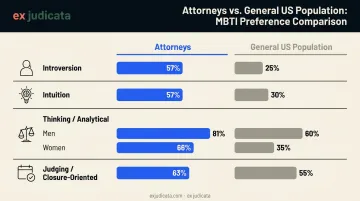
These aren't Big Five measures directly, but they point to a recognizable cluster: attorneys skew analytical, structured, and introverted relative to the general population.
Conscientiousness: Consistent Across Practice Areas
Of all the Big Five traits, conscientiousness shows up most reliably across practice areas. The profession rewards meticulous attention to detail, deadline precision, and sustained follow-through. Attorneys who lack it tend to exit early — the work doesn't accommodate imprecision.
Openness: Curiosity as a Professional Requirement
High openness to experience is another consistent pattern. Constructing multi-layered arguments, understanding clients' industries, and engaging with novel legal frameworks all require genuine curiosity. Rote rule-following doesn't cut it.
Agreeableness: Deliberately Low — and Why It Matters
Lawyers as a group score lower on agreeableness than most professional populations. In adversarial contexts, that skepticism is a feature, not a flaw:
- Negotiation — holding firm under pressure
- Cross-examination — probing without softening
- Sustained advocacy — maintaining positions against pushback
The tradeoff shows up in collaborative roles. Attorneys who move into consensus-driven environments — team leadership, stakeholder management, client relationship work — sometimes find the interpersonal friction that served them in court works against them in the conference room.
How Personality Shapes Your Legal Practice Area Fit
No validated study has directly measured personality differences between US litigators and transactional attorneys. What exists is a well-documented experiential pattern: certain personality clusters consistently gravitate toward certain practice environments.
The Analytical-Introvert Profile
This is the profile that thrives in transactional, research, and advisory law:
- High conscientiousness, high openness
- Lower agreeableness
- Introverted
- Strong preference for structured problems with definable answers
Practice areas that draw this profile: corporate/M&A, tax, intellectual property, securities, estate planning.
What energizes this type: deep expertise-building, methodical risk analysis, working within established frameworks, and predictable client relationships. The intellectual challenge is self-contained and success is measurable. The collaborative, client-close dynamic of celebrating a deal closing suits this profile well.
The Advocacy-Extrovert Profile
This cluster is naturally drawn to litigation, criminal law, and courtroom practice:
- Higher extraversion
- Comfort with adversarial dynamics
- Preference for narrative and performance
- Tolerance for unpredictability and changing circumstances
Those traits describe the role — but they don't guarantee longevity in it. One question every attorney should ask early: Do you leave the fight at the office, or does conflict follow you home?
The most satisfied litigators can advocate fiercely and disengage cleanly. They treat the adversarial dynamic as craft, not personal combat. Attorneys who can't make that separation often burn out regardless of skill level. Technical competence doesn't compensate for a chronic inability to decompress. That's worth knowing before you've built a decade of practice around the wrong environment.
When Your Personality Doesn't Match Legal Practice
Personality-practice misalignment — not incompetence — is behind most attorney career dissatisfaction. Krieger and Sheldon's research on approximately 6,200 lawyers in four US states found that autonomy, relatedness, competence, and internal motivation were far stronger predictors of wellbeing than income, law school rank, or grades. Internal motivation correlated with wellbeing at r = .55; law school US News rank correlated at r = .05.
Attorneys who chose law for external reasons — prestige, income, family expectation — showed significantly higher psychological distress than those driven by genuine interest.
Warning Signs of Personality-Career Mismatch
Watch for these patterns:
- Consistently dreading client-facing conflict, not just specific cases
- Feeling drained rather than energized by adversarial dynamics
- Craving collaborative team environments where you build things together
- A natural orientation toward "yes" and possibility rather than risk identification
- Wanting to create or grow something rather than resolve disputes
The legal profession's structural reality is that switching practice areas becomes considerably harder after the first few years. Attorneys who ignore personality fit early pay a real cost — and that window closes faster than most expect.
If you recognize those warning signs, a structured self-assessment is a logical next step. The EXJ Career Diagnostic was built specifically to help attorneys identify when their traits point toward nonlegal roles. At $25.95, it's a PhD-validated starting point for attorneys who suspect the problem is fit, not competence.
Attorney Traits That Translate Powerfully to Nonlegal Careers
Here's the reframe most attorneys miss: the traits that create friction in certain legal roles are exactly what organizations outside of law are actively looking for.
NALP's 2025 JD Advantage Career Guide identifies the core competencies that make JDs valuable across nonlegal functions:
- Reading and understanding complex documents
- Analyzing complicated information and arguments
- Identifying legal and organizational risks
- Researching law and regulation
- Negotiating with regulators and stakeholders
- Writing clearly and persuasively
These are transferable thinking skills — sharpened by legal training, valued well beyond it.
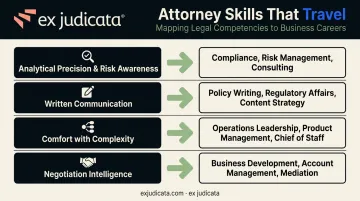
Here's how each maps to the business world:
- Analytical precision and risk awareness: The trained instinct to stress-test assumptions and identify what can go wrong translates directly to compliance, risk management, consulting, and strategic planning — skills that are genuinely scarce outside of law.
- Written communication: Attorneys who construct precise, persuasive arguments excel at policy writing, regulatory affairs, content strategy, and thought leadership. Clear, authoritative writing is a competitive differentiator in almost every business environment.
- Comfort with complexity: Lawyers who synthesized dense, multi-factor legal problems move naturally into operations leadership, product management, and chief of staff roles — jobs that are fundamentally about imposing structure on organizational chaos.
- Relationship and negotiation intelligence: Attorneys with stronger interpersonal orientation — often the profile that chafes under pure adversarial litigation — frequently excel as business development professionals, account managers, mediators, and client success leaders.
Nonlegal Career Paths by Personality Type
The Analytical, Detail-Oriented Attorney
This profile maps naturally to:
- Compliance and regulatory affairs — legal frameworks and precision are non-negotiable; JDs bring both
- Legal operations management — CLOC's 2025 State of the Industry Report found 83% of legal departments expected demand to rise
- Risk management — NALP explicitly identifies insurance/risk management as a JD Advantage pathway
- Policy analysis — regulatory fluency transfers directly
- Management consulting — BLS reports a median salary of $101,190 with 9% projected growth
Financial services firms, healthcare companies, and tech companies actively seek JDs for these roles. The methodical thinking and regulatory literacy attorneys develop is hard to replicate.
The People-Oriented, Mission-Driven Attorney
Attorneys with empathy, advocacy instincts, and a genuine drive to help often find the adversarial structure of litigation alienating. They flourish in environments where advocacy serves a cause or community.
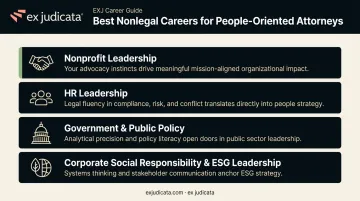
Strong fits:
- Nonprofit leadership — regulatory expertise and analytical training translate directly into mission-driven general counsel and leadership roles
- HR leadership — employment law attorneys make smooth transitions into senior HR roles; Francesca Lisk moved from M&A practice at Hughes Hubbard & Reed through nonprofit GC work at the Brooklyn Museum to Chief Talent Officer at Sotheby's
- Government and public policy — attorneys' regulatory expertise and analytical training are directly applicable
- **Corporate social responsibility and ESG leadership** — EXJ Search places JDs into ESG leadership specifically because the legal framing of stakeholder risk maps well to the role
The Entrepreneurial, Ideas-Driven Attorney
High openness, tolerance for ambiguity, and a bias toward possibility — traits that can make an attorney feel out of place in a risk-averse legal department — are natural advantages in fast-moving, opportunity-driven environments.
Where entrepreneurial attorneys land:
- Business development and sales leadership — most BD teams underrate the ability to understand complex client problems and articulate solutions clearly
- Startup operations — lawyers who can synthesize complexity and move quickly are valuable to early-stage companies
- Entrepreneurship — Neil Handwerker left legal practice after three months and built two companies. The JD credential doesn't expire.
- Thought leadership and academia — attorneys with high openness and strong communication skills can build significant platforms
The Ex Judicata Job Board lists only nonlegal roles, posted by organizations that already understand the JD skillset and are actively looking for it — no translation required.
Frequently Asked Questions
What personality traits do attorneys have?
The most common attorney personality traits include high conscientiousness, high openness to experience, a tendency toward analytical thinking, lower agreeableness than most professional populations, and introversion (approximately 57% in the most-cited attorney personality study). These vary by practice area — litigators tend toward higher extraversion than transactional attorneys.
What is the career path of an attorney?
Traditional paths include law firm associate to partner, in-house counsel, government and public interest roles, and academia. A growing number of JDs move into nonlegal business, compliance, consulting, and policy careers where legal training provides genuine competitive advantages — NALP counted 2,615 JD Advantage jobs in the Class of 2024 alone.
Can an attorney's personality type predict job satisfaction?
Alignment between personality and work environment is a meaningful predictor. Krieger and Sheldon's research on 6,200 lawyers found internal motivation correlated with wellbeing at r = .55 — versus r = .19 for income and just r = .05 for law school rank. Fit matters more than prestige.
What nonlegal careers suit analytical, detail-oriented attorney personalities?
Compliance, risk management, legal operations, regulatory affairs, consulting, and policy analysis are strong fits. Financial services, healthcare, and tech companies actively recruit JDs for these roles because analytical rigor and regulatory fluency are hard to develop outside legal training. Ex Judicata's destination-industry pages cover each of these paths in detail.
How do I know if my personality is a better fit for a nonlegal career?
Recurring signs include consistently feeling drained by adversarial dynamics (not just in difficult cases), craving collaborative or mission-driven work, and a natural orientation toward building rather than defending. A structured self-assessment like the EXJ Career Diagnostic can move you from vague dissatisfaction to a concrete, mapped direction.