

Introduction
Public defense puts you between a person and the state, with inadequate resources and an impossible caseload. That tension doesn't ease over time — it compounds, and it accumulates differently than ordinary job stress.
A 2020 study of public defender offices found that 66% of defenders rated caseload size a severe stressor — and that stress registers differently than standard burnout. Researchers describe it as secondary traumatic stress, not simply fatigue.
Leaving, though, feels complicated in a way that quitting a corporate job never does. Public defenders often carry the role as an identity, not just a paycheck. Walking away can feel like abandoning something.
This guide maps the actual exit paths available — four distinct options, from staying in law to leaving it entirely — with honest trade-offs for each, so you can make a decision based on information rather than exhaustion alone.
Key Takeaways
- Public defenders have at least four viable exit paths, ranging from private criminal defense to fully nonlegal careers.
- Your trial experience, client judgment, and comfort under pressure are marketable in ways most career guides underestimate.
- PSLF eligibility changes depending on where you land — calculate your forgiveness timeline before you decide anything.
- The right path addresses the actual source of your dissatisfaction, not just the nearest escape route.
- Free and low-cost resources — diagnostics, job boards, and coaching — exist specifically for lawyers making this move.
Why Public Defenders Consider Leaving
The Structural Problem
The numbers tell part of the story. NALP's 2023 national survey puts the median entry-level public defender salary at $69,608. For context:
- Private criminal defense attorneys in Oregon who handled fewer court-appointed cases averaged $145,758 in compensation
- The historical National Advisory Commission capped caseloads at 150 felonies or 400 misdemeanors annually — standards most public defender offices still don't meet
- Florida documented 26% statewide turnover among public defenders in 2021, with some circuits exceeding 50%
- Pennsylvania reports that more than 70% of its defender workforce has under five years of experience
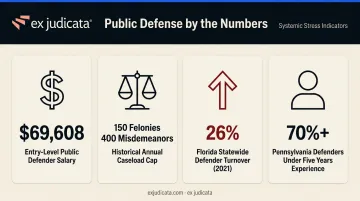
RAND's 2023 time-based study replaced the old caseload caps with case-specific hour estimates. Compliance with either standard remains the exception, not the rule.
The Burnout That's Harder to Name
Public defender burnout isn't the same as BigLaw burnout. BigLaw attorneys often leave because the work feels meaningless. Public defenders leave because the work carries too much meaning — and the system keeps failing their clients anyway.
Carrying a client's freedom, their trauma, and their desperation every day, with inadequate resources and limited wins, creates a particular kind of exhaustion. Research distinguishes this as secondary traumatic stress, not generic job dissatisfaction. The distinction matters practically: secondary traumatic stress doesn't resolve by switching offices or negotiating a lighter docket. The trigger is the weight of the work itself — which means the exit question is less about where you practice and more about whether you do.
The Identity Complication
Most public defenders internalized this work as a calling. Leaving triggers guilt that quitting a transactional practice rarely does. Any honest exit guide has to name that directly.
The question isn't whether leaving is acceptable. It is. The question is what leaving toward looks like.
Four Exit Paths for Public Defenders
No single path fits everyone. The right move depends on what you want more of — trial work, systemic influence, income, autonomy, mission — and what you're willing to give up. Here's how the four main options break down.
Private Practice: Criminal Defense and Law Firm Roles
This path requires less repositioning than almost any other exit. You move as an experienced trial attorney, not as someone who needs to be retrained.
What this looks like in practice:
- Solo or boutique criminal defense firm (most direct translation)
- Mid-size firm with a strong litigation practice
- Large firm white-collar or government investigations group (less common, but documented)
Former federal public defenders appear at firms including KaiserDillon and Cozen O'Connor's white-collar group — both list former assistant federal public defenders among their attorneys. The courtroom experience that feels routine inside a public defender's office is unusual in private practice, where many associates never see a jury trial.
The income upside is real, but it varies. Oregon's data shows private criminal defense practitioners averaging $145,758 when court-appointed work was a minority of their caseload. That figure reflects compensation, not salary — it includes overhead, ownership stakes, and collection rates. The actual financial improvement depends on your market, your client development capacity, and whether you're joining an existing firm or building your own.
The honest trade-offs:
- Your clients will pay — which means serving a different population than the one you chose this career for
- White-collar work at large firms can feel several degrees removed from the cases that motivated you
- Business development pressure is real and often underestimated by first-time private practitioners
If trial work is what energizes you and the financial gap is what's wearing you down, this path addresses both problems directly.

Prosecution and Government Legal Roles
Moving to a district attorney's office, U.S. Attorney's office, state attorney general, or federal agency (DOJ, DEA counsel) is a lateral move in terms of skill set. Nearly everything else changes.
Compensation benchmarks:
- Manhattan ADA salaries run $85,000–$171,500
- AUSAs operate on an experience and locality-based schedule, with senior positions capped at $195,100
- BLS data puts the federal government lawyer mean at $169,960
Depending on your jurisdiction and experience level, prosecution can represent a meaningful pay increase over local public defender salaries — or a modest one. Compare actual local figures, not job title impressions.
The core skills transfer almost directly: discovery, motions practice, witness examination, trial work. What changes is who you're working for. Government prosecution roles also remain qualifying employers for PSLF, which matters if you're mid-track on loan forgiveness.
"Crossing the aisle" isn't a betrayal, but it is a worldview shift. Some former public defenders find it clarifying. Others find it alienating within a year.
The attorneys who struggle most are those who take the job without examining which camp they're likely to fall into. That's worth sitting with before you accept an offer.
Policy, Advocacy, and Nonprofit Leadership
This path trades individual client representation for systemic impact. Instead of fighting case by case, you're working on the conditions that generate those cases: reform campaigns, litigation strategies, legislation, and coalition-building.
Brandon Buskey's trajectory is a concrete example. He went from practicing as a public defender in Montgomery, Alabama, to directing the ACLU's Criminal Law Reform Project, working on pretrial justice, the right to counsel, juvenile sentencing, and related issues at national scale.
Compensation deserves a clear-eyed look. Senior nonprofit leadership pays well at established organizations: Vera Institute's president reported over $596,000 in total compensation; NAACP LDF's leadership reported over $577,000. Those are executive-level figures. Staff attorney and program director roles at reform nonprofits typically pay less than even public defender salaries at comparable experience levels.
The Justice Policy Institute's research director reported $133,757. That's a more realistic benchmark for senior program staff, not yet executive leadership.
Who this path actually fits:
- Defenders whose burnout comes from powerlessness, not mission
- Lawyers who want to work on structural problems rather than individual cases
- Attorneys willing to accept slower, harder-to-measure results in exchange for broader reach
If your frustration came from watching the same systemic failures repeat case after case, policy work targets the root cause. If volume and pace are what's worn you down, this shift won't solve that — the work is slower, not lighter.
Nonlegal Careers: Where Public Defender Skills Travel Outside Law
This is the least obvious path and the one most public defenders underestimate. Moving entirely outside legal practice doesn't mean abandoning what you built — it means applying it differently.
Roles where public defender skills translate directly:
| Role | Median Wage (BLS, 2024) | What transfers |
|---|---|---|
| Compliance officer | $78,420 | Regulatory knowledge, client-facing judgment |
| Management analyst/consultant | $101,190 | Analytical rigor, structured argument, problem-solving |
| Postsecondary education administrator | $103,960 | Institutional navigation, student advocacy |
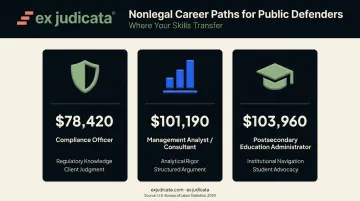
McKinsey explicitly recruits JDs and other advanced-degree holders into consulting roles. Compliance functions at major financial institutions, healthcare systems, and technology companies actively seek candidates with legal training — and public defenders bring something most compliance candidates don't: direct experience managing high-stakes client relationships under pressure, often with inadequate information and competing demands.
The EXJ Career Diagnostic ($25.95, available at exjudicata.com) maps attorney traits against 25 business careers, giving a data-backed starting point for a transition that can otherwise feel overwhelming. Ex Judicata's job board lists nonlegal roles specifically designed for JD-credentialed candidates — including compliance, consulting, and other categories where a public defender's background is genuinely valued.
How to Choose the Right Exit Path
Start With the Right Diagnostic Question
The wrong starting question is "which path pays most." The right one is: what was the actual source of my dissatisfaction?
- Burned out by caseload volume? Private practice may solve it.
- Exhausted by powerlessness and systemic failure? Policy work addresses the root problem.
- Drained by the legal system itself, not just public defense? A nonlegal career may be the only real exit.
Getting this wrong leads to expensive mistakes — lawyers who leave for private practice and discover the financial motivation was real but the identity loss wasn't worth it; lawyers who go into policy work expecting to feel less helpless and discover that legislative timelines are even more demoralizing than case outcomes.
Four Variables to Evaluate Before Deciding
1. How central is courtroom advocacy to your professional identity? If trial work energizes you, paths that eliminate it — policy roles, most nonlegal careers — require honest reckoning, not just optimism.
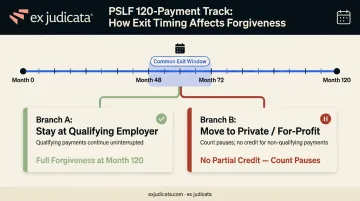
2. What is your actual financial floor — accounting for PSLF? If you're mid-way through a 10-year Public Service Loan Forgiveness track, leaving before 120 qualifying payments forfeits the benefit entirely — there's no partial credit.
Calculate your remaining payment count and outstanding balance before deciding anything. Private for-profit employment adds zero qualifying months. That math changes the comparison significantly.
3. Do you want to work with individual clients, or are you more motivated by structural change? This single variable routes most public defenders toward either private/prosecution paths or policy/nonlegal paths. Answering it quickly — before sitting with what the day-to-day of each actually looks like — is where most misaligned decisions start.
4. How strongly do you identify with the public defense mission specifically? Strong mission attachment means income-only decisions carry real risk. Finding an exit that preserves purpose matters as much as the salary change.
The EXJ Community — a free peer network for non-practicing lawyers — includes attorneys who have made each of these transitions. Those conversations surface what no written guide can: the unfiltered, six-months-in reality of each path.
What to Think Through Before Making the Move
Three things catch public defenders off guard when they start thinking seriously about leaving. Worth working through each before you make any moves.
Your trial experience travels well. Public defenders routinely assume their background is seen as niche or limiting. It isn't. Real depositions, real trials, real high-stakes witness examination — that's verified courtroom experience, and it's one of the most marketable legal credentials across multiple exit paths. In nonlegal roles, it signals analytical credibility and performance under pressure that few certification programs replicate.
PSLF timing is a real financial calculation. If you're five or six years into a 10-year forgiveness track with a six-figure loan balance, the forgiveness value is substantial. Run the actual numbers before assuming anything. Some defenders find that a private practice income increase covers the forgiveness loss within a few years; others find the opposite. Neither direction is automatic.
How you leave matters here more than most places. Public defense is a small professional community. Your relationships with judges, opposing counsel, colleagues, and supervisors follow you into every path you take next. The notice you give, how you transition your cases, the reputation you leave behind — these shape which doors stay open. The networks in public defense are tighter and longer-lasting than in most legal careers.
Conclusion
Public defenders have more options than most transition guides acknowledge. The trial experience, the client management, the constitutional law fluency, the ability to function under chaos — these travel. What varies is where they travel best, and that depends on the specific source of your dissatisfaction, not on a generic ranking of exit paths by salary.
The right move addresses the actual problem. That takes real information and real conversations, not just the nearest exit.
Platforms built specifically for this transition now exist. Ex Judicata's free resources include editorial content, the EXJ Interview Series (44+ first-person JD success stories), and the EXJ Community — a peer network for non-practicing lawyers. For lawyers ready to go deeper, paid tools include the $25.95 Career Diagnostic (which maps attorney traits to 25 business careers) and a coaching marketplace with vetted specialists. It's a structured starting point, not a generic career site.
Frequently Asked Questions
Can a public defender move to Big Law?
Yes, particularly for public defenders with federal defense or complex felony trial experience. Most large firms value this background in litigation and white-collar groups rather than transactional practice. NALP's 2025 data puts the first-year median at $215,000 at the largest firms — but these hires aren't common, and the cultural adjustment is significant.
What happens to PSLF eligibility if a public defender leaves government service?
PSLF requires 120 qualifying monthly payments at a qualifying employer. Leaving public defense pauses the count — prior qualifying payments are preserved, but private for-profit employment adds no new credit, and there is no partial forgiveness before 120 payments. That makes timing the exit carefully essential.
Can a public defender become a prosecutor?
Yes, and it's one of the more common lateral moves in criminal law. The core skill set — motions, trial work, witness examination — transfers almost directly. The shift is primarily one of professional identity and worldview rather than competence, which is why examining that honestly before accepting an offer matters more than most people expect.
What nonlegal careers are public defenders well-suited for?
Public defenders are well-positioned for roles that reward client empathy, structured communication under pressure, and analytical rigor — skills that define the work. Fields that recruit for this combination include:
- Compliance and legal technology
- Management consulting and corporate strategy
- Higher education administration (clinical faculty, dean of students)
- Social services leadership
How should a public defender explain leaving in a job interview?
Lead with what the role developed — trial advocacy, judgment under pressure, high-stakes client management — rather than what drove the exit. That framing positions the transition as a strategic move toward something, not an escape from something, which reads very differently to hiring managers.
Is it common for public defenders to leave early in their careers?
Attrition in public defense is well-documented and concentrated in the early years — Florida reported 26% annual turnover, and Pennsylvania's workforce skews heavily toward under five years of experience. Leaving early isn't a failure: the skills built in even two to three years are real, verifiable, and marketable across multiple paths.