
That's the power of the phrase. And it raises a legitimate question: what does "recovering lawyer" actually mean, and what does choosing that label say about the person using it?
This article breaks down the term, examines why lawyers reach for recovery language, unpacks what it signals about character, challenges the myths that keep JDs stuck, and maps out what comes next.
Key Takeaways
- "Recovering lawyer" is informal and self-applied — a candid label lawyers choose for themselves, not a bar designation or disciplinary outcome
- The addiction framing reflects structural and psychological realities of the legal profession, not personal weakness
- Choosing this label signals self-awareness, courage, and values clarity — skills that travel well across industries
- Your JD doesn't expire when you stop practicing — the skills behind it are in genuine demand outside law
- Connecting with others who've made the same move makes the transition significantly less isolating
What "Recovering Lawyer" Actually Means
The phrase has no official definition. You won't find it in the ABA's model rules or on any bar registration form. It's a colloquial, self-applied label — used in LinkedIn bios, startup pitch decks, yoga studios, and conference introductions — by people who hold a JD and have voluntarily stepped away from active practice.
Two Registers, One Phrase
The term operates on two levels:
- Light and humorous — a wry signal that says "I used to practice" while gently distancing from the attorney stereotype
- Genuinely descriptive — capturing the psychological work involved in leaving a career that consumed your identity for years
Both uses are valid — and they're not in conflict. Humor can coexist with real weight.
How It Differs from Other Labels
The more neutral professional term is non-practicing lawyer (NPL) — a work-status category used in labor research and sometimes in bar registration. What "recovering" adds is the acknowledgment that departure was a process, not just a decision. It admits that leaving took something out of you, and that the person on the other side is genuinely different from the one who walked into the firm.
Why It Resonates Instantly
When two former lawyers meet and one drops the phrase, they don't need lengthy explanations. A single word covers what would otherwise take paragraphs:
- The 2,200-hour years
- The Sunday-night dread
- The identity crisis that followed the exit
That compression — and that accuracy — is why the term follows JDs into startup ecosystems, coaching circles, and business communities long after they've left practice.
Why Lawyers Use the Language of Addiction and Recovery
The addiction metaphor is imperfect. Nobody is literally addicted to billable hours. But lawyers keep reaching for recovery language for reasons that are grounded in real structural dynamics — and it's worth understanding them clearly.
The Sunk Cost Trap
Law school is a significant commitment: three years of full-time study, a bar exam, and for most graduates, substantial debt. A 2021 ABA/AccessLex survey of 1,348 young lawyers reported average law-school debt of approximately $108,000. By the time genuine dissatisfaction sets in, many lawyers have invested enough that leaving feels less like a choice and more like an admission of failure. "Getting out" captures that feeling better than "moving on."
The Identity Dimension
For many lawyers, "attorney" isn't just a job title — it's a core identity, reinforced by credentialing, family expectations, and peer culture. Research summarized by Harvard's Center on the Legal Profession shows that legal socialization changes both career goals and the fundamental processes by which lawyers understand themselves. Leaving means answering "what are you now?" without an easy answer ready.
The Cultural Reinforcement Machine
Law firms and legal departments are unusually good at making staying feel like the only rational option:
- Prestige and external deference from non-lawyers
- Compensation structures that reward tenure over satisfaction
- A professional culture that subtly stigmatizes departure
- Peer cohorts who stayed, which makes leaving feel like divergence
These forces aren't subtle in their effect, even when they're invisible in the moment. Taken together, they explain why so many lawyers stay longer than they actually want to — and why leaving can feel like it requires the language of escape rather than simply of choice.
What the "Recovery" Metaphor Actually Does Well
Despite its imprecision, the framing does something genuinely useful: it validates difficulty. It gives permission to say, this was hard, it required real change, and I am not the same person I was. That validation matters — particularly for lawyers trained to suppress uncertainty and project confidence.
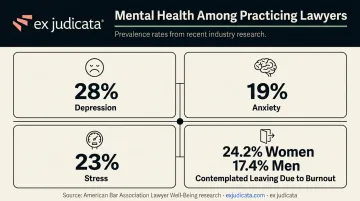
The mental health data supports taking the difficulty seriously. A 2016 study of 12,825 employed lawyers found 28% reporting depression symptoms, 19% anxiety, and 23% stress.
A separate 2021 study found that 24.2% of women and 17.4% of men had contemplated leaving the profession due to mental-health problems, burnout, or stress. These are not marginal figures.
What Calling Yourself a "Recovering Lawyer" Says About You
Let's be direct: this label carries more signal than it appears to. Here's what it actually communicates.
Self-Awareness That's Rarer Than It Sounds
Many lawyers suppress career dissatisfaction for years, rationalizing it with salary, prestige, or sunk cost logic. Reaching the point where you can name the misalignment — even with a joke — means you've done real internal work. Not many people get there. That makes it a distinguishing quality, not a vulnerability.
Willingness to Act Against Financial Gravity
Leaving a well-compensated, high-status profession is not the path of least resistance. The person who does it — or seriously considers it — has demonstrated a willingness to prioritize authentic fit over external validation. Senior employers in business, consulting, and the public sector notice that quality in experienced hires.
Values Clarity as a Career Asset
Research on lawyer attrition shows that most departures are driven by misalignment, not failure. People who leave know, often through hard experience, what they actually care about. That clarity is an asset in career transition — it helps you identify the right next move rather than defaulting to whatever's available.
A Transferable Skill Set That's in Demand
The "recovering lawyer" isn't leaving their JD at the door. NALP recorded 2,615 JD-Advantage jobs for the Class of 2024 — roles where a law degree provides a measurable edge without bar passage. Those positions represented nearly 6.9% of all reported jobs, and 86% were long-term and full-time.
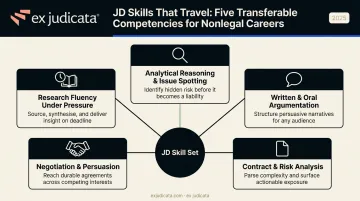
The cognitive toolkit JD training builds is genuinely distinctive:
- Analytical reasoning and issue spotting
- Written and oral argumentation
- Contract and risk analysis
- Negotiation and persuasion
- Research fluency under pressure
These skills command real demand across compliance, policy, financial services, consulting, corporate strategy, and technology.
Resilience Worth Owning
Recognizing a harmful dynamic, naming it clearly, and deciding to change course takes a specific kind of courage. The lawyers who do this aren't fragile — they're the ones who took an honest look at something most people avoid and made a hard call. In an interview, that story — told plainly and without apology — is more compelling than a polished answer about "seeking new challenges."
The "Recovering Lawyer" Identity: Myth vs. Reality
Several persistent myths keep lawyers stuck. Each one deserves a direct rebuttal.
Myth: Your Legal Education Was Wasted If You Don't Practice
That's simply false. A JD signals analytical rigor, communication discipline, and professional credibility to employers well outside the legal world. Organizations in compliance, policy, risk management, consulting, financial services, academia, and nonprofits actively recruit JD holders for nonlegal roles — not as a consolation prize, but as a deliberate talent strategy.
Ex Judicata's Job Board exists precisely because companies are seeking lawyers for these positions. The demand isn't theoretical; it's documented in hiring data and in placements like Nicolas Dumont at Lockton, Lee Garner at Guidepost Solutions, and Alan Kornberg at Marsh McLennan.
Myth: The "Recovering" Label Means You're Defined by What You Left Behind
The recovery metaphor is most powerful as a launching point, not a permanent identity. There's a meaningful difference between:
- "I used to be a lawyer" (backward-looking, defined by departure)
- "I bring legal training and business acumen to problems most people can't solve" (forward-looking, defined by capability)
One version closes doors. The other opens them. Which narrative you carry into your next chapter is a choice.
Myth: If You Were Really Good at Law, You Wouldn't Want to Leave
This one is worth retiring permanently. Many people who self-identify as recovering lawyers were objectively successful — partners with strong track records, in-house counsel at major companies, litigators by any external measure of achievement.
The names behind that pattern are telling:
- Julie Sweet spent ten years as a Cravath partner, joined Accenture, became CEO in 2019, and chair in 2021
- Adam Silver clerked federally, worked at Cravath, then went on to become NBA Commissioner
Neither left because they couldn't cut it. They left because the fit was wrong. Both thrived because of what their legal training gave them, not despite it.
From "Recovering Lawyer" to Thriving Professional: What Comes Next
Reframe the Internal Narrative First
"Recovering lawyer" works as social shorthand. As an internal identity, it has a shelf life. The more useful framing is professional with a JD — someone who carries legal training as an asset, not a prior life. How you describe yourself shapes how you show up in interviews, networking conversations, and new roles.
Practical First Steps
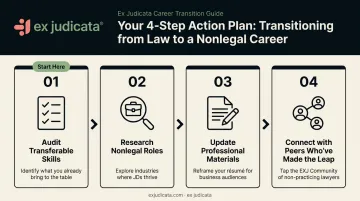
If you recognize yourself in this article, the path forward starts with concrete action:
- Audit your transferable skills — write down what you actually do well, not just your job titles
- Research nonlegal roles that match those strengths — compliance, consulting, policy, operations, business development
- Update your professional materials to lead with capabilities, not job history
- Connect with people who have made the leap — their experience is the most useful map you'll find
The last point matters more than it sounds. Co-founder Neil Handwerker described the "stress and loneliness" of leaving law with no one to turn to. That gap is real. The EXJ Community — Ex Judicata's peer-to-peer network built specifically for non-practicing lawyers — exists to close it, offering exclusive events, a member directory, and connection to others navigating the same transition.
The Infrastructure That Didn't Exist Before
For years, lawyers who wanted to leave had essentially nothing purpose-built for them — no dedicated job boards, no search firms, no community of peers who'd made it work. Ex Judicata was built to change that.
The platform brings together everything that was missing:
- A job board stocked exclusively with nonlegal roles
- 44+ first-person transition interviews through the EXJ Interview Series
- Career coaching through the Career Corner marketplace
- Courses like Financial Fluency for Lawyers built for exactly this moment
If you're ready to move, the infrastructure is there. Start with one step.
Frequently Asked Questions
What does it mean to be a recovering lawyer?
"Recovering lawyer" is an informal, self-applied term used by JDs who have voluntarily left active legal practice. It's often deployed with some humor, but it signals something substantive — that the exit involved real psychological and professional adjustment, not just a career pivot.
What personality type is best for a lawyer?
Research suggests lawyers tend toward analytical, detail-oriented, and risk-aware profiles. People who self-identify as recovering lawyers often have strong interpersonal, creative, or entrepreneurial traits. Those qualities tend to chafe against traditional legal environments — which is frequently what makes departure feel necessary.
Is it common for lawyers to leave the legal profession?
More common than it feels in the moment. The American Bar Foundation's cohort study of lawyers admitted in 2000 found 14.7% outside practice at year three, 21.4% at year seven, and 19.2% at year twelve. The experience is well-documented and far from exceptional.
Can a JD still be valuable if I'm not practicing law?
JD training is recognized outside legal practice for its analytical, communication, and negotiation value. Employers in business, compliance, consulting, policy, and finance actively seek candidates with legal backgrounds for nonlegal roles — and treat the credential as an asset, not a liability.
How do I explain leaving law to potential employers in nonlegal fields?
Frame the conversation around what you bring — your JD skill set, your problem-solving approach, your subject matter knowledge — rather than around departure. Outside law, a legal background tends to read as a differentiator when it's presented with confidence and connected to the role.