

Introduction
Big 4 JDs don't fit neatly into any hiring category. Their work — tax controversy, regulatory consulting, forensics, transfer pricing, legal management consulting — sits at the intersection of legal training and business advisory. That positioning opens real doors. It also creates real confusion about which doors to walk through.
The confusion typically crystallizes into one question: do I present myself as a lawyer returning to the legal world, or as a consultant who happens to have a JD? That framing decision determines which hiring managers call back, which roles open up, and whether the last several years of Big 4 experience read as an asset or a detour.
This article maps the full exit landscape — in-house legal, government, corporate strategy, legal tech, and fully nonlegal business careers — and explains the timing and positioning decisions that make the difference between a clean pivot and a prolonged stall.
Key Takeaways
- JDs at Big 4 firms work across tax advisory, compliance consulting, forensics, transfer pricing, and legal management consulting
- Exit paths are broader than for CPA-track colleagues — in-house, compliance, government, legal tech, and fully nonlegal business roles are all within reach
- Big 4 consulting experience counts toward in-house and compliance hiring — it is not a gap
- Practice area, seniority at exit, and how you frame your experience are the three variables that most determine the quality of your next move
- The Ex Judicata Job Board and EXJ Search exist specifically for JDs who want senior nonlegal roles — not generic job boards retrofitted for lawyers
JDs in Big 4 Consulting: Roles, Experience, and the Push to Exit
What JDs Actually Do at Big 4 Firms
PwC, EY, and Deloitte all maintain dedicated JD and LLM hiring tracks. PwC's entry-level tax page explicitly recruits JDs for ITS, M&A, SALT, and real estate practices. EY lists "Juris Doctor/Law LLM Taxation" as a qualification category and runs dedicated tax controversy and international tax services practices. Deloitte recruits JDs into both tax consulting and its Legal Business Services division, which covers legal management, technology, and operating model work.
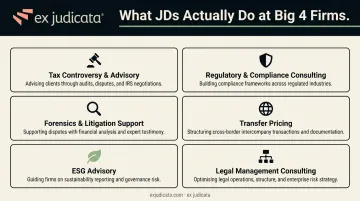
The roles JDs hold at these firms differ from what their CPA colleagues do:
- Tax controversy and advisory — representing clients in IRS disputes, managing tax risk, advising on complex transactions
- Regulatory and compliance consulting — helping clients navigate agency requirements across financial services, healthcare, and other regulated industries
- Forensics and litigation support — investigations, dispute advisory, expert witness support
- Transfer pricing — cross-border transaction analysis requiring both legal and economic reasoning
- ESG advisory — regulatory strategy, disclosure risk, governance frameworks
- Legal management consulting — process improvement, legal operations, technology implementation for legal departments
Why JDs Leave
The structural pressures at Big 4 firms are real, even if the timeline differs from Big Law. Three factors drive most exits:
- Narrow partner path — the funnel is small, the timeline is long, and competition is intense
- Lifestyle fatigue — client travel, billable targets, and project-based work without a stable client base add up
- Compensation ceiling — unlike a traditional law firm, the Big 4 partner track carries no equity ownership, which changes the long-term math significantly
JDs leaving Big 4 are also in a different position than first-time career changers. They have already made one nonlegal transition. That experience, layered on top of a JD, produces a hybrid credential that most hiring managers find hard to categorize but easy to value — which tends to work in a candidate's favor.
Big 4 Exit Opportunities for JDs: A Path-by-Path Breakdown
JD exits from Big 4 fall into two broad categories: legal-adjacent paths that use the JD credential in a formal capacity, and nonlegal paths where consulting experience and legal training together create a competitive edge. Both are legitimate. The choice depends on whether you want to return to proximity with law or move fully into business.
In-House Legal and Compliance
This is the most natural landing spot for JDs coming from Big 4 regulatory, tax advisory, or compliance consulting practices. Big 4 consulting builds business-side fluency — understanding how clients operate, managing risk in real time, advising across multiple industries — that pure law firm laterals rarely develop.
In-house hiring teams notice that difference. A JD who has spent three years advising five different financial services clients on regulatory risk has broader practical exposure than a firm associate who has worked within a single practice group.
On compensation: Robert Half's 2026 data puts experienced in-house counsel (four to nine years) at a national range of $107,000–$178,750. For compliance leadership, BarkerGilmore's 2024 CCO compensation report shows median base salaries of $419,000 at public companies and $299,541 at private companies — reflecting where this trajectory leads over time.
The Darrell Contreras case is instructive: a licensed attorney who worked in Ernst & Young's Health Sciences Advisory practice moved directly into the Chief Compliance Officer role at Millennium Health. That path — from Big 4 advisory into compliance leadership — reflects exactly how in-house teams evaluate this experience.
Government and Regulatory Agencies
JDs from Big 4 tax controversy, transfer pricing, or regulatory consulting are well positioned for roles at the IRS, Treasury, SEC, CFPB, and DOJ Tax Division. They arrive with private-sector advisory experience that career government attorneys often have not developed — they understand how companies actually structure transactions and where the pressure points are.
The Marjorie Rollinson trajectory is the clearest documented example: EY Senior Manager, then Partner, then IRS Chief Counsel roles, then back to EY, then IRS Chief Counsel again. That kind of bidirectional movement between Big 4 tax leadership and senior federal roles is well established, not exceptional.
Current government benchmarks: DOJ Tax Division Trial Attorney positions hire at GS-14 and GS-15, with 2026 Washington locality rates of $143,913–$187,093 and $169,279–$197,200, respectively. This represents a near-term compensation reduction for most senior Big 4 professionals, but government service creates long-term credentialing that reopens private-sector doors — often at a meaningfully senior level.
Corporate Strategy and Business Development
JDs with Big 4 advisory or transaction-oriented consulting backgrounds are competitive candidates for internal strategy, M&A advisory, and corporate development roles — particularly at companies that have been Big 4 clients.
The combination is genuinely rare: analytical rigor from consulting, legal risk awareness from the JD, and cross-industry exposure that generalist MBA candidates often lack. Strategy teams at large companies, especially those navigating regulatory complexity or M&A activity, find that profile valuable. Roles that fit this background include:
- Corporate development and M&A integration
- Regulatory strategy and government affairs
- Internal strategy and competitive intelligence
Legal Technology and Legal Operations
Legal tech companies and corporate legal operations teams actively recruit JDs with consulting experience. The global legal technology market was valued at $28.7 billion in 2025 and is forecast to reach $69.7 billion by 2033, a 12.2% CAGR — meaning this sector is expanding faster than most.
Big 4 consulting provides the operational and client-facing credibility that most law firm laterals haven't built. Product management, implementation leadership, regulatory strategy, and client success roles at legal tech companies all require someone who can translate between legal requirements and business execution — which is precisely the skill set Big 4 advisory develops.

Deloitte's own Legal Business Services practice — which covers legal process improvement, technology implementation, and operating model work — trains JDs for precisely the roles that corporate legal operations teams are now hiring to fill internally.
Fully Nonlegal Business Roles
JDs from Big 4 who want to move entirely away from legal context — into general management, financial services, entrepreneurship, or operations — have a compelling profile. The JD signals analytical discipline and high-stakes judgment. Big 4 consulting adds cross-industry business experience and client-facing credibility.
EXJ Search, the retained executive search practice built by Ex Judicata specifically for JDs entering nonlegal careers, has placed former Big Law attorneys in VP and Managing Director roles at firms including Lockton, Marsh McLennan, and Guidepost Solutions. The same applies to JDs exiting Big 4 with comparable profiles — transaction advisory experience, compliance and investigations leadership, and senior advisory functions are all roles that EXJ Search actively places.
The Ex Judicata Job Board lists exclusively nonlegal roles for JDs, with filters for compliance, corporate strategy, financial services, risk management, and legal operations — categories that map directly to Big 4 consulting experience.
Key Factors That Shape a JD's Exit Options from Big 4
Practice Area Is the Starting Point
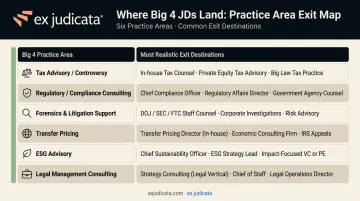
Your Big 4 practice area is the single most important determinant of your exit profile. Here is how the major areas map to realistic destinations:
| Big 4 Practice Area | Most Realistic Exit Destinations |
|---|---|
| Tax advisory / tax controversy | In-house tax counsel, IRS Chief Counsel, Treasury |
| Regulatory / compliance consulting | Government agencies, in-house regulatory affairs, CCO roles |
| Forensics and litigation support | DOJ, compliance leadership, litigation finance, investigations firms |
| Transfer pricing | Treasury, in-house international tax, corporate finance |
| ESG advisory | In-house regulatory affairs, corporate sustainability leadership, government |
| Legal management consulting | Legal operations, legal tech, corporate strategy |
Seniority at Exit Matters — In Both Directions
Leaving too early means the credential has not yet fully formed in the eyes of outside employers. A JD who exits at 18 months has consulting experience but not enough practice area depth to be legible to in-house or compliance hiring teams.
Staying too long creates a different problem. Once compensation expectations exceed $250,000 at the Manager and Senior Manager level, the pool of nonlegal roles that can match that number shrinks considerably. If the Partner track is not realistic, staying past the Manager level can create inertia that is hard to reverse.
The strongest exits typically occur once a JD has developed a defined practice area identity and real client-facing responsibility — generally three to five years in.
Framing Determines Which Conversations You Get
Two JDs with identical Big 4 experience can generate completely different hiring conversations based on how they position themselves. Consider the difference:
- Version A: "I'm a consultant with a law degree who has spent five years advising clients on regulatory risk." This framing attracts consulting and advisory roles, corporate strategy interest, and legal tech inquiries.
- Version B: "I'm a legally trained regulatory advisor with five years of private-sector advisory experience across regulated industries." This framing attracts in-house compliance, government agency, and legal operations roles.
Both are accurate — but each opens a different set of doors. Decide which path you are targeting before you update your resume and LinkedIn profile, then build your positioning around that destination.
Network Leverage Is Disproportionately Important
Big 4 JDs operate in a small, poorly understood talent segment. Most available advice on Big 4 exits is written for CPAs — FP&A, private equity, investment banking paths that are less accessible and often less relevant for JDs. That means market information is thin and the recruiting infrastructure is sparse.
Three channels to activate, in order of effectiveness:
- Former clients — The professionals you advised are now your best network. Reconnect with them before you start a formal search, not after.
- Former colleagues — Particularly those who have already exited. They know which employers valued the Big 4 background and which did not.
- Sector-specific recruiters — Not all legal recruiters understand the Big 4 JD profile. Seek out firms that operate at the intersection of legal and executive search, and that have documented placements of JDs into nonlegal roles.
How to Time and Plan Your Big 4 Exit as a JD
Preparation Steps
Knowing where you want to land is only half the equation. The most effective Big 4 exits are planned twelve to eighteen months out — not in the month before you need a new role.
Decide whether you are pursuing legal-adjacent (in-house, compliance, government) or fully nonlegal (strategy, financial services, legal tech) before beginning outreach. The two paths require different positioning language, different networks, and different recruiters.
Your resume and LinkedIn profile should not just say "consultant." Make the JD credential visible and specific: name the practice area, the client type, the regulatory frameworks you worked within. In-house and compliance hiring teams scan for exactly this.
The Ex Judicata Career Diagnostic is designed to help JDs identify which business career paths align with their professional traits and working style — useful before committing to a direction, not after.
The EXJ Community at Ex Judicata is a peer-to-peer network for non-practicing lawyers across the US. It is a practical resource for finding others who have navigated Big 4-to-nonlegal transitions and can provide candid, experience-based guidance.
Reach out to former clients and colleagues before you have a specific ask. Practice telling a coherent professional story — one that explains why a legally trained advisor with Big 4 experience is the right fit for the specific role you are targeting.

The common thread: each of these steps works best when you start before the pressure is on.
Frequently Asked Questions
What are Big 4 exit opportunities?
For JDs, the most relevant Big 4 exit paths are in-house legal and compliance, government and regulatory agencies, corporate strategy, legal tech and legal operations, and fully nonlegal business roles. Each draws on legal training in ways that the standard CPA-track paths do not.
What is the rule of 3 in consulting?
An informal guideline suggesting consultants exit at natural three-year intervals — associate, senior, manager — when experience and market demand align. For Big 4 JDs, exiting at the right seniority level matters more than adding years once the Partner track becomes unlikely.
What roles do JDs typically hold at Big 4 firms?
The primary practice areas are tax advisory and controversy, regulatory and compliance consulting, forensics and litigation support, transfer pricing, ESG advisory, and legal management consulting. PwC, EY, and Deloitte all maintain dedicated JD and LLM hiring programs for these tracks.
Does Big 4 consulting experience count toward in-house legal hiring?
Yes. JDs from Big 4 regulatory, tax, and compliance consulting practices are regularly hired for in-house and compliance leadership roles. In-house hiring teams frequently view the business-side exposure as an advantage over law firm laterals who have not had direct client advisory experience.
When is the best time for a JD to leave a Big 4 firm?
The strongest exits happen once a JD has a defined practice area and meaningful client-facing responsibility — generally three to five years in. Staying past the Manager level without a Partner trajectory raises salary expectations that can price you out of most available roles.