

Introduction
You've hit the milestone. The firm name on your business card is one people recognize. The salary is real. The title is legitimate. And somewhere between the 2,200th billable hour and the third consecutive cancelled weekend, a quiet question settled in and wouldn't leave: is this actually it?
For most unhappy BigLaw attorneys, the question isn't why to leave. It's how — how to leave without financial catastrophe, without losing your professional identity, without feeling like you're dismantling everything you built.
Bloomberg Law's 2024 Attorney Well-Being Report found that 48% of attorneys reported experiencing burnout, with that figure climbing to 58% among attorneys aged 25–34. Nearly half were actively seeking or open to new employment.
This guide is for BigLaw attorneys who don't just want to switch firms or go in-house — but who want to build something genuinely different. We'll cover why the golden handcuffs feel permanent (and why they aren't), where your JD skills land outside law, and a concrete roadmap for making the move without blowing up your finances or your future.
Key Takeaways:
- Golden handcuffs are real, but with a plan they're workable — not a life sentence
- Nearly 1 in 5 lawyers admitted in 2000 was no longer practicing law by year 12
- JD skills are actively sought in compliance, consulting, operations, and risk management
- Financial runway of at least 6 months is the standard starting point for a deliberate exit
- Building your bridge before you resign cuts the transition timeline by months
Why So Many BigLaw Attorneys Feel Trapped (But Aren't)
The Golden Handcuffs Are Real — Just Not Unbreakable
The math is genuinely intimidating. According to NALP, the median first-year associate salary at firms with 701+ lawyers was $215,000 in 2025, with senior associates on the Cravath scale earning up to $420,000. Walk away from that, and you're not just changing jobs — you're recalibrating your entire financial life.
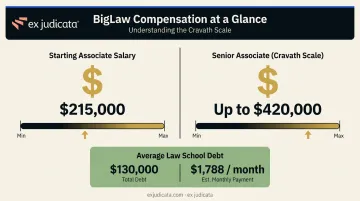
Compound that with law school debt. The average law school borrower carries roughly $130,000 at graduation, which grows to approximately $150,110 by the first payment date, with monthly obligations of around $1,788 on a standard 10-year plan. The combination of high income and significant debt service is a real constraint, not an irrational fear.
Those are constraints to plan around, not walls that make leaving impossible. The attorneys who exit successfully treat this as a financial planning problem — not a verdict.
The Identity Problem Nobody Talks About
BigLaw doesn't just take your time. After years of 2,000+ billable hours, your firm title becomes fused with your sense of self. Leaving starts to feel less like a career change and more like self-erasure.
That experience is common — and workable, but only once you name it. Harvard Law School's Center on the Legal Profession has documented how legal training systematically reshapes how lawyers see themselves, blurring the line between professional role and personal identity. Recognizing that process for what it is gives you room to separate who you are from what you bill.
The Echo Chamber Effect
When everyone in your professional circle is also a risk-averse lawyer managing the same pressures, the exit door can become genuinely invisible. That's not weakness — it's a structural feature of the BigLaw environment.
Outside perspective consistently changes the calculus. Attorneys who leave faster tend to have access to:
- A mentor who has already made the move
- A peer community of former lawyers in nonlegal roles
- A coach or advisor who works specifically with JDs in transition
That kind of exposure — to people who've navigated the same exit — makes the path visible in a way that internal deliberation rarely does.
Recognizing When It's Really Time to Leave
Burnout from overwork is recoverable. Genuine misalignment is different — and the difference matters.
Ordinary burnout says: I need a vacation, a lighter deal, a better team.
Genuine misalignment says: I do this work competently and feel nothing. I've lost all curiosity about it. I spent a deposition mentally drafting a resignation letter.
Four Signals Worth Taking Seriously
If several of these apply, the signal is worth acting on:
- You've stopped caring about the partner track — not because you're tired, but because the destination itself no longer interests you
- Your evenings are spent researching industries, companies, and roles that have nothing to do with law
- The prestige no longer compensates for what the job takes from your health, relationships, or sense of meaning
- You've been planning to leave "next year" for multiple years in a row
The "next year" loop — waiting until the debt is paid, until the bonus lands, until after the big deal closes — is how attorneys stay stuck for half a decade past the point where the decision was already made.
The right moment is rarely a perfect moment. It's when the cost of staying outweighs the cost of leaping. For most attorneys, that crossover point arrives well before they're willing to admit it — sometimes years before they act.
Breaking Through the Mental Barriers That Keep You Stuck
Fear Is Structural, Not Personal
Lawyers are trained to be risk-averse. BigLaw amplifies that through an environment built on institutionalized caution. The same careful, worst-case-scenario thinking that makes you excellent at your job can paralyze career decision-making when pointed inward.
Recognizing this isn't a character flaw — it's a feature of legal training — is the first step to getting unstuck.
The Prestige Problem
Giving up a title that made parents proud, that impressed people at dinner parties, that validated years of sacrifice — that's genuinely hard. But it's worth asking an honest question: is prestige a currency you're spending your days earning for others, or one you're actually cashing in for yourself?
The Sunk Cost Trap
Law school debt, years invested, the identity built around the profession — these are real costs. But they're already spent. They don't get recovered by staying another five years. The more useful question is: what will the next five years cost if you don't make a change now?
The Trail-Blazing Pressure
This pressure falls unevenly. For women and attorneys from underrepresented groups, leaving can feel like retreat rather than choice — a signal to others that the path doesn't work. NALP's 2023 data found women made up 50.31% of associates but only 27.76% of partners, and attorneys of color were 1.3 to 1.5 times as likely to voluntarily leave law firms as white male attorneys. Those numbers reflect systemic pressures, not individual failure. Leaving on your own terms is a decision about your future — not a verdict on what you've already built.

Seek Outside Perspective
Attorneys who exit fastest frequently credit one outside voice — someone who sees the situation without the profession's built-in risk aversion. That person looks different for everyone:
- A partner or spouse who can name what you're not saying
- A friend in business who doesn't share your sunk-cost framework
- A mentor who left law and lived to tell about it
- A career coach who works specifically with lawyers in transition
That external perspective doesn't just validate the decision. It shortens the timeline from "thinking about it" to actually moving.
Mapping Your Nonlegal Career: Where JD Skills Are Genuinely Valued
Reframing What You Actually Bring
The "transferable skills" pitch from pre-law school is vague enough to feel meaningless. Here's the specific version: complex problem-solving, high-stakes negotiation, synthesizing enormous volumes of information under pressure, managing demanding stakeholders, and precision in written communication are genuinely rare outside law. These are the product of rigorous training, not generic corporate experience.
Where Former BigLaw Attorneys Land
The strongest fits tend to cluster in categories where analytical rigor and stakeholder management are premium skills:
- Compliance and risk management — perhaps the most natural landing spot; organizations actively recruit JDs because the training, not bar admission, is what they want
- Business operations and strategy — deal experience translates directly into project and stakeholder management
- Consulting — the same frameworks attorneys use to analyze complex problems map well to management consulting
- Government and policy — legislative drafting, regulatory work, and public-sector roles that value precision
- Legal tech and startups — growing demand for JDs who understand both the legal landscape and the business side
- Finance — transaction work, due diligence, and structured finance experience transfer meaningfully
- Nonprofits and mission-driven organizations — for attorneys who want their work to reconnect with purpose
- Academia — research, policy, and teaching roles that value depth of legal training

NALP's 2024 data found 2,615 JD Advantage jobs in the Class of 2024 — roles where a law degree provides a distinct advantage but bar admission isn't required. Top categories included compliance (15.5%), tax associate (12%), and consulting (11.3%).
Compensation Reality Check
The initial pay adjustment is real. NALP's JD Advantage salary data shows median compensation of $95,000 in compliance, $100,000 in consulting, and $140,000 in management roles — compared to BigLaw starting salaries that begin at $200,000+. But factoring out lifestyle inflation often makes that gap smaller than it first appears, and earning trajectories in business roles tend to steepen with seniority.
Do the Self-Assessment First
The worst version of leaving BigLaw is fleeing into whatever opportunity appears first and recreating the same pressures in a different context. Before applying broadly, map your interests, values, and the environments that actually energize you.
Ex Judicata's EXJ Career Diagnostic is a PhD-validated assessment built specifically for lawyers weighing nonlegal careers. The platform also includes a Job Board (100% nonlegal roles for JDs) and an Interview Series with 44+ first-person accounts from attorneys who've made the transition successfully.
Translating Your Background for Nonlegal Employers
Once you know where you're headed, the next task is making your background legible to hiring managers who've never read a BigLaw resume. That translation work falls on you:
- Deal work → project management, stakeholder coordination, cross-functional leadership
- Litigation → advocacy, strategic communication, high-stakes decision-making under pressure
- Due diligence → analytical research, risk assessment, synthesizing complex information quickly
Frame your experience in terms the hiring manager recognizes. Drop the firm shorthand and lead with the business outcome your work actually produced.
Your Step-by-Step Roadmap for Quitting BigLaw
Step 1: Get Clear Before You Get Moving
This is the mental work that has to come first. Not stolen late-night minutes — real, dedicated time spent identifying patterns. What problems do you actually want to be solving in five years? What environments energize you versus drain you?
Without this clarity, you risk trading one misaligned role for another.
Step 2: Build Your Financial Bridge
Calculate your actual minimum monthly expenses — not BigLaw lifestyle spending, but what you genuinely need. The CFP Board recommends at least 3 to 6 months of essential expenses in savings, with more recommended when job risk is elevated. For a voluntary BigLaw exit, 6 months is a reasonable floor.
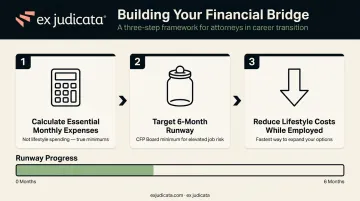
Reducing lifestyle expenses while still employed is the fastest way to expand your options.
Step 3: Set a Real Quit Date and Tell Someone
Set a hard quit date — and tell someone who will hold you accountable. This single move forces the transition from theoretical to actual and breaks the "next year" delay loop that keeps most attorneys stuck for longer than they intend.
With a date locked in, the next priority is using your remaining employed time strategically.
Step 4: Build the Bridge While Still Employed
Consistent, small actions generate real momentum before you need it:
- Reach out to one person per month in a field you're curious about
- Attend one industry event per quarter
- Take one online course in a relevant domain
These moves do two things: they generate real information about whether a direction is worth pursuing, and they build a network before you need one.
Step 5: Prepare Your Materials for a Nonlegal Audience
- Update your LinkedIn profile to speak to impact and transferable skills, not firm tenure
- Write a cover letter framing that leads with what you're moving toward, not what you're leaving
- Translate your experience into the language of your target industry — then test that framing with people in that field before you use it widely
Setting Yourself Up for Long-Term Success After the Leap
The transition doesn't end when you hand in your notice.
Identity vertigo in the first several months of a new role is common — especially when the feedback loops are less immediate than billable hours. There's no monthly utilization report telling you whether you're succeeding. That ambiguity is disorienting, and it's normal. It doesn't mean you made the wrong call.
Community matters more than most attorneys expect at this stage. Peer connection with others who've navigated the same transition normalizes the experience in ways that no amount of career advice can.
That's exactly what Ex Judicata's EXJ Community is built for — the first peer-to-peer network for the 600,000+ non-practicing lawyers already working in nonlegal careers in the US. It offers shared experience and the grounding reminder that the disorientation is temporary.
The legal training you spent years building doesn't expire when you change your title. It compounds. Organizations across business, nonprofits, government, and academia are actively seeking the analytical depth that BigLaw develops. You're not starting over. You're repositioning from a genuinely strong foundation.
Frequently Asked Questions
How long does it typically take to transition out of BigLaw into a nonlegal career?
Timelines depend on financial runway, role clarity, and how actively you're networking — starting while still employed compresses the process significantly. Runway savings let you search deliberately rather than grabbing the first offer available.
Will leaving BigLaw hurt my earning potential in the long run?
There's an initial adjustment, but nonlegal roles in compliance, consulting, business strategy, and management offer competitive compensation for JD talent. NALP reports median salaries of $95,000–$140,000 in these categories. Factoring out lifestyle inflation often makes the gap smaller than the raw numbers suggest, and business compensation tends to grow with seniority.
What nonlegal careers are best suited for former BigLaw attorneys?
Compliance, risk management, business operations, consulting, government and policy, legal tech, and nonprofits are the strongest fits for former BigLaw attorneys.
Do I need to have a job lined up before I quit BigLaw?
Both approaches work depending on your financial situation and risk tolerance. Having an offer eliminates income uncertainty; leaving with runway allows for a more deliberate search. Regardless of which path you choose, having at least 6 months of essential expenses saved first is a reasonable baseline.
How do I explain leaving BigLaw on my resume or in interviews for nonlegal roles?
Frame the transition as intentional and forward-looking — lead with what you're moving toward, not what you're leaving behind. Translate your BigLaw experience into the language of the target industry; hiring managers outside law respond to impact and transferable skills, not firm pedigree.
What skills from BigLaw are most valued by nonlegal employers?
Complex problem-solving, high-stakes negotiation, synthesizing large volumes of information quickly, project and stakeholder management, and precision under pressure are the most transferable. BigLaw produces these at a level most industries simply don't encounter — which is exactly why JD talent is in demand outside the law.