Introduction
Leaving legal practice is a serious career decision — and one that a surprising number of attorneys are actively considering. A 2021 peer-reviewed study of nearly 3,000 employed attorneys found that roughly 1 in 4 women and nearly 1 in 5 men had contemplated leaving the profession due to burnout, stress, or mental health concerns.
What most of those attorneys discover quickly: the document that got them into law is not the document that gets them out.
A traditional legal CV — built around bar admissions, law review, clerkship details, and legal publications — signals everything a law firm wants to see and almost nothing a business hiring manager cares about. Used without modification, it can actively work against you.
This guide covers exactly what to do instead:
- How to choose the right document format for nonlegal hiring managers
- What to cut from your legal CV — and what to keep
- How to translate legal experience into business language
- How to write a professional summary that positions you as a business candidate
Key Takeaways
- Nonlegal employers expect a one-to-two-page resume — not a multi-page legal CV
- Translate your legal experience into business language — your JD signals rigor, but employers need to see it in their terms
- The professional summary is your single most important section when transitioning
- Condense or cut legal-specific content — bar details, law review, and CLE credentials rarely help outside law
- Tailor your document to each target industry — compliance, consulting, finance, nonprofit — every time
CV or Resume? Choosing the Right Format When Leaving Law
Most attorneys use the terms interchangeably, but the distinction matters when you are crossing into the business world.
A CV is a comprehensive record of your academic and professional history — publications, presentations, clerkships, bar memberships. It is the standard in legal practice, academia, and research-intensive roles.
A resume, by contrast, is a targeted marketing document: concise, focused on what is relevant to a specific employer, and typically one to two pages.
Columbia Career Education draws this line clearly: in the US, a CV is used for academic careers while a resume is the default for business and professional roles. NIH's career guidance aligns with this, recommending a CV only for faculty positions, research-intensive roles, fellowships, and grant applications — a resume for everything else.
For most attorneys leaving law, the answer is a resume.
That said, there are genuine exceptions:
- Academia — Law school teaching roles and legal research positions still call for a full CV
- Policy research — Think tanks and research-focused government roles may expect a more comprehensive record
- Federal government — Since September 27, 2025, USAJOBS resumes are capped at two pages by OPM rule, so even federal applications demand brevity
Throughout this guide, "CV" and "resume" are used in the way attorneys typically talk about their career document. The practical advice applies regardless of what you call it.
What to Keep, Cut, and Reframe on Your Attorney CV
This is where most attorneys make their first mistake: treating the transition document as an update of the legal CV rather than a rebuild. Here is how to approach each section.
What to Keep
These elements translate well and should remain visible:
- JD credential and law school name — signals analytical training and intellectual rigor, regardless of industry
- Substantive work experience — the raw material that, once reframed, becomes your value proposition
- Leadership roles — managing teams, running practice groups, serving on committees
- Measurable accomplishments — deals closed, clients served, matters managed, revenue generated
What to Cut or Condense
Remove or minimize anything that only means something to a legal audience:
- Extensive bar admission details (state bar year and status is enough; bar number is unnecessary)
- Law journal membership, unless the publication demonstrates business-relevant expertise
- Judicial clerkship minutiae beyond the judge's name and court
- Legal citations and publication lists (unless applying to policy or research roles)
- CLE credentials — outside the profession, these mean nothing
How to Reframe Experience Descriptions
Legal bullet points describe tasks. Business bullet points describe results. That distinction drives every rewrite decision you make.
Every description that reads "drafted," "appeared before," or "researched the law on" needs to be rewritten around outcomes, scope, and impact. The legal task becomes the method; the business result becomes the headline.
Before: "Drafted contract provisions governing data-sharing obligations under state privacy law." After: "Reduced vendor contract cycle time by 30% by standardizing data-privacy terms across a portfolio of 80+ agreements."
Handling the Education Section
Once you have several years of practice behind you, lead with experience — not education. Nonlegal employers care far more about what you have done than where you went to school.
That said, keep the JD prominent. It signals intellectual rigor and a credentialing standard that most business candidates cannot match — and that distinction still opens doors.
If you want hands-on help executing this rebuild, Ex Judicata's Career Corner connects transitioning JDs with vetted CV and LinkedIn specialists who work specifically with attorneys making this move.
Translating Legal Skills Into Business Language
Nonlegal hiring managers will not decode legal jargon for you. That burden falls entirely on the attorney — which means the translation has to happen on your CV, before the interview ever starts.
The Translation Framework
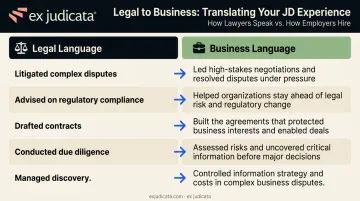
The goal is to take what you actually did and describe it in terms that a business audience immediately understands. Here are concrete examples:
| Legal Language | Business Language |
|---|---|
| Litigated complex disputes | Managed high-stakes negotiations and conflict resolution under pressure |
| Advised corporate clients on regulatory compliance | Provided risk assessment and strategic guidance to C-suite stakeholders |
| Drafted contracts | Authored high-value agreements with significant financial and operational implications |
| Conducted due diligence | Evaluated risk exposure and identified material issues across complex transactions |
| Managed discovery | Coordinated cross-functional teams to synthesize large volumes of information under deadline |
Core Transferable Skills to Highlight
The ABA's accreditation standards confirm that law school training produces verified competencies in legal analysis, research, problem-solving, and written and oral communication. Your skills section, though, should reflect what you specifically developed in practice — not just what law school delivered in theory.
Business employers consistently value what JDs bring to the table:
- Analytical reasoning and structured problem-solving
- Risk identification and mitigation
- Negotiation and conflict resolution
- Complex written communication
- Project and matter management
- Synthesizing large amounts of information quickly
- Attention to detail in high-stakes environments
Using Action Verbs That Cross Industries
Drop the purely legal verbs — "argued," "pleaded," "appeared." Replace them with verbs that work in any business context: led, analyzed, negotiated, advised, managed, built, synthesized, influenced, resolved, designed, evaluated, coordinated.
Tailoring the Translation by Target Industry
Not every competency resonates equally across sectors. Match your emphasis to where you are headed:
- Compliance and risk — regulatory expertise, risk assessment, policy implementation
- Consulting — analytical frameworks, client advisory, stakeholder management
- Nonprofit — advocacy, community engagement, grant compliance, board relations
- Finance and insurance — contract fluency, due diligence, risk analysis, regulatory knowledge
- Project management — deadline management, cross-functional coordination, scope control
Writing a Professional Summary as a Legal Career Changer
The professional summary is the most consequential section on a transitioning attorney's document. It is the only place where you can proactively frame who you are becoming rather than defending who you have been.
Without a strong summary, hiring managers read your job titles and draw their own conclusions — usually the wrong ones. A well-crafted summary sets the reader's interpretation before your legal titles do.
What a Strong Transition Summary Must Do
Columbia's career guidance advises career changers to lead with a summary highlighting accomplishments relevant to the new field — advice that's especially apt for attorneys, whose job titles alone tend to narrow rather than open doors. A strong transition summary should:
- Acknowledge your legal background as a foundation of skill — not an awkward detour
- Articulate the specific value you bring to a new field
- Name the direction you are heading, clearly
- Signal intent, not just history
Summary Structure That Works
Aim for three to four sentences, written in third-person-implied style (no "I"). The opening sentence should establish your strongest transferable identity. The closing sentence should signal where you are going.
Example: Transactional attorney with 9 years of contract negotiation and risk management experience across technology and financial services clients. Skilled at advising senior stakeholders on complex operational decisions with significant legal and financial implications. Transitioning into corporate strategy and business operations, where analytical rigor and high-stakes decision-making experience translate directly.

What to Avoid
- A summary that reads like a law firm bio — too formal, too legal in tone
- Vague language about "seeking new opportunities" without naming a direction
- Omitting a summary entirely — a chronological list of legal titles will not make the case for you
Structuring Your Document for Nonlegal Employers
Recommended Section Order
For a transitioning attorney's resume, this sequence works well:
- Contact Information — name, city/state, phone, email, LinkedIn URL
- Professional Summary — three to four sentences framing your transition
- Core Skills / Competencies — a compact block of six to ten keywords
- Professional Experience — reverse chronological, with reframed bullet points
- Education — JD prominent; undergrad below it
- Optional — Publications, affiliations, community involvement (if relevant to target role)
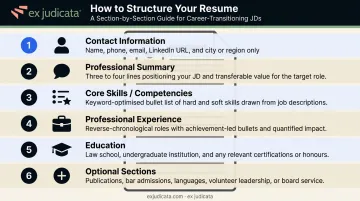
Item #3 — the Core Skills block — deserves particular attention for career changers. It lets both human reviewers and ATS systems register your value before they encounter your legal job titles. That matters: Jobscan's 2025 ATS usage report found that 97.8% of Fortune 500 companies use an applicant tracking system. A keyword-rich skills block helps ensure your document clears that first filter.
Tailoring for Each Role
One version of your resume will not serve you across different industries and job functions. Maintain a master document and build tailored versions for each application — adjusting the summary, skills block, and highlighted bullet points to match the specific language and priorities of each employer. Hiring managers can tell the difference between a document assembled for the role and one that was repurposed from somewhere else.
Formatting and Final Polish Tips
The formatting rules that govern legal CVs — multiple pages, dense text, exhaustive credential lists — do not apply here.
Length: One to two pages maximum. Two pages only if you have ten or more years of experience with relevant content to fill them. Penn Career Services and Harvard Business School alumni guidance both recommend one to two complete pages for experienced professionals.
Font: Times New Roman, Calibri, or Garamond at 11–12 point. Keep it clean and readable throughout.
White space: Do not crowd the page. Adequate margins and spacing make the document easier to scan — and according to a Ladders eye-tracking study, recruiters make their initial assessment in roughly 7 seconds.
File format: Save and submit as a PDF to preserve formatting, unless the employer's application system specifies otherwise. Note that some ATS platforms parse PDFs less reliably — if applying through an online portal, a clean Word document may be safer.
Proofreading: Hiring managers expect attorneys to produce flawless documents. Proofread top-to-bottom, then again bottom-to-top to catch what a forward pass misses. Run an editing tool and have a trusted colleague review the final draft before you submit.
Frequently Asked Questions
Should an attorney use a CV or a resume when leaving law?
For the vast majority of nonlegal roles — corporate, nonprofit, consulting, finance, tech — a one-to-two-page resume is the appropriate format. A full CV is only warranted when the position is genuinely research-intensive or academic in nature.
What to put on an attorney's resume when transitioning out of law?
A well-structured attorney resume for nonlegal roles typically includes:
- A targeted professional summary
- A transferable skills block
- Reframed work experience with business-language bullet points
- Education with the JD prominently listed
- Leadership, publications, or affiliations relevant to your target field
How do you explain leaving law on a resume?
The professional summary is the right vehicle. Present your legal background as the foundation of a specific, valuable skill set, not a detour, and name the type of role or industry you are pursuing. Clear intent reads as confidence, not defensiveness.
What skills from law practice transfer to nonlegal careers?
The most universally valued: analytical reasoning, risk assessment, negotiation, complex writing and communication, project management, and the ability to manage high-stakes decisions under pressure. These apply across compliance, consulting, finance, nonprofit, and corporate roles.
What to do when leaving a law firm?
Beyond updating your resume, clarify your target industry before you start applying and begin networking in that space. Ex Judicata is built specifically for this: connecting JDs with employers actively seeking legal talent for nonlegal roles, which puts you ahead of a generic job board search from the start.
How long should a resume be for an attorney leaving law?
One to two pages is the norm for nonlegal roles. Brevity signals that you understand business conventions — and that awareness itself makes a positive impression on hiring managers who are not lawyers.