

Legal training doesn't just prepare lawyers to practice law. It builds a specific cognitive architecture—analytical, risk-aware, ethically grounded—that maps almost directly onto what demanding CEO roles require. This post explains why, backed by academic research and real-world examples, and what it means for lawyers who are thinking beyond the practice.
Key Takeaways
- Roughly 9% of S&P 1500 CEOs hold law degrees, spanning banking, tech, media, and insurance
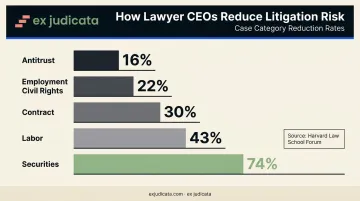
- Firms led by lawyer CEOs show litigation frequency reductions of 16% to 74% across multiple case categories
- Legal training builds the judgment, risk instincts, and negotiation skills that CEO roles demand
- Lawyers are underrepresented in the C-suite despite being fully equipped for the role
- 85% of executives report rising compliance complexity — making legal-trained leaders more relevant than ever
The JD Advantage: Legal Training as Leadership Preparation
Thinking Like a CEO Starts in Law School
MBA programs teach financial modeling, operational management, and market strategy. Law school teaches something different: how to reason through incomplete information, identify what can go wrong, and construct a defensible position under pressure. That's not just useful in a courtroom—it's precisely what high-stakes executive decisions require.
An MBA graduate often enters leadership through the P&L. A lawyer enters through judgment. Neither path is superior, but the legal one develops a specific set of muscles that CEO work exercises constantly.
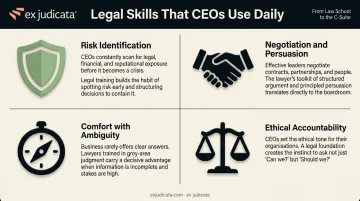
Four Skills Legal Training Builds—That CEOs Use Daily
Each of these capabilities maps directly to what separates competent executives from exceptional ones:
- Risk identification: Lawyers are trained to see what can go wrong before it does. In the CEO role, this means sharper regulatory foresight, tighter contract discipline, and a natural instinct to stress-test decisions before committing — skills with real dollar value as compliance burdens rise.
- Negotiation and persuasion: Litigators argue. Transactional lawyers draft, negotiate, and close. Those skills transfer directly to M&A, investor communications, board relations, and managing stakeholders whose interests frequently conflict.
- Comfort with ambiguity: Lawyers make recommendations without perfect facts routinely. That tolerance for uncertainty, paired with systematic reasoning, serves CEOs well in fast-moving environments where waiting for complete information means missing the decision entirely.
- Ethical accountability: Legal training comes embedded with professional conduct rules — candor, duty of loyalty, conflict avoidance. As corporate governance scrutiny has increased sharply, a CEO who has internalized those norms brings a credibility to the boardroom that policy training alone can't replicate.
Lawyer CEOs Who Reached the Top
The examples below aren't clustered in one sector. They span industries where complexity, negotiation, and stakeholder management define the job.
| CEO | Company | Law School | Industry |
|---|---|---|---|
| Brian Moynihan | Bank of America | Notre Dame | Banking |
| Safra Catz | Oracle | University of Pennsylvania | Technology |
| David Zaslav | Warner Bros. Discovery | Boston University | Media |
| Alan Schnitzer | Travelers | Columbia | Insurance |
| Debra Cafaro | Ventas | University of Chicago | Healthcare REIT |
A few things stand out about this group. The law schools range from elite to regional—Penn and Columbia sit alongside Notre Dame and Boston University. The common thread is the training itself, not institutional prestige.
The path from JD to CEO also wasn't always direct. Alan Schnitzer joined Travelers in 2007 as Vice Chairman and Chief Legal Officer, then built operational credibility across the business before stepping into the Chairman and CEO role. That GC-to-CEO progression is among the most traveled routes for lawyer executives.
What the Research Actually Says
The Study
A peer-reviewed paper by Hutton, Henderson, Jiang, and Pierson—summarized on the Harvard Law School Forum on Corporate Governance—analyzed approximately 3,500 CEOs paired to nearly 2,400 publicly traded S&P 1500 firms. About 9% of those CEOs held law degrees. That's a meaningful share given that the role is almost universally associated with finance or business backgrounds.
The Core Finding
Firms led by lawyer CEOs experienced statistically significant reductions in litigation frequency across multiple categories—antitrust, employment civil rights, contract, labor, and securities cases. The reductions ranged from roughly 16% to 74% relative to unconditional mean litigation rates depending on the category.
For context: a 74% reduction in securities litigation isn't a marginal improvement. At that scale, it changes how a company prices risk, structures deals, and plans for growth.
The Mechanism
The research found that lawyer CEOs manage litigation risk before it materializes, not just after. They were associated with:
- More cautious earnings management in high-litigation industries
- Greater future presence of legally trained directors on boards
- More conservative investment policies, including lower R&D and return volatility
This points to culture-setting, not just legal oversight. The lawyer CEO shapes how the organization thinks about risk at every level.
The Honest Caveat
The same study found that the value-add of lawyer CEOs is most pronounced in high-litigation, high-growth, or pharmaceutical industries. Outside those environments, an overly risk-averse posture can dampen growth. Fit matters. A lawyer CEO isn't the right answer for every organization, but for complex, regulated, or high-stakes businesses, the data is clear: legal training at the top reduces costly surprises.
Why Lawyers Are Underrepresented in the C-Suite
Despite strong qualifications, lawyers are scarce in CEO roles. Research cited in GC Magazine shows 52% of FTSE 100 CEOs have finance backgrounds. Lawyers account for a fraction of what remains.
The gap is a mindset problem, and it operates on two levels.
The Identity Trap
Legal culture defines success as making partner or becoming General Counsel. Lawyers compare themselves horizontally—to other lawyers—not vertically toward general management. The question "could I run this company?" rarely gets asked because the reference group doesn't include people who did.
The Advisor Posture
Lawyers are trained to be the "critical friend": objective, set apart from the business, focused on downside. That posture works well in legal practice. In executive settings, it can read as detachment or lack of ownership. Lawyer CEOs who succeed make a conscious shift from advisor mode to accountability mode—they stop protecting the organization and start steering it.
For lawyers who do make that leap, the competitive field is less crowded. Organizations increasingly need leaders who can navigate regulation, litigation risk, ESG obligations, and stakeholder complexity. Few candidates combine that legal fluency with genuine general management ambition.
How Today's Business Environment Favors the Legal Mindset
The regulatory environment has grown substantially more complex. PwC's Global Compliance Survey 2025 found that 85% of executives feel compliance requirements have become more complex over the past three years. Thomson Reuters reports its regulatory intelligence service captures an average of roughly 200 international regulatory changes and announcements daily.
That's the world a modern CEO operates in. Legal literacy at the executive level is now a baseline expectation — driven by:
- Data privacy mandates (GDPR, CCPA)
- Emerging AI governance frameworks
- ESG reporting requirements
- Intensifying antitrust enforcement
Meanwhile, the pipeline for lawyers into non-legal business roles is growing. NALP's Class of 2024 data shows JD Advantage jobs — roles where the JD is valued but not required — rose from 8.8% to 16.9% of all law graduate employment.
Compliance positions lead that category, but the trend reaches well into corporate strategy, operations, and senior leadership. Organizations are recognizing that the JD skill set translates far beyond the legal department.
From JD to CEO: Making the Transition
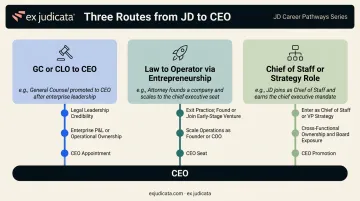
Most lawyer CEOs didn't vault from associate to corner office. The paths tend to look like one of these:
- GC or CLO to CEO — Build operational relationships across the business, own enterprise risk, then step into broader leadership. Alan Schnitzer's path at Travelers is the clearest example.
- Law to operator via entrepreneurship — Mike Votto practiced commercial real estate law at Goodwin Procter and Schulte Roth before co-founding Votto Vines Importing, eventually scaling it past $50M in annual revenue. Legal training shaped how he structured deals and managed risk through three equity fundraising rounds.
- Chief of Staff or strategy role — Cross-functional exposure to P&L, operations, and investor dynamics accelerates the shift from advisor to owner. Many lawyers use this as the bridge between legal leadership and general management.
What the Transition Actually Requires
Legal training doesn't automatically cover what executive roles demand. Lawyers who make the transition successfully close that gap deliberately — by building skills and taking on accountability in areas like:
- Reading and owning financial statements, not just reviewing contracts
- Leading revenue-generating teams rather than advising them
- Engaging with investor dynamics and go-to-market decisions firsthand
The JD is a strong foundation. But the lawyers who reach the C-suite treat it as a starting point, not a finish line — actively seeking out P&L ownership and commercial exposure before the CEO title arrives.
For lawyers ready to pursue that path with structure behind them, Ex Judicata offers several resources built for exactly this transition. The EXJ Interview Series features first-person accounts from JDs who've moved into CEO, COO, and other C-suite roles across industries. The Career Corner connects lawyers with vetted coaches specializing in leadership development and executive positioning. EXJ Search places JD-credentialed professionals into senior nonlegal roles at organizations that actively value the legal skill set.
Frequently Asked Questions
Do lawyers make good CEOs?
Yes—research and real-world examples support it, particularly in industries with high regulatory complexity or litigation risk. Legal training in analytical reasoning, risk management, negotiation, and ethical accountability translates directly to executive leadership demands.
What percent of CEOs are lawyers?
Approximately 9% of CEOs at S&P 1500 companies hold law degrees, based on research analyzing around 3,500 CEO-firm pairs. That's a smaller share than finance or MBA backgrounds, but a consistent and well-documented presence at the top of major companies.
Are there CEOs in law firms?
Law firms are typically led by Managing Partners rather than CEOs, though some large firms use the CEO title for administrative leadership. The more notable trend is JDs becoming CEOs of non-legal companies across banking, insurance, technology, and media.
What skills from law school translate best to business leadership?
The most transferable: structured analytical thinking, risk identification, negotiation, persuasion, comfort with ambiguity, and a strong ethical framework.
Can a lawyer transition to a CEO role without prior business experience?
Pure legal experience alone is rarely sufficient—but most lawyer CEOs built toward the role through General Counsel positions, entrepreneurship, or cross-functional leadership that added operational depth to their legal training.