

Introduction
Your law school classmates are clerking or making partner. Your firm colleagues refer cases to each other. Your clients call you for legal advice. Every professional relationship you've built over the past decade points in one direction: law.
That's the central networking problem for attorneys leaving practice. It's not a lack of connections—most lawyers have hundreds of them. The problem is that nearly all those connections exist inside the legal world, making the "warm introduction" pathway into business, compliance, government, or nonprofits broken.
A five-year randomized study of more than 20 million LinkedIn members found that moderately weak ties—acquaintances, not close contacts—drive job mobility more than strong ones. For transitioning attorneys, those weak ties almost exclusively run through legal channels, which means building a second, parallel network isn't optional. The transition depends on it.
This article covers how to work both networks at once—preserving the legal relationships you've built, breaking into industry circles where you know no one, and positioning yourself on LinkedIn as a career changer rather than someone still waiting to decide.
Key Takeaways
- Former clients and in-house counsel contacts are your strongest bridge to nonlegal opportunities—they already know your work
- Reframe JD skills in plain language before any networking conversation: analytical thinking, risk assessment, persuasive communication
- Informational interviews deliver the highest return of any networking tactic during this transition
- Update your LinkedIn profile to signal career changer before you begin any outreach
Why Networking for Career-Transitioning Attorneys Is Different
Standard legal networking advice—attend bar association events, collect referrals, work your CLE circuit—is designed to grow a legal practice. It doesn't translate to a career pivot. Worse, it can actively reinforce the professional identity you're trying to move beyond.
The structural problem runs deeper than just attending different events.
You're Starting With a Siloed Network
Most lawyers have deep, concentrated networks inside the legal world and almost no first-degree contacts in the industries they want to enter. Financial services, compliance, consulting, healthcare administration, government—the people who hire for those roles are simply not at the events lawyers attend.
This matters because most hiring still travels through relationships. When your entire relationship graph points toward law, you're not just behind—you're working from an entirely different starting point.
The Identity Problem Is Real
Unlike most career changers, attorneys often carry a professional identity tightly bound to their JD. Networking outside law can feel like misrepresentation rather than repositioning. It isn't—but that discomfort is worth naming because it shapes how lawyers show up in nonlegal networking conversations.
The instinct to lead with firm name, bar admissions, and practice area is strong. Nonlegal audiences find those signals irrelevant. What they respond to is demonstrated value and transferable capability.
Different Norms, Different Expectations
Nonlegal professional communities tend to be less credential-focused and more community- and interest-driven. Relationship-building happens through:
- Industry conferences and professional associations
- Trade publications and thought-leadership forums
- Local business groups—not CLE sessions
In these spaces, contribution comes before credibility. You earn trust by showing up and adding value, not by listing credentials. That dynamic also shapes how carefully you need to approach the process: many transitioning attorneys are still employed and cannot openly signal their intent to leave. A targeted, relationship-by-relationship approach works far better than any broadcast strategy.
Mining Your Existing Legal Network Without Burning Bridges
Here's the counterintuitive truth: your existing legal network probably contains your best early connectors into nonlegal careers—you just haven't been looking at it that way.
Who to Look For First
Start by auditing your contacts specifically for:
- Former clients in industries you want to enter—they know your capabilities and already work in business environments
- In-house counsel and legal department contacts who operate at the intersection of law and business daily
- Law school classmates who've already transitioned—they've done exactly what you're doing and often have nonlegal networks they're willing to share
- JD-holders working in business, government, or nonprofits anywhere in your extended network
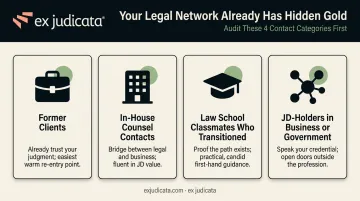
The EXJ Interview Series at Ex Judicata documents this pattern repeatedly across 44 first-person transition stories. One recurring insight: former clients who bring lawyers into business-side roles do so based on trust and credibility, not legal expertise. The attorney-client relationship has already done the relationship-building work.
How to Reach Out Without Making It Feel Transactional
The goal is genuine curiosity, not job hunting. Framing is everything.
What works:
- Lead with interest in their nonlegal path, not your own situation
- Ask for a 20-minute conversation to learn about their field
- Frame it as learning, not networking ("I'd love to understand how you made the transition...")
- Let the conversation open doors naturally rather than asking for introductions directly
What doesn't work:
- Opening with frustrations about law firm life
- Asking for job leads in the first conversation
- Signaling desperation or urgency
The best opportunities, according to network theory, come through second- and third-order contacts. Your first-order legal contacts don't need to hire you—they need to know what you're looking for so they can broadcast it into their own nonlegal networks.
Protecting the Relationships You Have
The legal world is small and long-memoried. Attorneys who position their departure as "escaping" law, or who vent frustrations about their firms or clients in networking conversations, consistently regret it. Future employers in business, compliance, and government still have ties to the legal community, and word travels.
Stay connected to law firm colleagues. Be gracious. Avoid oversharing. Attorneys who transition to client companies often bring their former firms along as outside counsel, so the professional relationship can strengthen rather than end.
How to Break Into Nonlegal Industry Networks
Before networking broadly, do the targeting work. Pick one or two industries or functional roles—compliance, risk management, business development, policy, healthcare administration—and research where those professionals actually gather.
Sector Mapping Before Outreach
For each target industry, identify:
- Relevant professional associations (Society of Corporate Compliance & Ethics for compliance, for example)
- Industry trade publications and their events
- LinkedIn groups where practitioners are active
- Local business organizations with relevant sector presence
This step prevents generic networking that produces no meaningful contacts. Attending a compliance conference as a lawyer with risk management experience is a genuine differentiator. Walking into a bar association event looking for a pivot is not.
The Informational Interview Strategy
Informational interviews are the most consistently effective tactic for transitioning attorneys. They work because the dynamic is genuinely mutual: you learn about a field, the other person gets to talk about their own path, and neither party is selling anything.
Finding targets:
- Search LinkedIn for JD-holders working in your target role or industry
- Use law school alumni networks filtered by current employer or function
- Ask first-order contacts who else they'd recommend speaking with (this builds your second-order network fast)
Outreach message structure:
- One sentence on who you are and how you found them
- Genuine reason you reached out to them specifically
- Specific ask: 20 minutes to learn about their path
- Zero pressure on outcome
What to ask in the conversation:
- How did you get from law into this role?
- Which skills from your legal training actually transfer?
- What would you have done differently?
- Who else should I be talking to?
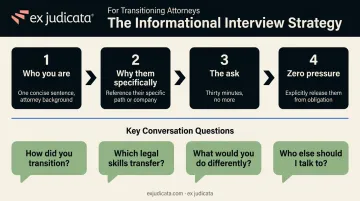
That last question is the one that compounds — each conversation opens two or three more.
Give Before You Get
In new industry networks, contribution precedes credibility. Look for early ways to add value:
- Share a relevant legal analysis or policy brief in a professional group
- Volunteer for a committee in a trade association
- Offer a concrete skill—contract review, policy drafting—to a nonprofit or professional organization
Ex Judicata's EXJ Community was built specifically for this phase of the transition. As the first peer-to-peer network for non-practicing lawyers in the US, it connects attorneys who've already made the jump with those still navigating it—people who understand the challenges, can give candid guidance, and often have nonlegal industry connections they're willing to share. For attorneys who feel like they're figuring this out alone, that community is a concrete starting point.
The research backs this up. According to a 2023 systematic review of 244 career transition studies, social support and professional networks consistently appear as key factors in successful lateral career transitions. The mechanism matters less than having it—peer networks, informational contacts, and industry associations all serve this function.
Leveraging LinkedIn and Digital Presence for Your Career Pivot
LinkedIn is the single most important digital tool for this transition. A standard lawyer profile—bar admissions, practice areas, firm history—will signal the wrong identity to every recruiter and professional you want to reach.
According to Employ's 2023 Recruiter Nation Report, 41% of recruiting organizations use or plan to use LinkedIn as their primary social channel. That makes your profile not just a networking tool but a first impression that precedes every conversation.
Repositioning Your Profile Before Outreach
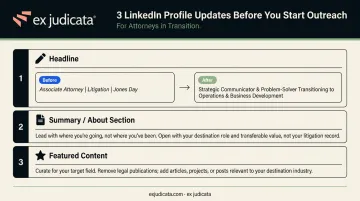
Three elements need to change before you start reaching out:
- Headline: Drop "Attorney at [Firm]" and lead with your target direction. "JD | Risk & Compliance Professional | Transitioning to Business" signals where you're going without abandoning your credential.
- Summary/About section: Open with where you're heading and what you bring. Connect your legal background to that destination — don't recap your career chronologically. That's what the experience section is for.
- Featured content: Curate articles or projects that show genuine knowledge in your target field. Targeting compliance? Feature a piece on regulatory trends. Targeting policy? Lead with legislative analysis. Commitment reads differently than curiosity.
Using LinkedIn as an Active Networking Tool
Once your profile reflects the right identity, it creates the foundation for outreach. Active engagement is what builds real visibility:
- Comment thoughtfully on posts from professionals in your target sector—this appears in their networks
- Join LinkedIn groups relevant to your target industry and participate, don't just observe
- Publish short-form content that positions your legal perspective as an asset in the target field
The Career Corner at Ex Judicata connects transitioning attorneys with vetted coaching specialists — including experts focused specifically on LinkedIn repositioning, personal branding, and CV work for JDs. If profile strategy isn't your strength, the Career Corner offers complimentary discovery consultations so you can find the right fit before committing.
The Mindset Shift: Networking as a Career Changer, Not a Lawyer
The most common instinct transitioning attorneys have in nonlegal networking conversations is to minimize or hide their legal background. That's exactly backwards. A JD is a differentiator. The challenge is translating it, not hiding it.
How to Describe What You Actually Do
Nonlegal audiences don't respond to titles, firm prestige, or bar credentials. They respond to problems you can solve.
Here's a practical reframing exercise. Instead of saying "I'm a corporate attorney at a midsize firm," try describing what you actually do in plain language:
| Legal framing | Business framing |
|---|---|
| "I practice M&A law" | "I analyze complex transactions, assess risk, and advise executives on high-stakes decisions" |
| "I draft contracts" | "I identify where agreements break down and structure terms to protect against foreseeable problems" |
| "I handle regulatory matters" | "I translate regulatory requirements into operational guidance for business teams" |
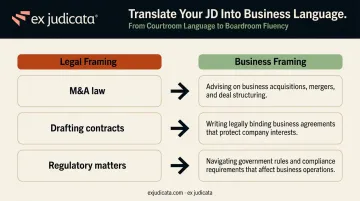
The NALP JD Advantage Career Guide identifies the core transferable competencies lawyers bring to business settings: analytical reasoning, negotiation, risk assessment, persuasive communication, compliance program development, and policy analysis. These map directly to functions in banking, consulting, healthcare administration, and government—often better than those sectors' own practitioners articulate.
Putting the Reframe Into Practice
This reframing is hard to do alone, especially when your professional identity has been "lawyer" for years. Ex Judicata's EXJ Career Diagnostic maps attorney traits to 25 business career pathways, giving you a concrete starting point. From there, the Career Corner coaching marketplace connects you with specialists like John Costango—a certified executive coach with 20 years of Wall Street experience, including Chief of Staff for JPMorgan's global legal team—who help attorneys articulate their skills in the language business actually uses.
Once you have your language down, the "If I Leave the Law" webinar series and the 44+ first-person stories in the EXJ Interview Series show attorneys what the reframe looks like in practice—from people who've done it across compliance, financial services, business development, and beyond.
Frequently Asked Questions
How do attorneys network when leaving law and building new professional ties?
Work two tracks simultaneously. Re-engage existing legal contacts—especially former clients, in-house counsel, and law school alumni who've transitioned—for warm introductions into nonlegal circles. At the same time, join target-sector associations, conduct informational interviews with professionals in your desired field, and build visibility through LinkedIn engagement before making any direct asks.
Can I still use my existing legal network when transitioning to a nonlegal career?
Yes—start there. In-house counsel, former clients, and alumni who've already transitioned know your capabilities and have direct ties to nonlegal communities. Frame your outreach around genuine curiosity, not job hunting.
What industries most actively hire lawyers for nonlegal roles?
NALP's Class of 2024 JD-Advantage data shows banking and finance (17% of business-sector placements), compliance (15.5%), accounting firms (14%), consulting (11.3%), technology (8.4%), and healthcare (7%) as leading destinations. Which aligns best for you depends on your practice background and target function.
How should I explain my legal background when networking outside law?
Translate your experience into plain language: analytical thinking, risk assessment, persuasive communication, regulatory reasoning. Leave firm prestige and bar credentials out of your opening pitch—nonlegal audiences don't evaluate candidates that way. Tailor every conversation to what the target industry actually values.
Is LinkedIn effective for lawyers pivoting to nonlegal careers?
Yes, but only after deliberate repositioning. Your headline, summary, and content strategy must signal "career changer with legal expertise" rather than practicing attorney. Outreach before repositioning your profile works against you—first impressions happen before any conversation starts.
How long does it take to build a meaningful nonlegal network from scratch?
Two to three informational interviews per week, regular LinkedIn engagement, and participation in one or two target-sector associations typically yields meaningful connections within three to six months. Your timeline will vary based on industry, practice background, and whether you have bridge contacts who can accelerate introductions.