

NALP reported that overall lateral hiring declined 35% in 2023 following an 11.5% drop in 2022 — a sharp correction after the pandemic-era hiring surge that left many associates exposed when deal flow dried up. The good news: lateral hiring rebounded nearly 14% in 2024, and the market is actively recovering. But that doesn't help much when you're the one who just got the call.
This guide covers what to do in the hours and days after a layoff, how to protect your professional reputation and finances, and — most importantly — how to decide whether you want to return to legal practice or use this moment to build something different.
Key Takeaways
- Layoffs almost never reflect individual performance — economic cycles, practice area slowdowns, and pandemic-era overcorrection drive the vast majority
- In the first 48 hours: protect relationships, review your severance terms, and resist acting without a plan
- JDs have two legitimate paths forward: return to law or pivot to a nonlegal career, each with meaningful upside
- The JD credential carries weight outside law — intentional repositioning determines how well it translates
Why Attorney Layoffs Happen — and Why It's Not About You
The Economic Forces at Work
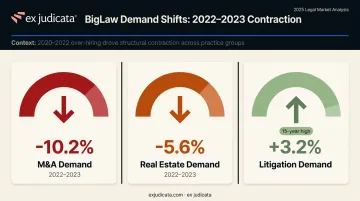
Law firm layoffs track practice area demand, not individual performance. Bloomberg Law connected the 2022–2023 BigLaw cuts directly to pandemic over-hiring and steep declines in IPO and M&A work. Through November 2023, M&A demand had fallen 10.2% and real estate demand had dropped 5.6%, while litigation demand rose 3.2% — reaching a 15-year high. That data tells the story clearly: transactional practices contracted, and the attorneys staffed to handle deal work bore the cost.
Firms that over-hired during 2020–2022 faced a straightforward math problem when the transaction market cooled: too many lawyers, not enough work to bill. Layoffs followed.
Open Layoffs vs. Stealth Layoffs
One distinction worth understanding before you speak to future employers:
- Open layoffs — publicly announced reductions where firms acknowledge economic rationale
- Stealth layoffs — firms characterize cuts as performance-related to avoid the reputational hit of announcing a reduction in force
Bloomberg Law has reported that firms sometimes describe economic layoffs in performance terms precisely because they're reluctant to admit a headcount correction. If your departure was framed as performance-based but your reviews were solid, there's a real possibility you experienced a stealth layoff.
The Law360 Pulse Layoff Tracker and resources like Big Law Investor's tracker document firm-by-firm cuts and can help you verify whether your firm had broader reductions around the same time.
That framing matters when you explain your departure to future employers. "My firm made significant cuts in my practice area" lands very differently than an ambiguous exit story.
You Were Not the Problem
Layoffs tend to target:
- Associates in practice areas with declining demand (especially M&A, corporate, real estate)
- Senior associates whose compensation outpaces their current billable output
- Attorneys hired during the 2021–2022 boom when firms over-projected sustained growth
None of these are performance indictments. They are the result of market forces, not your work. Knowing that clearly — and being able to say it clearly — shapes how you'll come across in every conversation ahead.
Your First 48 Hours: Steps to Take Immediately After a Layoff
The instinct to act fast is understandable. Resist it. The decisions you make in the first 48 hours have long-term consequences, and most of them benefit from a cooler head.
Before You Leave the Conversation
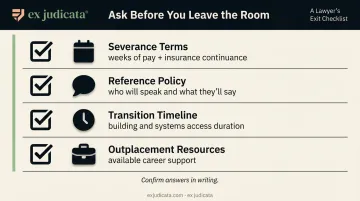
Ask these questions before the layoff meeting ends:
- Severance terms: How many weeks, and does health insurance continue? When does it start?
- Reference policy: What will the firm say if a future employer calls? Will a specific partner speak for you?
- Transition timeline: How long can you remain in the building or on systems?
- Outplacement resources: Does the firm offer any career support for departing attorneys?
Get the answers in writing or confirm them in a follow-up email. Shock and adrenaline make it easy to misremember what was said.
How You Exit Matters More Than the Exit Itself
Former employers become references, sources of introductions, and sometimes clients. Attorneys who handle layoffs with professionalism (no hostile emails, no burned bridges, no dramatic LinkedIn posts in the first 48 hours) routinely get warm calls to their next role from the same partners who delivered the news.
Before you leave, also:
- Secure writing samples: Ask for permission to retain redacted samples of your best work
- Document your matters: Write down key deals, cases, or projects while the details are fresh — you'll need these for interviews
- Identify two to three references: Confirm that specific partners or colleagues are willing to speak positively on your behalf
Do Not Immediately Blast Your Network
Give yourself a window, even three to five days, before reaching out broadly. Networking before you have a coherent story wastes relationship capital and leaves people with a fragmented impression of what you're looking for.
That said, your LinkedIn profile is worth updating right away — it works for you passively while you think through your next move. Refresh it to reflect your full experience, skills, and accomplishments. Many laid-off attorneys are publicly sharing their availability on LinkedIn, which works well in some practice area communities. Whether that approach fits depends on your specific situation and the norms in your field.
Rebuilding Your Mindset After a Law Firm Layoff
The Identity Trap
Lawyers are particularly vulnerable to one pattern after a layoff: conflating who they are with where they worked. Firm name, title, and practice group become load-bearing parts of professional identity in ways that make their sudden removal feel like a personal unraveling.
It isn't. You were a capable attorney before this firm, and you remain one now. The credential, the analytical training, the client relationships, the judgment — none of those walked out the door with you.
An ABA survey of approximately 1,300 lawyers found that 37% reported increased depression and roughly two-thirds of junior and midlevel lawyers reported reduced well-being — and that was just pandemic-period stress, not layoff-specific.
Job loss compounds existing professional stress. That's normal, and it's worth naming rather than powering through.
Processing Before Searching
Career coaches who work with lawyers say the same thing: attorneys who rush into interviews before processing the layoff often underperform. They come across as reactive rather than intentional. They take offers that don't fit because they needed something to happen fast.
The fix isn't to slow your search — it's to prepare before you start. Give yourself permission to:
- Talk to someone — a coach, a counselor, a trusted mentor
- Access your support system without framing it as weakness
- Visit Ex Judicata's Wellbeing resources, which address the psychological dimensions of career transition for attorneys specifically
Attorneys who do this work first show up in interviews with the confidence and clarity that actually gets them hired.
Should You Return to Law or Pivot to a New Career?
This question deserves real thought, not a reflexive answer. A layoff strips away the inertia that keeps many lawyers in roles they've long stopped enjoying. Use the open space deliberately.
The Honest Self-Assessment
Ask yourself:
- Did you love the actual work of practicing law, or the identity and compensation that came with it?
- Which parts of your job did you actively look forward to — client conversations, analysis, negotiation, writing, strategy?
- What would you gladly leave behind?
- Were you staying out of genuine preference, or sunk cost and fear of the unknown?
Your answers will tell you more than any external advice.
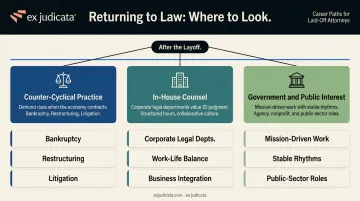
If You Want to Return to Law
The lateral market has specific rhythms and the 2024 rebound is real. Options include:
- Counter-cyclical practice areas: Bankruptcy, restructuring, and litigation all showed strength when M&A contracted — and these areas may be actively hiring
- In-house counsel roles: Companies continue recruiting legal talent, often offering better work-life balance than BigLaw
- Government positions and public interest law: These roles have different rhythms than private practice and suit attorneys who prioritize mission over compensation
Research current demand in your specific practice area before applying broadly. The market is practice-specific, not monolithic.
If You Want to Pivot Out of Law
If your self-assessment points away from practice, that's a legitimate path — and a layoff is a better moment to explore it than most attorneys expect.
A few reasons this timing works in your favor:
- Your resume reflects legal experience and sophistication — nonlegal employers see that as a differentiator
- You have runway before financial pressure forces a rushed decision
- "I reassessed after my firm downsized" is a credible, non-stigmatizing explanation that nonlegal hiring managers understand
NALP data for the Class of 2024 documented 2,615 JD-advantage jobs — positions specifically seeking JD credentials for nonlegal work — representing 7.4% of reported employment outcomes for new graduates alone. That's the entry-level slice. For experienced JDs with practice area depth, the nonlegal market is wider and the roles more senior.
Nonlegal Career Paths Where Your JD Is a Competitive Advantage
Where Experienced JDs Land
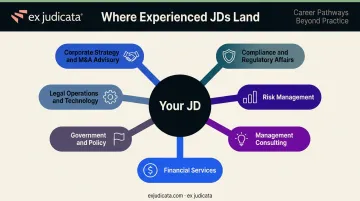
The sectors actively recruiting JDs for nonlegal roles include:
- Compliance and regulatory affairs — one of the highest-fit destinations for attorneys, particularly those from regulated industries or with transactional backgrounds
- Risk management — where legal training in identifying and mitigating exposure translates directly
- Management consulting — McKinsey explicitly includes JDs in its Advanced Professional Degree recruiting pipeline, alongside MBAs and PhDs
- Financial services — especially in deal-adjacent roles, transaction advisory, and structured finance
- Government and policy — where legal analysis and regulatory literacy are core competencies
- Legal operations and technology — a fast-growing field where legal knowledge and business process thinking combine
- Corporate strategy and M&A advisory — particularly for transactional lawyers with deal experience
JDs often enter these fields at higher levels than non-JD peers, because their training — structured reasoning, risk identification, regulatory literacy, high-stakes communication — is genuinely scarce.
How to Reframe Your JD for a Nonlegal Audience
The gap isn't your qualifications — it's translation. Nonlegal employers aren't always trained to read a legal resume, so you have to do the work for them.
Lead with:
- Analytical reasoning — the ability to assess complex, ambiguous situations and reach defensible conclusions
- Risk assessment — identifying exposure and advising on mitigation strategies
- Regulatory and contract literacy — understanding the rules that govern business decisions
- Communication under pressure — delivering clear guidance to non-expert stakeholders
- Stakeholder management — navigating competing interests to move decisions forward
These are skills lawyers use daily. They're also exactly what compliance functions, strategy teams, and advisory firms need.
Where to Find JD-Specific Nonlegal Opportunities
For JDs pivoting out of law, the real challenge isn't qualifications — it's knowing where to look and how to present yourself to employers who specifically want a JD for a nonlegal role. General job boards weren't built for this search.
Ex Judicata was built for exactly this transition. Three tools make the difference in practice:
- The Job Board lists exclusively nonlegal roles where employers are actively seeking JD holders — not generic listings where a legal background is incidental
- The EXJ Career Diagnostic maps your specific attorney traits to 25 business career paths, with probability-of-success scores for each ($25.95, one-time)
- The EXJ Community connects you with hundreds of thousands of non-practicing lawyers already working in nonlegal careers — people who made the same pivot and can tell you what actually worked
Hearing directly from attorneys who navigated this transition — what they wished they'd known, how they explained the move to employers — tends to cut through what generic job search advice misses.
Frequently Asked Questions
Who usually gets laid off first in law firms?
Associates in practice areas facing reduced demand — particularly corporate, M&A, and real estate during downturns — are typically the first affected. Senior associates can also be targets because their salaries are higher relative to their billable output when work has contracted.
What is the 80/20 rule for lawyers?
In law firm economics, roughly 20% of attorneys — typically senior partners with the largest client relationships — generate approximately 80% of firm revenue. Associates and attorneys without portable business are more exposed during downturns because they represent cost rather than revenue.
Can being laid off from a law firm hurt your legal career?
In the current market, economic layoffs carry very little stigma. Prospective employers understand market cycles. How you handle the departure matters more: a clear, confident narrative makes the layoff a non-issue.
What nonlegal careers are best for laid-off attorneys?
Compliance, risk management, consulting, financial services, government and policy roles, legal operations, and technology companies are strong fits — fields where the JD's analytical and regulatory training translates directly into value.
Should I tell future employers I was laid off?
Yes — be honest, and frame it proactively. Briefly acknowledge the economic circumstances, then pivot to what you're seeking next and why. A confident, forward-looking framing makes the layoff a non-issue in most interviews.
How long does it typically take to find a new job after a law firm layoff?
Timelines vary based on practice area, geographic flexibility, and whether you're targeting a legal or nonlegal role. Nonlegal transitions take longer given the repositioning involved — which is why building your narrative, network, and materials early shortens the search considerably.