

Introduction
Lawyers are analytically sharp, persuasive, and trained to manage high-stakes decisions under pressure. Yet when they interview for nonlegal roles, many struggle with a specific category of question — the ones that probe business acumen.
The problem isn't a lack of ability. It's translation. Most JDs have spent years thinking and speaking in legal terms, and when a hiring manager asks "How have you contributed to revenue growth?" the instinct is to reach for a legal answer. That instinct rarely lands.
This guide covers the business acumen questions you're most likely to face, how to reframe your legal experience so it resonates, and practical frameworks for delivering confident, business-oriented answers.
Key Takeaways:
- Business acumen means understanding how an organization makes money and makes decisions — not just managing legal risk
- Every major legal skill has a direct business acumen equivalent; the gap is translation, not substance
- Answers must end with measurable business outcomes, not legal conclusions
- Two or three well-prepared, business-framed stories can carry an entire interview
- Hearing directly from JDs who've already made this transition is one of the fastest ways to calibrate your answers
What Business Acumen Means in a Nonlegal Business Interview
SHRM's Body of Applied Skills and Knowledge defines business acumen as understanding an organization's operations, functions, and external environment — then applying analytical methods and metrics to strategic decisions. Its three named subcompetencies are Business and Competitive Awareness, Business Analysis, and Strategic Alignment.
That's a different thing from legal compliance knowledge. It's also distinct from commercial awareness, which focuses on the business environment around you — markets, competitors, clients, external forces.
Here's a useful distinction:
| Concept | Focus |
|---|---|
| Commercial awareness | Industries, competitors, clients, market forces, external events |
| Business acumen | Applying that context to internal operations, analysis, and strategic decisions |
Employers interviewing JDs probe for both — but the emphasis is on acumen. They want to know whether you can think like a business partner, not a legal technician who flags issues and hands them back.
Many hiring managers carry a default assumption about lawyers: that they think narrowly about legal risk rather than business value. Business acumen interview questions exist specifically to test whether you've moved past that limitation — and the questions ahead will show you exactly how to answer them.
How Lawyers Can Reframe Legal Skills as Business Acumen
The core challenge is that most lawyers have never been asked to describe their work in business terms. The skills are there. The translation layer isn't.
McKinsey's framework for next-generation legal departments supports exactly this kind of reframing — moving from isolated issue-handling toward enterprise risk calibration, joint business prioritization, and measurable performance. That's a useful map.
Here's how the most common legal competencies translate:
Risk Assessment → Strategic Risk Management
Lawyers evaluate risk constantly — contract exposure, litigation probability, regulatory penalties. The business reframe is to express this in terms of financial exposure, reputational impact, and operational continuity.
Instead of: "I identified a clause that could void the indemnification provision." Try: "I identified a contract structure that exposed the company to an estimated $4M in uncapped liability and recommended an alternative that was accepted and eliminated that exposure."
Stakeholder Persuasion → Influencing Without Authority
Lawyers persuade judges, opposing counsel, executives, and clients every day — without formal authority over any of them. That's exactly what cross-functional business roles demand. Frame it as building consensus across functions and driving decisions through data-backed recommendations, not legal arguments.
Due Diligence → Data-Driven Decision-Making
Legal research and document review mean synthesizing large volumes of complex information under time pressure to produce a clear recommendation. In business language: "I synthesized [X] sources to deliver a recommendation that protected $Y in value within a [Z]-day timeline."
Contract Negotiation: Quantify the Value, Not Just the Terms
Negotiating terms and structuring agreements is commercial deal-making. Position it in terms of value created or protected — revenue preserved, liability capped, deal economics shaped — not legal provisions won.
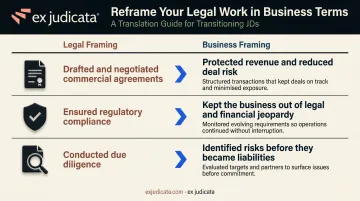
The table below shows how this reframing looks across common legal tasks:
| Legal framing | Business framing |
|---|---|
| "Secured favorable indemnification terms" | "Structured the agreement to cap our liability at $2M, protecting $6M in potential exposure" |
| "Advised on regulatory compliance" | "Built a compliance program that kept us out of a regulatory action that cost a competitor $1.2M in fines" |
| "Reviewed 300 documents in due diligence" | "Identified a material risk in diligence that led to a 15% price reduction — saving $3M on the acquisition" |
Business Acumen Interview Questions Lawyers Should Prepare For
These questions come up consistently in interviews for business development, operations, compliance, strategy, risk, and general management roles. Each one is an opportunity to deploy the translation layer described above.
"Tell me about a time you identified and managed a significant risk. What was the business impact?"
Why it's asked: Employers want to see you think about risk in terms of business consequences — financial, operational, reputational — not just legal liability. A purely legal answer won't land.
How to answer it: Use the STAR method, but pay close attention to Result. Structure your answer to include:
- The business context (what was at stake for the organization)
- The risk you identified and how you spotted it
- The decision or recommendation you made
- A measurable outcome — expressed in dollars, time, operational continuity, or avoided cost
Avoid ending at the legal conclusion. "I flagged the clause" is not a complete answer. "I flagged the clause, recommended a restructure, and we closed the deal on terms that reduced our exposure by $2M" is.
"How do you approach a situation where you need to influence a decision but don't have formal authority?"
Why it's asked: Nonlegal roles depend on lateral influence — working across functions without a hierarchy to enforce decisions. Interviewers are checking whether a lawyer can operate outside a command-and-control structure.
How to answer it: Draw on a real example of persuading a client, executive, or counterparty. Then reframe it using business collaboration language:
- Aligning stakeholders around a shared goal
- Presenting data-backed recommendations rather than legal opinions
- Building cross-functional consensus rather than issuing legal directives
The instinct to say "I convinced opposing counsel to accept our terms" is fine as raw material. The translation is: "I built alignment with a counterparty on a complex deal by identifying the underlying interest driving their position and proposing a structure that addressed it — which got us to close without litigation."
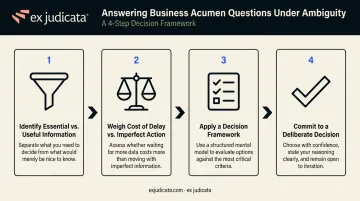
"Describe a time you had to make a decision with incomplete information. How did you weigh your options?"
Why it's asked: Business environments rarely offer the complete record lawyers are trained to compile. Interviewers want to see comfort with ambiguity and pragmatic judgment — two qualities that don't always come naturally to lawyers conditioned to build airtight records.
How to answer it: Acknowledge your instinct for thoroughness — then demonstrate you can identify the threshold of "sufficient" information and move forward. Structure your thinking around three questions:
- What information was essential versus merely useful?
- What was the cost of delay compared to the cost of acting on imperfect data?
- What framework did you apply to make the call?
Show you made a deliberate decision — not a paralyzed one.
"How do you stay informed about market trends and industry changes relevant to this business?"
Why it's asked: Many hiring managers worry that lawyers are deep in doctrine but disconnected from market dynamics. This question surfaces whether you engage with the broader business environment on your own initiative.
How to answer it: Prepare a specific, credible answer that references:
- Industry publications or data sources relevant to the target employer's sector
- Professional communities or networks where you follow business developments
- How you connect external trends to business implications — not just regulatory changes
Vague answers ("I read the news") signal exactly what the interviewer fears. Specific answers ("I follow [publication] and have been tracking [trend] because it directly affects [business issue relevant to this company]") demonstrate genuine business orientation.
"Can you give an example of how you've contributed to revenue growth, cost savings, or operational efficiency?"
Why it's asked: This is often the hardest question for lawyers. Legal work is typically framed as cost management or risk avoidance — not value creation. The question cuts to the core of whether you think like a business contributor.
How to answer it: Reframe legal contributions in business value terms:
- A deal that closed because of your contract structure → quantify what the deal was worth
- A compliance program that avoided a regulatory fine → cite the fine that was avoided
- A process you streamlined that reduced attorney review time → convert that to dollar cost or hours saved
- A negotiation outcome that improved business terms → express the value of the improvement
If you've never had P&L ownership, that's fine — but you need to demonstrate awareness of the business value your legal work created, even indirectly.
Interview Frameworks Lawyers Should Know
The 30-60-90 Day Plan
For mid-to-senior roles, some employers expect you to articulate what you'll accomplish in your first 30, 60, and 90 days. Harvard Business School's guidance on first-90-day transitions treats this as learning the organization, aligning expectations, building relationships, and establishing priorities.
For a JD transitioning to a business role, a strong 30-60-90 structure looks like:
- Days 1-30: Learn the business model, key stakeholders, current risks, and where your legal background is immediately useful
- Days 31-60: Identify a quick win within your expertise — a process gap, a risk you can address, a relationship you can build
- Days 61-90: Articulate a longer-term contribution goal tied to the organization's strategic priorities
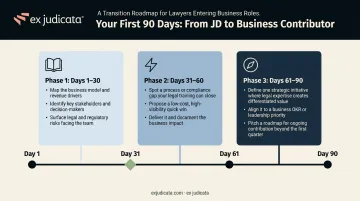
Even if the employer doesn't ask directly, volunteering a structured 30-60-90 shows you've thought beyond the interview — and that you already understand how the role creates value.
The 80/20 Rule in Interview Preparation
Trying to prepare for every conceivable question is a poor use of preparation time. A more effective approach: craft two or three polished, business-framed stories from your legal career that can flex across multiple question types.
A story about managing a high-stakes regulatory investigation can answer risk questions, ambiguity questions, and influencing-without-authority questions — depending on how you frame the emphasis. Building flexible stories is more valuable than rehearsing rigid scripts.
The 5 C's of Interview Delivery
Once your stories are built, how you deliver them matters just as much. A practical framework: Clear, Concise, Confident, Compelling, and Credible.
Lawyers typically score high on credible and clear. The gaps are usually concise and compelling. Legal communication is trained toward exhaustive coverage — which works in a brief, not in a 90-second interview answer.
Consciously practice:
- Cutting your answers by half before you speak
- Leading with the outcome, not the context
- Using narrative structure (situation → decision → result) rather than procedural recaps
How to Prepare for Business Acumen Interviews as a Lawyer
Build Your Business Vocabulary
Before the interview, study the target industry's key metrics and be able to speak to how your legal work intersected with them:
- EBITDA — earnings before interest, taxes, depreciation, and amortization; a standard measure of operating performance that comes up constantly in M&A and investor discussions
- Gross margin — revenue retained after direct production costs; different from operating or net margin, and a signal of pricing power
- Customer acquisition cost (CAC) — especially relevant in recurring-revenue or subscription businesses
- Churn rate — the percentage of customers or subscribers who leave during a defined period
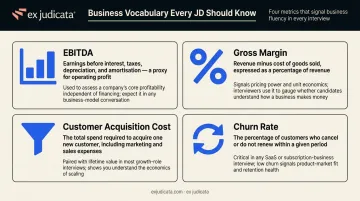
Your research should go beyond what the company does. It should include how the company makes money, what its margin pressures are, and what strategic challenges it's navigating. That context turns generic interview answers into specific, credible ones.
Practice STAR with Business Results
The STAR method (Situation, Task, Action, Result) is well-established for behavioral interviews. The critical adjustment for lawyers: most instinctively end their stories at the legal conclusion — contract signed, case settled, risk flagged — without articulating the downstream business value.
Force yourself to answer: What happened to the business because of what you did? That's the Result that matters.
Connect with JDs Who've Already Made the Transition
The fastest way to prepare for these interviews is to talk to someone who's been through one. JDs who've already moved into nonlegal business roles can tell you what questions actually came up, how interviewers reacted to legal backgrounds, and which framings resonated — and which fell flat.
The EXJ Community at Ex Judicata is a peer-to-peer network built specifically for this purpose: connecting lawyers exploring the transition with non-practicing JDs who've already made it. Peer insight is hard to replicate — but structured preparation helps too.
Ex Judicata offers courses designed for lawyers preparing for nonlegal careers, including a Financial Fluency for Lawyers course that covers the business vocabulary and financial concepts hiring managers expect, and a Data Analytics primer focused on evidence-based decision-making and communicating data insights as business recommendations.
Frequently Asked Questions
How do lawyers demonstrate business acumen in an interview?
Translate your legal experience into business language — framing risk assessment, negotiation, and stakeholder persuasion as business competencies. Every answer should end with a measurable business outcome: financial exposure avoided, deal value protected, cost savings generated, or operational efficiency created.
What is the 30-60-90 rule in an interview for lawyers?
The 30-60-90 day plan outlines what you'll learn, deliver, and build in your first 30, 60, and 90 days in a role. When employers ask for it — or when you volunteer it — it signals strategic thinking and genuine preparation beyond the job description.
What are the 5 C's of an interview for lawyers?
The five C's are Clear, Concise, Confident, Compelling, and Credible. Lawyers tend to land well on credibility and clarity — but conciseness and storytelling take deliberate work. Legal training optimizes for exhaustive coverage, which actively works against you in an interview room.
What is the 80/20 rule for interviews for lawyers?
Focus your preparation on two or three polished, business-framed career stories that can flex across multiple question types — rather than building a separate answer for every possible question.
What is the biggest mistake lawyers make when answering business acumen interview questions?
Answering in legal terms instead of business terms. The most common failure is ending a story at the legal conclusion — deal closed, risk avoided — without explaining the actual business impact that followed. That's where interviewers lose confidence in a candidate's business orientation.