

The MBA question comes up constantly among lawyers considering a pivot. And the honest answer is: it depends on exactly where you're trying to go. For some destinations, an MBA from a target school is genuinely a near-requirement. For most nonlegal business roles, it isn't—and buying an MBA to figure out what you want is one of the most expensive ways to defer a decision you could make right now.
This article breaks down what an MBA actually gives you, what it costs in full, and a clear framework for deciding whether it fits your specific target—not just a general assumption about business credibility.
Key Takeaways
- An MBA unlocks specific roles—investment banking, strategy consulting, private equity—but is not required for most lawyers pivoting to business
- Lawyers already hold core MBA-taught skills: analytical thinking, negotiation, risk assessment, and written communication
- The total cost (tuition + lost income + existing law school debt) can easily exceed $300,000
- Many high-demand nonlegal roles—compliance, legal operations, business development, policy—do not require an MBA
- Define your specific target role first; only then does the MBA question have a meaningful answer
What Lawyers Actually Gain from an MBA
The core value of an MBA for a lawyer isn't intelligence—it's business fluency. Legal training largely skips the formal vocabulary of finance, marketing, operations, and strategy. If your target role involves reading P&Ls, making capital allocation decisions, or owning a go-to-market plan, that gap is real.
An MBA delivers four distinct things. They're not equally valuable for every lawyer, so it's worth knowing what you're actually buying:
Business Knowledge
Finance, accounting, operations, strategy—the curriculum covers ground that law school doesn't. Markus Hartmann, featured in Ex Judicata's "If I Leave the Law" webinar series, put it plainly: he pursued his MBA specifically to "understand the language of business" and speak credibly to internal clients about P&Ls and cash-flow statements. His goal wasn't a consulting firm pipeline. It was functional fluency.
For lawyers without any business or finance background, this knowledge gap is real. If you're heading into a role where financial literacy is table stakes, filling it before you arrive matters.
Credential Signaling and Recruiting Pipelines
In certain industries, the MBA from a target school isn't about what you learn. It's a filter. Goldman Sachs, JPMorgan, and KKR publish structured MBA associate programs. BCG runs school-specific on-campus MBA recruiting. If your destination is bulge-bracket banking, MBB consulting, or some private equity firms, the MBA credential grants access to pipelines that are structurally difficult to enter otherwise.
McKinsey, Bain, and BCG all explicitly recruit JDs through separate advanced-degree hiring tracks. If consulting is the destination, an MBA opens one door. A JD-specific recruiting track opens another. Which one you pursue depends on timing, cost, and how committed you are to a two-year detour.
Network Access
MBA cohorts create cross-industry relationships that most lawyers never build in practice. This network effect is concrete and often undervalued, but program caliber shapes it dramatically. A top-ten program's alumni network spans industries and geographies in ways a regional school's simply doesn't. If you're targeting finance or strategy roles in competitive markets, the strength of that network is often what makes introductions possible in the first place—not just your credentials on paper.
A Credible Signal of Intent
For skeptical hiring managers who see a JD applicant for a business role, an MBA sends a clear message: this career switch is intentional and serious. It's a way of showing your work on the pivot. That friction-reduction has real value, particularly in organizations without a history of hiring lawyers into business roles. Without the MBA, you're asking the hiring manager to make a bet most of their peers haven't made before. The degree doesn't eliminate that skepticism, but it significantly lowers the bar.
The Real Costs: Time, Money, and Opportunity
Before deciding anything, you need the full financial picture—not just tuition.
Tuition Alone Is Only the Start
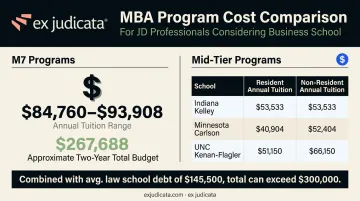
Published 2026–27 annual tuition at M7 programs runs from $84,760 to $93,908. When you factor in living expenses, the five M7 schools publishing comparable annual budgets average $133,844 per year—meaning a two-year program at those costs totals roughly $267,688 before any aid.
Mid-tier programs are cheaper but still significant:
| Program | Annual Resident Tuition | Annual Non-Resident Tuition |
|---|---|---|
| Indiana Kelley | $29,573 | $55,695 |
| Minnesota Carlson | $47,640 | $62,280 |
| UNC Kenan-Flagler | $55,416 | $74,138 |
The Law School Debt Reality
Most lawyers considering this already carry student loans. NCES data shows indebted law-degree completers averaged $145,500 in cumulative borrowing (2015–16 figures—the most recent comparable national data). Stack that against even the lower end of M7 tuition, and combined education debt crosses $300,000 quickly.
That number is worth calculating for your specific situation before you apply anywhere.
Two Years Is the Other Cost
A full-time MBA pulls you out of the workforce for two years at exactly the moment when a direct pivot might already be achievable. A part-time or executive MBA preserves income but can stretch three to four years—which is a long time to remain in a job you're trying to leave.
Meanwhile, peers who pivot directly are gaining two-plus years of experience in their new field, building relevant track records, and often earning competitive salaries. MIT Sloan's Class of 2024 reported median post-MBA base salaries of $190,000 in consulting and $170,000 in finance—compelling figures, but compare them against starting salaries in your specific target role before assuming the two-year delay pays off.
When an MBA Is Genuinely Worth It for Lawyers
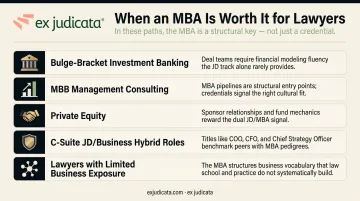
The MBA makes sense for lawyers in specific situations — and in those situations, it makes a strong case. Here's where the credential genuinely moves the needle:
- Bulge-bracket investment banking: Goldman, JPMorgan, and peers run structured MBA associate programs. Getting in without one is possible but harder to navigate structurally.
- MBB management consulting: McKinsey, Bain, and BCG all have on-campus MBA recruiting and Summer Consultant programs for MBAs. They also recruit JDs through advanced-degree tracks—but the MBA pipeline is broader and more structured.
- Some private equity roles: KKR runs a formal MBA internship program, and at many mid-size and large PE firms, an MBA is the expected credential for associate-level entry. Recruiting varies by firm, but the pattern holds widely.
- C-suite roles at the JD/business intersection: For lawyers targeting positions like Chief Legal and Strategy Officer or corporate development at regulated companies, the JD + MBA combination can be a genuine differentiator — not redundancy.
- Lawyers with limited business exposure: If you spent a decade in immigration, criminal defense, or family law with no corporate or client-development experience, the MBA's network and career services infrastructure may be your fastest path to building business credibility.
Geography adds another layer. In New York finance and Chicago private equity, the MBA functions as a cultural passport — firms expect it not because of what you learned, but because of the recruiting pipeline and peer cohort it signals you came through. Knowing whether your target market operates that way is part of making the call.
When an MBA Probably Isn't Necessary
This category is larger than most lawyers assume.
NALP's 2025 JD Advantage Career Guide explicitly identifies roles where bar passage isn't required but legal education provides an advantage—and where MBA requirements are absent entirely:
- Compliance and regulatory affairs (Compliance Specialist, Ethics and Compliance Officer, Chief Compliance Officer)
- Legal operations
- Government and policy roles
- Business development at law-adjacent companies (legaltech, insurance, financial services)
- Corporate affairs and nonprofit leadership
In these roles, the JD is the differentiator. Lawyers bring analytical rigor, risk assessment, written communication, and negotiation—skills that business teams actively want and that complement, rather than duplicate, existing team capabilities.
Ex Judicata's EXJ Interview Series makes this pattern concrete:
- Waleed Diab (former practicing attorney) became Director and Global Head of Recorded Music Business Development at YouTube — no MBA involved
- John Scannell moved from Skadden and Cadwalader to co-founding Hildene Capital Management, serving simultaneously as COO, General Counsel, and CCO
- Alexander Su went from Sullivan & Cromwell to Chief Revenue Officer at Latitude, building on his JD without a graduate business degree
The pattern is consistent: for lawyers with strong firm or in-house training, the JD translates to business roles directly. Intentional positioning and a clear entry point matter more than an additional degree.
Alternatives to an MBA for Lawyers Transitioning to Business
If the specific knowledge gap is the problem, there are targeted ways to close it without two years and $150,000+.
Targeted Credentials and Courses
- CFA: Total exam fees of approximately $3,520–$4,600 across three levels, though requires 3–4 years and significant study hours
- PMP (operations/project management): $405–$655 for the exam, with 35 training hours required
- HBS Program for Leadership Development: $57,000 for a blended six-month executive program—expensive, but a fraction of a full MBA
- Financial Fluency for Lawyers through Ex Judicata: A CLE-eligible, three-hour course taught by Notre Dame Law Professor Matthew J. Barrett, focused on the P&L and financial statement literacy that lawyers entering business roles most often lack
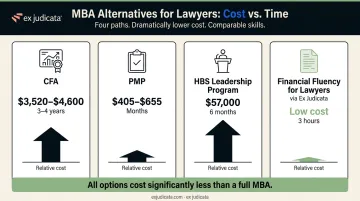
Credentials aren't the only path. In many cases, they're not even the fastest one.
The Direct Application Strategy
Lawyers underestimate how far a strong resume, a well-articulated pivot narrative, and strategic networking can carry them. Board service, fractional roles, consulting projects, or advisory positions in your target industry can demonstrate business capability more concretely than a degree—and build a track record that hiring managers can evaluate directly.
Ex Judicata as a Starting Point
Before committing to any credential investment, Ex Judicata's platform is designed specifically for this decision point. The EXJ Career Diagnostic ($25.95) maps attorney traits to business career paths. The Career Corner connects lawyers with vetted coaching specialists who work on pivot narratives, resume repositioning, and strategic networking. The EXJ Community puts you in contact with lawyers who have already made the pivot—across roles, industries, and credential backgrounds—so you can get real intelligence on what actually mattered in their transitions.
For most lawyers at this decision point, that's the right place to start: low cost, fast, and grounded in what's actually worked for people who've already made the move.
How to Decide: A Framework for Lawyers
Three questions narrow this decision considerably:
- What specific role and industry am I targeting? Not "business" or "finance"—a specific job title and sector.
- Does that field use the MBA as a hard filter, or as a nice-to-have? This requires actual research, not assumption.
- Can I build the credential, network, and skills that role requires through a faster or less expensive path?
The research step is non-negotiable. For each target role, do the following:
- Search LinkedIn profiles of people currently in that position and check how many hold MBAs
- Identify whether JDs reached the same role without one
- Talk directly to practitioners and ask whether the MBA is common, expected, or rare
If that research hasn't happened yet, you're not ready to answer questions two and three. An MBA bought to figure out what you want is the most expensive possible way to defer that question—and one of the most common mistakes lawyers make in this process.
Get specific about the destination first. Once you know the role and have talked to people who hold it, the credential question usually answers itself.
Frequently Asked Questions
Frequently Asked Questions
Who makes more money, an MBA or a JD?
It depends on industry and role. MIT Sloan's Class of 2024 reported $190,000 median in consulting and $170,000 in finance; NALP data shows first-year BigLaw associates earn a $200,000 median base. For lawyers pivoting to business, the target role matters far more than the credential.
Is 33 too old for an MBA?
No—the average age in EMBA-Global's Class of 2023 was 36, with a range of 28–49. For lawyers with 5–10 years of experience, 33 is well within the typical range for both full-time and executive programs. ROI timeline and target role matter more than age.
Is an MBA worth it if I already have a JD?
It depends entirely on your target career path. The JD + MBA combination is most valuable when the destination genuinely requires both credentials. For most nonlegal business pivots, a JD combined with relevant experience and deliberate positioning is sufficient—and the ROI on adding an MBA is harder to justify.
What careers can lawyers transition to without an MBA?
High-demand options include compliance, legal operations, policy and government affairs, business development, corporate strategy at companies that value legal backgrounds, and nonprofit leadership. NALP explicitly categorizes these as JD-advantage roles, and organizations increasingly recruit lawyers specifically because of JD-derived skills.
Can a lawyer get an MBA without taking the GMAT?
Yes—more than 1,300 business schools accept GRE scores, and Harvard Business School reports that 44% of its Class of 2027 submitted GRE scores. Programs including Georgetown, UVA Darden, and UNC also offer standardized test waivers for applicants with significant professional experience, which most practicing lawyers qualify for.