

Directors with legal backgrounds are increasingly sought after as regulatory complexity, cybersecurity exposure, and ESG accountability reshape what boards actually need. This isn't a trend reserved for retired judges or former general counsels. JDs at various career stages are landing board seats, earning meaningful compensation, and exercising strategic influence that looks nothing like the daily grind of legal practice.
This guide covers why boards want JDs, the specific skills that translate, how to match your background to the right type of board, and the practical steps to build a board-ready profile — including the ethical risks that attorney-directors must manage proactively.
Key Takeaways
- Board service offers strategic influence and real compensation — without full-time legal hours
- JDs are valued for issue-spotting, risk analysis, and regulatory fluency — but must lead as directors, not as in-house counsel
- Nonprofit and private company boards are accessible entry points; public company boards demand deeper business credentials
- Building a board-ready profile takes years of intentional preparation, not a last-minute pivot
- Ethical risks like privilege confusion, insurance gaps, and conflicts of interest require active management from day one
Why Attorneys Are Increasingly Sought After for Board Seats
The data on this is older but striking. Research published through Cornell Law found that among S&P Composite 1500 nonfinancial companies, boards with at least one JD-credentialed director rose from 24.5% in 2000 to 47.5% by 2005. In banking, the shift was even more pronounced — boards with a lawyer-director climbed from 43% in 1999 to roughly 77% by 2014.
What's driving continued demand:
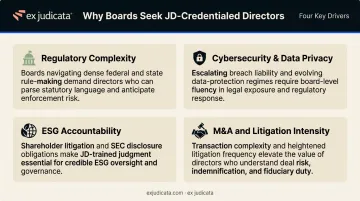
- Regulatory complexity — companies in financial services, energy, and healthcare face layered oversight that most business executives can't fully navigate alone
- Cybersecurity and data privacy — boards need directors who understand regulatory exposure, not just technical risk
- ESG accountability — disclosure obligations and stakeholder scrutiny have made governance fluency more commercially valuable
- M&A and litigation intensity — companies navigating acquisitions or significant legal disputes actively seek directors who can read a situation the lawyers in the room are describing
The Cornell study defines "lawyer-director" by JD credential, not by current practice status — and that distinction matters. Boards typically care more about the analytical mindset a legal education produces than whether someone is actively billing hours. A JD who spent fifteen years in corporate development is often a stronger candidate than a current practitioner: the business context is already there, and so is the legal literacy.
The JD Skill Set That Boards Value Most
Legal training produces a specific cognitive toolkit. In a boardroom context, several of these capabilities translate directly.
Issue Spotting and Analytical Rigor
Lawyers are trained to find what's missing or problematic in a document, a proposal, or a financial summary. The ability to raise the question no one else thought to ask is genuinely rare at the board level — and it's frequently what separates a meaningful director from a passive one.
Risk and Regulatory Fluency
JDs with backgrounds in regulated industries, government, or compliance bring a working understanding of legal exposure that most business executives develop only through painful experience. Cybersecurity, employment law, M&A integration, and ESG reporting are all areas where boards face growing scrutiny — and where that fluency pays off immediately.
Negotiation and Contract Literacy
Board members regularly evaluate deals, executive compensation arrangements, and partnership agreements. A JD who can actually read the agreement — not just the summary — and identify problematic terms provides immediate, practical value that non-lawyer directors can't replicate.
Governance and Fiduciary Duty Familiarity
Concepts like duty of care and duty of loyalty aren't abstractions to attorneys — they're professional vocabulary. That fluency shortens the learning curve and lets JD-directors contribute from day one, rather than spending early board time catching up on doctrine.
The critical caveat: None of this matters if you arrive at the boardroom table thinking like a lawyer. Boards want business judgment, not legal opinions. The most important transition an attorney-director must make is learning to lead with strategic judgment rather than liability analysis — and many JDs underestimate how difficult that actually is.
Types of Boards: Matching Your Background to the Right Opportunity
Not all board seats are created equal. The right starting point depends on your experience, your professional stage, and what you're realistically qualified to offer.
Public Company Boards
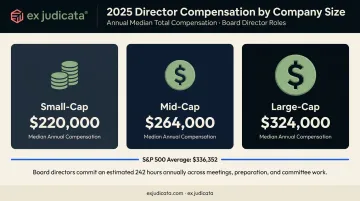
These are the most visible, most compensated, and most demanding. According to the 2025 FW Cook Director Compensation Report, median total director compensation runs $220,000 at small-cap companies, $264,000 at mid-cap, and $324,000 at large-cap. Spencer Stuart's 2025 data puts the S&P 500 average at $336,352.
The tradeoff: public-company directors averaged 242 hours annually in Spencer Stuart's 2024 survey. Independence requirements are strict, committee obligations are real, and pre-meeting document packages can run hundreds of pages.
Best suited for JDs with deep financial literacy, industry-specific experience, and a track record that goes well beyond legal expertise alone.
Private Company and PE-Backed Boards
These boards are more operationally hands-on than their public counterparts. Directors often engage directly with management on strategy and execution — a dynamic that suits JDs comfortable moving beyond pure legal counsel.
JDs with practical experience in any of the following areas tend to be strong candidates:
- M&A advisory and deal structuring
- Compliance infrastructure and regulatory risk
- Crisis management and internal investigations
Conflicts of interest that can complicate firm-partner participation are less of an issue here. Compensation varies widely but runs lower than public board equivalents.
Nonprofit Boards
Typically unpaid. Often underestimated.
Nonprofit board service is where most serious board careers begin. The governance experience you build here translates directly to for-profit board candidacy:
- Audit committee oversight
- Capital campaign leadership
- Executive hiring and succession planning
Choose organizations whose mission you genuinely care about. Boards can tell when someone is there for the credential rather than the cause — and that distinction affects how much real governance responsibility you'll actually be given.
How to Build a Board-Ready Profile as a JD
Reframe Your Professional Narrative
The most common mistake JDs make is submitting a lawyer's CV when pursuing a board seat. Boards don't care that you made partner or clerked for a federal judge. They want to know about:
- Crisis management you led or participated in
- Budget or P&L responsibility you held
- Enterprise risk decisions you influenced
- Strategic initiatives you shaped
NACD recommends a two-to-three-page board resume that centers governance readiness and business impact — not credentials and casework. Build that document now, even if you're years away from actively pursuing seats.
Close the Financial Literacy Gap
No single skill gap holds more JDs back from board readiness than limited fluency in finance and operations. You don't need to become a CFO, but you do need to read financial statements with confidence, understand P&L dynamics, and engage with company strategy on its own terms — not just through a risk lens.
That gap is addressable. Ex Judicata's Financial Fluency for Lawyers course covers financial concepts specifically for attorneys navigating business environments — and it's CLE-eligible, so it fits into a practicing lawyer's schedule without friction.
Network With Intention
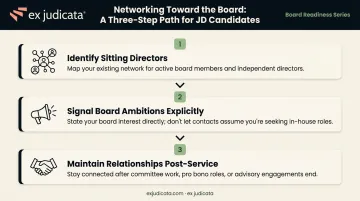
Most board seats are filled through relationships. Not applications. The path typically runs through:
- Identifying sitting directors in your network or extended network
- Signaling your board ambitions explicitly — most people assume you're still focused on legal practice unless you say otherwise
- Maintaining those board relationships even after service ends — alumni networks matter more than most candidates expect
For women lawyers specifically, DirectWomen offers a structured Board Institute program. Nearly 40% of alumnae have obtained at least one corporate board seat, with alumnae collectively serving on 220+ corporate boards.
Roles like Chief Compliance Officer, Chief Risk Officer, Board Secretary, and ESG leadership aren't just strong career moves — they're the kind of operational experience that makes a board CV credible. Ex Judicata Search places JDs into exactly these positions, sitting at the nexus of legal search and executive search.
Start with Starter Boards
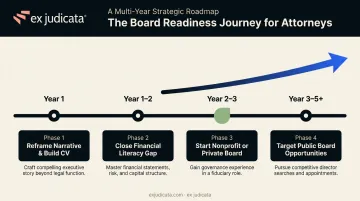
Pursue a nonprofit or private company board seat before targeting public boards. The governance experience you gain — running a committee, navigating a difficult executive transition, overseeing an audit — becomes the evidence base you cite when approaching larger opportunities.
Choose organizations you actually care about. Authentic engagement produces real governance experience — and search committees can tell the difference.
Plan Early and Be Patient
The timeline from active pursuit to first board seat is typically 18 months to several years — and that's assuming a well-organized campaign. JDs in their 30s and 40s who want a meaningful board career by their 50s or 60s should start building the narrative, the network, and the financial literacy now.
Board candidacy is not something you prepare for six months before you want a seat.
Risks and Ethical Considerations Unique to Attorney-Directors
Board service carries real legal and professional responsibility risks that non-attorney directors don't face in the same way. JDs need to manage these proactively.
Role Confusion and the Privilege Trap
When an attorney on a board begins offering legal opinions — even casually, even informally — they may inadvertently create an attorney-client relationship. ABA Model Rule 1.7 Comment 35 specifically warns that discussions held while a lawyer is present in a director capacity may not be protected by attorney-client privilege.
The practical implication: be explicit about which hat you're wearing, every time. If you're offering a legal opinion, say so — and make sure meeting minutes reflect the distinction accurately. When in doubt, treat it as legal advice and document it accordingly.
Insurance Coverage Gaps
D&O insurance covers directors acting as directors. Lawyers' professional liability coverage covers attorneys acting as counsel. An attorney-director who blurs those roles may find neither policy responds to a claim against them.
Before accepting any board appointment, audit both policies. Understand precisely what each covers and where the gaps are. This isn't hypothetical — the ABA has documented that professional-services exclusions can specifically bar D&O coverage under certain policy language.
Conflicts of Interest
Attorney-directors face two overlapping conflict frameworks: the standard business conflicts that apply to all board members, and the additional layer of professional responsibility obligations under ABA Model Rules. Rule 1.7 on concurrent conflicts is the primary concern — Ohio Opinion 2008-2 held that a lawyer-director representing a client suing that same corporation faced a nonconsentable conflict, one that was imputed to the entire firm.

Attorneys at law firms face particular scrutiny here. Most firms have formal approval processes for partner board service, and that scrutiny exists for good reason.
Fiduciary Liability and Reputational Risk
Board members are accountable for the materials they receive, including extensive pre-meeting document packages. Delaware's Smith v. Van Gorkom decision remains the cautionary example: a board that included directors with legal backgrounds was found to have breached its duty of care by approving a major transaction after only two hours of consideration, without a written agreement summary or supporting valuation.
Legal training does not substitute for an informed board process. Your professional reputation also becomes publicly tied to every board you join — and in a small professional world, one troubled company can follow a name for years.
Frequently Asked Questions
Can a lawyer serve on a board of directors?
Yes. Lawyers can and do serve on boards at public companies, private firms, and nonprofits. No ABA Model Rule categorically prohibits it, though law firms typically have internal approval processes for partner board service, and professional responsibility considerations apply throughout.
Do lawyers get paid for serving on a board of directors?
Compensation depends on the board type. Public company directors receive meaningful cash and equity packages — median total compensation ranges from $220,000 at small-cap companies to over $336,000 at large S&P 500 companies. Nonprofit boards are typically unpaid.
What skills do JDs bring to a board of directors?
Issue spotting, regulatory fluency, risk analysis, negotiation experience, and familiarity with fiduciary duties are the strongest JD contributions. Boards value these skills most when deployed through a business lens — strategic judgment, not legal advice.
What is the difference between serving on a nonprofit board versus a for-profit corporate board?
Nonprofit boards are generally unpaid and more hands-on, often involving direct operational support for the organization. For-profit boards — especially public companies — offer compensation and focus on strategic oversight rather than execution.
Can a non-practicing lawyer serve on a corporate board?
Yes. The research tracking JD prevalence on boards counts directors by credential, not by current practice status. Many companies value the analytical and business skills a legal education produces regardless of whether the person is actively practicing law.
How long does it take to land a first board seat?
Typically 18 months to several years from the start of an active, organized pursuit. The process is nonlinear, relies heavily on relationships, and rewards candidates who built relevant experience and governance credentials well before they want to serve.