

Key Takeaways
- Your LinkedIn headline is the single biggest mistake most transitioning JDs make — fix it first
- Translate legal skills into business language recruiters actually search for
- Build a non-legal network deliberately, not passively
- A consistent content strategy reshapes how recruiters see you — usually within 60–90 days
- Ex Judicata's Career Corner matches you with vetted specialists in JD-to-nonlegal career pivots
Why LinkedIn Is Your Most Powerful Tool When Leaving Law
Leaving law creates an immediate identity problem on LinkedIn. Your profile announces "Attorney at [Firm Name]" to every recruiter who lands on it — which is exactly the wrong first impression when you're targeting compliance, corporate strategy, nonprofit leadership, or government roles.
This matters because LinkedIn is where hiring decisions begin. Employ's 2024 survey of more than 1,200 North American recruiters found that 71% currently use or plan to use LinkedIn for recruiting — meaning an untouched lawyer profile can quietly disqualify you before you ever submit an application.
That statistic makes the stakes concrete. Your legal background is genuinely valuable to employers in business, nonprofits, government, and academia — but only if your profile translates it into terms they recognize. What follows is about doing exactly that.
Start with Your Visual Identity and Profile Basics
Photo and Banner
Your profile photo should reflect where you're going, not where you've been. Courtroom-formal attire signals one world; business-casual or industry-appropriate dress signals another. Use a clean, well-lit background and a direct, approachable expression. The banner image is often ignored — don't ignore it. A simple, professional graphic aligned with your target industry (or a neutral, polished image) reinforces the new direction before anyone reads a word.
Custom URL
Set a custom LinkedIn URL at linkedin.com/in/firstnamelastname. It takes two minutes through LinkedIn's profile settings, and it signals digital awareness to non-legal recruiters who will notice the difference between a clean link and a string of random numbers.
Open to Work — Use It Carefully
Once your URL is set, the next visibility decision is LinkedIn's "Open to Work" feature, which has two modes:
- All LinkedIn members — adds the green photo frame, visible to everyone including colleagues at your current firm
- Recruiters only — limits visibility to LinkedIn Recruiter users
If you're still employed, use the recruiter-only setting. LinkedIn attempts to hide this from recruiters at your current employer, though it explicitly states that complete privacy isn't guaranteed — so use it knowing discretion is likely but not absolute.
Craft a Headline and About Section That Tell Your Transition Story
The Headline Problem
Defaulting to "Attorney at [Firm Name]" is the most common — and most costly — mistake transitioning lawyers make on LinkedIn. It anchors every recruiter's first impression to the role you're leaving.
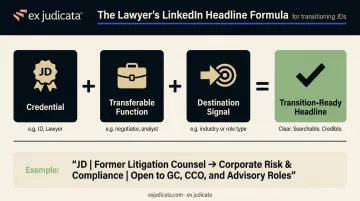
A transition-ready headline names both your background and your direction. Some formats that work:
JD | Risk & Compliance Professional | Transitioning to Corporate StrategyFormer BigLaw Associate | Regulatory Affairs & Policy | Seeking Operations LeadershipJD | Contract Strategy | Moving from Litigation to Business Development
Each example combines credential + transferable function + destination signal — all three together tell a non-legal recruiter exactly how to place you.
Rewriting Your About Section
A legal bio reads in third person, lists practice areas, and describes case outcomes. A transition narrative is built for a different reader entirely — one who doesn't know legal titles and isn't looking for them.
Your About section needs to answer four things:
- Who you are — not your title, your professional identity and direction
- What you did in law — summarized, not exhaustive
- What skills you built — in business language, not legalese
- What you're seeking — specific enough to be actionable
Write in first person. Speak the language of your target field. If you're moving into healthcare administration, your About section should read like it belongs in that world, not like a bar association profile.
The First Two Lines Are Everything
That four-part structure above only works if readers get past the first two lines. Whatever appears before LinkedIn's "See more" on desktop functions like a subject line, and most visitors won't click through unless the opening earns it. Lead with where you're heading, not where you've been.
Close with a Call to Action
End your About section with a specific next step: an invitation to connect, a link to a portfolio or publication, or a note that you're open to conversations in a particular field. Give recruiters and hiring managers somewhere to go.
Ex Judicata's Career Corner includes vetted CV and LinkedIn specialists who focus on helping JDs reposition for non-legal roles — a practical option if you want expert eyes on your transition narrative before it goes live.
Reframe Your Legal Experience for Non-Legal Employers
The Core Mindset Shift
Your Experience section shouldn't read like a legal résumé. Non-legal hiring managers don't search for "motion practice" or "legal research" — they search for risk management, regulatory compliance, negotiation, stakeholder communication, and strategic analysis.
LinkedIn's skills-first research, drawing on anonymized data from more than 900 million members, found that matching by skills rather than prior titles substantially expands talent pools. That's good news for transitioning JDs — but only if your profile speaks the right language.
Before-and-After Rewrites
Here's what translation looks like in practice:
| Original (Legal) | Rewritten (Business-Facing) |
|---|---|
| "Drafted and negotiated commercial contracts" | "Led contract strategy and risk mitigation for deals valued at $X, partnering cross-functionally with finance and operations teams" |
| "Conducted legal research on regulatory compliance matters" | "Analyzed federal regulatory frameworks and produced strategic guidance adopted by senior leadership to shape business decisions" |
| "Represented indigent clients in criminal proceedings" | "Managed complex, high-stakes advocacy under resource constraints, consistently delivering results through preparation, negotiation, and rapid issue analysis" |
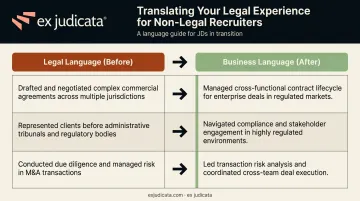
The substance is the same. The framing is entirely different.
What to Keep, Condense, or Drop
- Keep and expand: Non-legal projects, volunteer leadership, board positions, business-adjacent work — give these full descriptions
- Keep but condense: Core legal roles — summarize with transferable outcomes, not practice area lists
- Deprioritize: Positions from 10+ years ago that don't connect to your target; list them without descriptions
- Drop: Accomplishments that have no bridge to where you're going
The Featured Section
Use it to show where you're headed. Visitors to your profile should see your future, not just your past, when they scroll the Featured section. Strong candidates for this section include:
- An article or post you wrote on a business, strategy, or industry topic
- A certification or course completion relevant to your target field
- A conference presentation, panel appearance, or webinar recording
- A project portfolio, case study, or media mention from nonlegal work
Reframing Your JD in Education
The JD isn't just a gateway to bar admission. It signals advanced analytical training, professional rigor, and the demonstrated ability to navigate dense, high-stakes material — qualities that transfer directly to business roles. Frame it that way. And list any business courses, certificates, or continuing education prominently here, not buried in a skills section.
Optimize Your Skills Section and Endorsements
Audit Your Listed Skills
The Skills section affects how you appear in LinkedIn searches. If your top skills include "motion practice," "legal research," or "trial preparation," non-legal recruiters searching for compliance managers or risk analysts won't find you.
Replace hyper-legal terms with transferable equivalents that match what hiring managers in your target field actually search for:
Skills to remove:
- Motion practice
- Legal research
- Litigation
Skills to add:
- Risk management
- Regulatory compliance
- Negotiation
- Strategic analysis
- Stakeholder communication
- Contract management
You're not misrepresenting your background — you're describing it in language your target audience actually uses.
Endorsements That Actually Help
Once your skills list reflects your target field, the right endorsements reinforce it. A former client endorsing "project management" or "business judgment" matters more to a non-legal recruiter than a fellow attorney endorsing "litigation." Reach out proactively to colleagues, clients, or supervisors who can speak to non-legal competencies — and be specific about what you're asking them to validate.
Pin the Right Three Skills
With your endorsements in order, the final step is controlling what a recruiter sees at a glance. LinkedIn lets you pin your top three skills to the most prominent position. Don't pin the three with the most endorsements — pin the three most aligned with your target role. That's what a recruiter in your target field will see first.
Build a Non-Legal Network Strategically
The Problem Most Transitioning Lawyers Face
A career spent in law produces a network that is almost entirely composed of other lawyers. That network has real value — but it won't introduce you to a compliance director at a Fortune 500 company or a VP of operations at a healthcare system. That introduction requires deliberate effort.
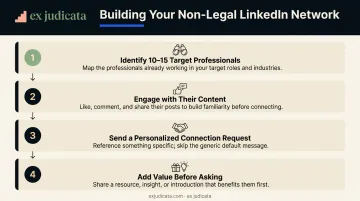
Start by mapping your target field:
- Identify 10–15 professionals in your target industry or role
- Follow their content and engage genuinely with their posts for a few weeks
- Send a personalized connection request that references something specific — a post, an article, a shared background
- After connecting, look for opportunities to add value before asking for anything
A peer-reviewed LinkedIn study involving over 20 million users found that moderately weak ties — connections outside your immediate circle — produced more job mobility than strong ties. For transitioning JDs, that's a research-backed argument for building bridges into new fields, not just deepening existing legal networks.
A lawyer targeting healthcare administration should be active in healthcare executive groups, not just bar association groups. Industry associations, university alumni networks, and professional communities in your target field offer lower-stakes entry points for building visibility — and often surface contacts who are genuinely open to connecting with career changers.
Informational Outreach That Works
The goal of cold outreach is a conversation, not a job. A message that works:
- References something specific (a post they wrote, an article they published, a shared connection or background)
- Asks for 20 minutes, not a favor
- Positions you as genuinely curious about their experience, not just job-hunting
This approach builds real relationships. Referrals follow relationships, not applications — and roughly 1 in 10 referrals leads to a hire, compared to 1 in 50–60 job-board applications.
Ex Judicata's Job Board and EXJ Community offer a direct complement to cold LinkedIn outreach. The EXJ Community's member directory is built specifically for non-practicing lawyers, filterable by industry and career type — so you can find JDs who already made the exact move you're considering and reach out with real context rather than a cold message to a stranger.
Share Content That Signals Your New Career Direction
The Content Paradox
Posting only legal commentary keeps you anchored to the old identity. Posting nothing makes you invisible. The solution is content at the intersection of law and your target field — pieces that validate your JD background while making clear where you're headed.
Useful angles:
- "What lawyers know about contract risk that every operations manager should too"
- "How regulatory analysis shapes better business decisions"
- "Three things I learned from litigation that apply directly to compliance leadership"
These posts establish you as someone whose legal training adds value in business contexts — which is exactly what non-legal hiring managers need to see.
A Sustainable Posting Rhythm
You don't need to post daily. Analysis of over 2 million posts from more than 94,000 LinkedIn accounts found that 2–5 posts per week correlated with stronger reach and engagement.
For someone still employed in law while actively transitioning, one or two thoughtful posts per week is enough — especially when combined with consistent, value-adding comments on posts by professionals in your target field. That combination shifts how your network perceives you over time.
Share Your Transition Milestones
Completing a relevant certification, attending an industry conference, connecting with a mentor in your new field — these are legitimate, strategic things to post about. They make your pivot visible, invite connection from others who've made similar moves, and signal seriousness to recruiters watching your profile.
The 4-1-1 rule gives you a practical structure: for every six pieces of content, share four educational or valuable pieces for your audience, one soft promotion (your own article or milestone), and one direct promotion. Applied to a career transition, this keeps your feed relevant to your target audience while shifting your content identity toward the new direction.
Frequently Asked Questions
Should I keep "Attorney" or "Lawyer" in my LinkedIn headline if I'm transitioning to a nonlegal career?
Your JD can remain visible — in the Education section or briefly noted in the headline itself — but the headline should lead with your target direction. A recruiter in your destination field should immediately understand where you fit, not have to read past your legal title to find out.
How do I explain on LinkedIn that I'm leaving law without burning bridges at my current firm?
Use the "Open to Work" setting on recruiter-only visibility, frame your About section in forward-looking terms without criticizing the profession, and turn off the "Share profile updates with your network" setting in LinkedIn's privacy preferences before making major changes. Edits save silently; it's announcements that broadcast.
What is the 4-1-1 rule on LinkedIn?
For every six pieces of content you share: four should be educational or valuable to others, one should be a soft promotion (your own article or milestone), and one should be a direct promotion. Transitioning lawyers can use this ratio to gradually shift their content identity toward the target field without losing their existing network.
Can ChatGPT improve my LinkedIn profile?
AI tools can help draft your About section, rewrite experience bullets in non-legal language, and brainstorm headline options, but the output needs careful review for accuracy, tone, and authenticity. For transitioning lawyers, having that draft reviewed by someone who understands both legal backgrounds and non-legal hiring — such as the specialists in Ex Judicata's Career Corner — adds a layer of judgment AI can't replicate.
What LinkedIn connections should a lawyer prioritize when switching to a non-legal career?
Focus on professionals already working in your target role or industry, recruiters who specialize in that sector, and fellow JDs who have successfully made the transition. That last group — accessible through Ex Judicata's EXJ Community directory — is especially valuable because they provide both network reach and concrete proof that the path is achievable.
How long does it take to get noticed on LinkedIn when making a career change from law?
Meaningful traction typically builds over 60–90 days of consistent profile optimization, strategic networking, and content engagement. That timeline shortens when your profile is repositioned clearly from day one — a deliberate overhaul aimed at the right audience will always outpace a slow, piecemeal update.