

Introduction
Three or four years into BigLaw, something shifts. You're no longer the associate who gets assigned a task, completes it, and waits for the next one. Partners expect you to own matters. Clients call you directly. Junior associates are asking you questions you used to ask someone else.
Nobody scheduled a training session for any of this.
That gap between what the job demands and what anyone formally prepared you for is the defining experience of the BigLaw midlevel years. It's disorienting in a specific way: you're competent enough that your confusion is invisible, but stretched enough that it starts affecting your work, your energy, and how you think about your future.
This guide has two purposes. The first is to help you navigate the midlevel transition — understanding what's actually changing, where associates thrive versus stall, and what habits separate those who advance from those who plateau.
The second is to give you an honest framework for the question most midlevel associates are already asking themselves: whether BigLaw is still the right place to be.
Key Takeaways
- At the midlevel, the job changes from learning to leading — with no formal training for the gap in between
- Burnout at this stage is structurally driven, not a personal failure — Bloomberg Law found mid- and senior-level associates experience burnout 51% of the time
- Associates who thrive share three habits: ownership of outcomes, proactive communication, and deliberate career reflection
- Years 3–7 are peak marketability for both in-house and nonlegal moves — know what's available even if you're not ready to act
- BigLaw dissatisfaction doesn't require an exit — but it does require an honest look at your options
What Actually Changes When You Become a Midlevel BigLaw Associate
The midlevel title rarely arrives with a formal orientation. There's no ceremony, no transition meeting. One quarter you're a senior junior associate; the next, expectations have recalibrated significantly.
Shifting Responsibilities
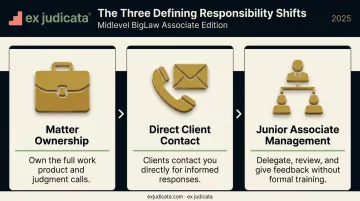
Three changes define the midlevel role:
- Matter ownership: You're no longer drafting sections. You're responsible for the whole work product and the judgment calls embedded in it.
- Direct client contact: Communication is no longer filtered through a senior associate — clients email and call you, expecting informed, prompt responses.
- Junior associate management: You're delegating, reviewing, and giving feedback, often without any formal management training.
Firms handle this tier differently. Dentons, for example, uses a "Managing Associate" title for lawyers in the 4-6 year range, making the elevation explicit. Most firms leave it implicit, which means the responsibility jump is real even when the title change isn't.
The deeper cognitive shift is moving from "how do I complete this?" to "why does this matter?" A junior associate drafts a section of a brief. A midlevel associate understands how that section fits the overall argument — and whether the argument itself is sound. That's the judgment partners are now looking for.
That expanded judgment also changes how you're seen inside the firm.
Navigating Firm Politics and Visibility
Midlevel associates become visible to partners in ways they weren't before. That's mostly good — matter ownership creates opportunities to demonstrate judgment and initiative. But it also means mistakes land differently. A first-year's error gets quietly absorbed. A midlevel associate's error gets noticed, remembered, and sometimes discussed.
A few realities worth acknowledging:
- The partnership track becomes concrete: roughly 1 in 10 associates at Am Law 100 firms make equity partner — a number that motivates some and quietly unsettles others
- Peer dynamics shift: collegial competition starts to reshape relationships in ways that weren't obvious at the junior level
- Organization becomes non-negotiable — managing multiple workstreams, coordinating across practice groups, and supervising junior work requires systems that most junior associates never needed
The Psychological Reality of the Midlevel Transition
Most people enter law with a purpose narrative — justice, intellectual rigor, building something that matters. The midlevel years are when the gap between that narrative and the firm's actual value system becomes hardest to ignore. Billable hours, client economics, internal positioning: these are the metrics that actually govern advancement, and they aren't always aligned with what you thought you were building toward.
Value Dissonance vs. Job Dissatisfaction
These are different problems, and conflating them leads to wrong solutions.
Job dissatisfaction is situational — it's about this firm, this partner, this practice group. A lateral move can fix it.
Value dissonance is structural — you may find the work intellectually engaging and still experience significant psychological cost from the gap between what the firm rewards and what you thought you were building. A lateral move won't fix this. Only clarity about what you actually want will.
Many midlevel associates respond to this tension by unconsciously compartmentalizing: maintaining private idealism while performing professional pragmatism. Without that awareness, the split tends to produce cynicism and early-stage burnout.
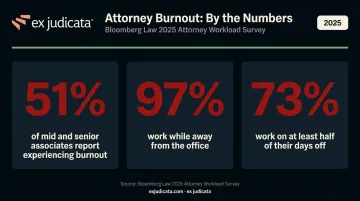
This pattern is structurally driven, not a personal weakness. Bloomberg Law's 2025 Attorney Workload Survey puts numbers to what midlevels already feel:
- Mid- and senior-level associates report burnout 51% of the time, vs. 42% for attorneys overall
- 97% report working while away from the office
- 73% work on at least half their days off
One grounding reframe: the midlevel transition is a developmental crucible for essentially every BigLaw attorney, not a crisis unique to those who ultimately leave. Attorneys who make partner work through the same dissonance. They reach different conclusions about whether the trade-offs are worth it.
How to Navigate the Midlevel Years Successfully
The associates who thrive at the midlevel stage don't wait for ownership to be assigned — they take it.
That means volunteering for the lead role before a partner assigns it, surfacing strategic issues before they're asked, and making their thinking visible — not just their completed work product.
Developing Client and Communication Skills
Direct client contact demands more than legal analysis. The skill set that actually matters here:
- Active listening for unstated goals — clients often say what they want; they rarely say what they need
- Prompt, clear written communication — response time and clarity are themselves signals of competence
- Escalation judgment — knowing when to handle independently versus when to loop in a partner is one of the most cited gaps in midlevel performance reviews, and one of the least formally taught
Managing up requires equal attention. Partners and senior associates are no longer checking in constantly, which means you need to proactively update them, flag problems early, and frame communications in terms of solutions rather than questions. The structure that works: "Here's the issue, here's how I'm thinking about it, here's what I need from you."

Building a Career Identity Within the Firm
Midlevel is the stage to become known for something specific within your practice area — a niche that aligns with both the firm's needs and your own strengths. This isn't about locking yourself in. It's about being recognizable before partnership conversations begin.
Business development groundwork also starts here, earlier than most associates expect:
- Writing for legal publications
- Speaking at industry events in a supporting role
- Cultivating relationships with clients you're already serving
These activities distinguish midlevel associates on a genuine partnership track from those who are drifting toward plateau.
While building that identity, it's worth periodically stepping back to assess whether the trajectory you're building is actually the one you want. Examine your practice preferences, the client types you find most engaging, and whether your path inside the firm is tracking toward what matters to you.
Research by Lawrence Krieger and Kennon Sheldon across thousands of practicing lawyers found that well-being correlates more strongly with autonomy, competence, and intrinsically motivated values than with income or prestige — which may explain more about midlevel dissatisfaction than billing targets ever will.
Recognizing When BigLaw No Longer Fits
The diagnostic question that separates "I dislike this firm" from "I dislike this career" is this: Would a different firm, different partners, or a different practice mix solve the problem?
If yes — a lateral move is worth exploring.
If no — if the dissatisfaction is tied to the structure of legal service itself, the billing model, the nature of the client relationship, or the professional identity law firm life requires — no lateral move will fix it.
Signals Worth Taking Seriously
These point to structural mismatch rather than situational frustration:
- Persistent feeling that your contributions are invisible despite real effort
- Loss of interest in the subject matter itself, not just the workload
- Disconnection from the outcomes your work produces
- A recurring pull toward a different kind of professional identity
The golden handcuffs problem is real. BigLaw compensation, status, and professional identity create powerful psychological inertia — and that inertia keeps many associates stuck long past the point of genuine fit.
The NALP Foundation's 2025 report found that 83% of associates who departed firms in 2025 did so within five years of hire, across 141 participating US and Canadian firms. That reckoning is the norm, not the exception.
Knowing you're not alone is useful. Knowing where you'd actually fit is more useful. Ex Judicata's EXJ Career Diagnostic ($25.95) is built specifically for this moment — a PhD-validated assessment that maps attorney traits against 25 business careers, giving you a data-backed starting point before you commit to any direction.
Mapping Your Path Forward from BigLaw
Legal-Adjacent Options
These paths preserve the JD's value in a legal context while changing the environment:
- In-house counsel — The most common exit. Compensation at entry runs below BigLaw, but the trajectory is real: Robert Half's 2026 benchmark for in-house counsel with 4–9 years of experience ranges from $107,000 to $178,750 nationally, and MLA's 2026 data puts GC/CLO median total cash at $500K (private) to $739K (public).
- Government and public interest — Prestigious credentialing that reopens private-sector doors; meaningful for associates whose original purpose narrative was closer to public service
- Boutiques and mid-size firms — More matter ownership faster, accelerated partnership track, lower compensation ceiling

The common thread: same profession, different setting.
Fully Nonlegal Paths
The JD is not a limitation outside law. It signals analytical rigor, high-stakes judgment, and comfort with complexity — qualities that are rare in most business environments.
BigLaw midlevel experience is a direct competitive advantage in:
- Compliance and risk leadership
- Legal tech and legal operations
- Management consulting
- Financial services advisory
- Policy and regulatory affairs
- Nonprofit executive leadership
Ex Judicata's platform exists specifically for this transition. The Job Board features 100% nonlegal roles for JDs. The EXJ Community connects you with a peer network of non-practicing lawyers already working in the roles you're considering.
EXJ Search places experienced JDs into senior nonlegal roles: CCO, CRO, Chief of Staff, ESG leadership, Board Secretary — at the executive level.
Documented placements include Alan Kornberg (Marsh McLennan, ex-Paul Weiss), Lee Garner (Guidepost Solutions, ex-Skadden), and Nicolas Dumont (Lockton, ex-Cooley).
A Practical Action Framework for Midlevel Associates
Get financially honest before any decision. Understand your student debt, how much your lifestyle has inflated around a BigLaw salary, and whether you could sustain 6–12 months of lower or transitional income. These numbers don't determine the decision. They define what the decision actually costs.
Explore before you commit. Talk to attorneys who have already made the move — BigLaw clients and opposing counsel are underused intelligence sources. Run an assessment like the EXJ Career Diagnostic to generate data about fit before choosing a direction. Use the EXJ Community to hear honest first-person accounts from lawyers already working in roles you're considering.
Understand the timing dynamics. The 3-to-7-year window is when recruiters and career advisors identify BigLaw associates as most marketable for both in-house and nonlegal transitions. A 2017 MLA analysis noted increasing employer demand for associates in the 5–7 year range for entry-level in-house roles.
Leaving too early means the credential isn't fully built. Waiting too long compounds inertia and makes the transition psychologically harder. The goal is to leave — or decide to stay — with a clear professional narrative.

Frequently Asked Questions
What is the biggest difference between a junior and midlevel BigLaw associate?
Junior associates execute assigned tasks under close supervision. Midlevel associates own matters, manage junior colleagues, communicate directly with clients, and are expected to understand strategic context — completing assignments is the floor, not the job. The shift is less about seniority and more about accountability.
When do most BigLaw associates start thinking seriously about leaving?
The 3-to-5-year mark is the most common inflection point. That's when the gap between original expectations and the firm's actual value system crystallizes — and when rising compensation starts making an exit feel both more necessary and harder to act on.
What transferable skills does a midlevel BigLaw associate bring to nonlegal careers?
Analytical reasoning, high-stakes written communication, complex negotiation, client management, and fluency with regulatory and compliance frameworks. These translate directly into compliance leadership, consulting, financial services advisory, and legal operations roles — fields where that combination is genuinely hard to find.
How do I know if I'm unhappy with BigLaw specifically or with law as a profession?
Ask whether a firm switch or practice group change would solve the problem. If the dissatisfaction is tied to the culture or partners, a lateral move is a reasonable response. If it's structural — connected to the nature of legal service, the billing model, or the professional identity required — a lateral move won't change anything fundamental.
Is leaving BigLaw at the midlevel a career setback?
No. Midlevel BigLaw experience is a credential that opens doors in compliance, consulting, legal tech, financial services, and executive roles. The JD doesn't disappear on exit — it signals analytical rigor and high-stakes judgment to employers who specifically want that background in nonlegal functions.
What is the best time to transition out of BigLaw?
The practical window is 3-7 years: enough tenure to tell a coherent professional story, but before lifestyle costs and sunk-cost thinking narrow your options. Start exploring before you're ready to act — the earlier you map the landscape, the more paths stay open.