

Key Takeaways
- Traditional legal recruiters are paid by law firms and legal departments to fill legal roles — career changers don't fit their mandate.
- EXJ Search created the first recruiting firm dedicated to placing lawyers into senior nonlegal roles — that category didn't exist before 2022.
- The right resource matches your specific goal: a nonlegal career where JD skills are valued, not redirected into another legal role.
- Early-stage career changers benefit most from coaching and job boards.
- Senior JDs targeting business leadership roles need executive-style search.
- Reputable recruiting firms are paid by employers — candidates should never pay placement fees.
Why Traditional Legal Recruiters Won't Help You Leave Law
Most lawyers who reach out to traditional recruiters expecting help leaving practice run into the same wall quickly: recruiters return their calls, listen politely, and then pitch them on lateral moves to other law firms. This isn't indifference — it's economics.
How the Business Model Works Against You
Traditional legal recruiting firms — including nationally recognized names like BCG Attorney Search, Robert Half Legal, and Major, Lindsey & Africa — are hired and paid by employers. Those employers are law firms and in-house legal departments looking for attorneys who fit a narrow, predefined profile. BCG Attorney Search's own qualification guide makes this explicit: candidates need a US JD, relevant bar admission, and practice experience to be competitive. That's a legal-placement checklist, not a career-change framework.
As JDCOT's Marc Luber explains, the employer is the recruiter's client — not the candidate. A recruiter has no financial reason to pitch a business-side client on hiring a lawyer for a nonlegal role when that's not what the client asked for.
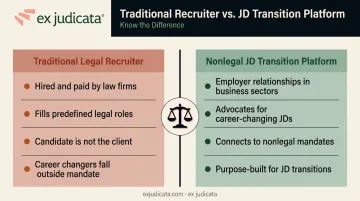
The AESC's foundational definition of retained search confirms this dynamic: executive search firms are retained by clients on an exclusive basis to find someone meeting specific criteria. The search is mandate-driven from start to finish.
What This Means for BigLaw Lawyers
Senior associates and partners in BigLaw are accustomed to constant recruiter outreach. The calls feel like opportunity. But every one of those calls is for a legal role. The recruiter network built around law firm hiring was never designed to place someone out of law — and it won't start now because you ask nicely.
The right resource for leaving law isn't one who sells you to employers as a lawyer — it's one who connects you to employers actively seeking JD-trained problem solvers for nonlegal roles. The options below are built around exactly that model, which is why they produce different results.
The Best Recruiting Firms and Platforms for Lawyers Leaving Legal Practice
This list focuses on resources that either specialize in nonlegal JD transitions or that a transitioning lawyer can realistically access — evaluated on employer relationships, JD-specific focus, and transition track record.
Ex Judicata Search
Founded in 2022 by Neil Handwerker (a former attorney and veteran legal recruiter) and Kimberly Fine (an MBA and legal media veteran), Ex Judicata is the world's only comprehensive employment platform dedicated exclusively to helping JDs transition to nonlegal careers. The platform crossed 500,000 unique users in January 2026.
EXJ Search emerged organically: after the Ex Judicata Job Board launched, companies began approaching the platform directly, seeking JDs for sophisticated nonlegal roles that general job boards couldn't fill. The result was an entirely new category of recruiting — operating at the nexus of legal search and executive search.
Documented hiring employers include Lockton, Marsh McLennan, Guidepost Solutions, and MSIG USA. Documented placements include former attorneys from Cooley, Skadden, and Paul Weiss moving into senior nonlegal business roles.
| Category | Details |
|---|---|
| Specialization | The only recruiting firm purpose-built for nonlegal JD transitions, at the nexus of legal search and executive search |
| Services | Executive search placement, Job Board (100% nonlegal roles), Career Diagnostic, courses, coaching marketplace, peer community |
| Best For | JDs at any career stage seeking business, nonprofit, government, or academic roles where JD-caliber skills are the differentiator |

Major, Lindsey & Africa
MLA is one of the largest global legal recruiting firms, with 40+ years placing associates, partners, general counsel, and in-house legal teams. Their core business is legal-to-legal placement.
Where MLA becomes relevant for career changers is narrow but real: senior JDs targeting chief compliance officer, heavily business-oriented GC roles, or senior risk leadership may find MLA's in-house practice has adjacent mandates.
Their website confirms they build "legal, government affairs, and compliance teams" — which occasionally touches hybrid territory.
The important caveat: MLA has no documented dedicated service for JDs seeking genuinely nonlegal careers. They serve employer mandates, not career-change aspirations.
| Category | Details |
|---|---|
| Specialization | Lateral legal placement: associates, partners, GC, in-house legal departments |
| Services | Executive search, interim staffing, law firm management advisory |
| Best For | Senior JDs targeting GC or hybrid in-house/business leadership where legal credentials remain central |
Korn Ferry
Korn Ferry is a global executive search firm that acquired Lucas Group (which included a legal recruiting practice) in November 2021. Its executive search practice spans industries well beyond law.
For very senior lawyers — equity partners or GCs with deep industry expertise — Korn Ferry's executive search practice can be a legitimate path into C-suite or board-adjacent business roles. The firm has a dedicated in-house legal recruiting practice and Legal Center of Expertise.
The same limitation applies: Korn Ferry is entirely mandate-driven. They engage only when a specific client role matches your profile. Transitioning lawyers should not expect Korn Ferry to proactively advocate for their career change — that's simply not how retained executive search works.
| Category | Details |
|---|---|
| Specialization | Senior executive placement across industries; not dedicated to JD transitions |
| Services | Retained executive search, leadership consulting, organizational advisory |
| Best For | Partner-level or GC-level JDs with strong industry expertise targeting CEO, COO, or other C-suite roles |
JD Careers Out There (JDCOT)
Founded by Marc Luber — a former legal recruiter turned career coach — JDCOT is a coaching and education platform for lawyers considering a transition. It is not a recruiting or placement firm.
JDCOT is worth including here because many lawyers searching for recruiting help will find it first — and it addresses something recruiting can't: the early-stage clarity problem. Self-assessment, career exploration, and networking strategy all need to happen before recruiter engagement makes sense.
JDCOT's video library, coaching programs, and Career Mirror self-assessment tool serve that preparatory function well.
For actual job placement in nonlegal roles, lawyers will still need a platform with employer relationships and a placement mechanism — which JDCOT doesn't provide.
| Category | Details |
|---|---|
| Specialization | Career coaching, self-assessment, and alternative career exploration |
| Services | Coaching, career video library, JD Refugee program, self-assessment tools |
| Best For | Lawyers in early exploration who need directional clarity before pursuing opportunities |
How We Chose These Options
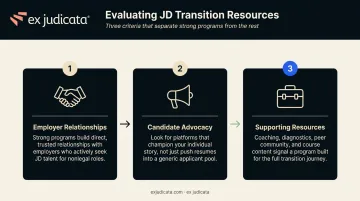
The criteria here differ fundamentally from how traditional legal recruiters are evaluated. Law firm placement volume and Am Law 100 relationships don't matter for this list. Three questions drove the selection:
- Employer relationships: Does this resource have connections with employers actively seeking JD talent for nonlegal roles — not just legal departments?
- Candidate advocacy: Is there a mechanism to advocate for the career-changing lawyer, rather than just fill predefined job specs?
- Supporting resources: Are there coaching, community, or tools that help lawyers navigate the distinct challenges of leaving practice?
Until Ex Judicata Search launched, a dedicated full-service recruiting firm for lawyers leaving law simply didn't exist. NALP's 2025 JD Advantage Career Guide documents the role families where JDs hold a genuine edge — compliance, risk management, government affairs, legal operations, consulting — but connecting lawyers to employers actively hiring for those roles required infrastructure that didn't yet exist.
Building that infrastructure is what distinguishes a purpose-built platform from a generic job board or a traditional recruiter with a side practice.
Most resources on this list still require lawyers to do significant self-directed work. A platform that combines job placement, coaching, assessment tools, and peer community addresses that gap in a way a recruiter alone cannot.
Conclusion
If you're a lawyer looking to leave practice, the traditional legal recruiting market was not built for you. Most firms will either redirect you toward another law job or simply not engage — not out of malice, but because their entire business model runs on filling legal roles for legal clients.
Choosing the right resource means finding one aligned with your actual goal: a nonlegal career where your JD skills are genuinely valued. Successful transitions depend on clarity of direction, a strong network, and access to employers who actively seek JD talent. Ex Judicata is built around exactly that:
- Job Board — 100% nonlegal roles curated for JDs
- Career Diagnostic — maps your attorney traits to specific business careers
- Career Corner — vetted coaching specialists for CV, LinkedIn, and interview prep
- EXJ Community — peer network of non-practicing lawyers who've made the move
- EXJ Search — retained executive search for senior or specialized placements
Visit Ex Judicata to get started.
Frequently Asked Questions
What are the top legal recruiting firms?
The top traditional legal recruiting firms — Major, Lindsey & Africa, BCG Attorney Search, and Robert Half Legal — specialize in placing lawyers in legal roles. For lawyers seeking to leave practice entirely, these firms are generally not the right fit; dedicated platforms like Ex Judicata are better suited to nonlegal transitions.
Can a recruiter help me leave law practice entirely?
Traditional legal recruiters are compensated by employers to fill legal roles and rarely advocate for career changers. Ex Judicata Search was built specifically for this purpose, connecting JDs with companies that actively seek JD-trained professionals for nonlegal business roles.
What kinds of nonlegal jobs can a JD get through a recruiting firm?
JDs land roles in compliance, risk management, government affairs, consulting, business development, finance, and executive leadership — fields where legal training's analytical rigor and communication discipline transfer directly. NALP data shows compliance alone accounts for nearly 16% of JD-advantage business jobs for recent graduates.
Do I need to pay a fee to use a recruiting firm as a lawyer leaving practice?
Reputable recruiting firms are compensated by the hiring employer, not the candidate. As the FTC's guidance on job placement confirms, honest placement firms do not charge candidates. Some career coaching or educational platforms may charge for premium services, which are separate from placement.
How is Ex Judicata Search different from a traditional legal recruiter?
Ex Judicata Search sits at the intersection of legal search and executive search, placing JDs into senior nonlegal roles — CCO, CRO, Chief of Staff, ESG leadership — for employers who actively want JD talent. Traditional legal recruiters fill legal department headcount; Ex Judicata Search does the opposite.
When in my transition should I engage a recruiting firm?
Recruiting firms work best once you have clarity on your target role and industry. Early-stage explorers should start with self-assessment and networking — platforms like JDCOT are built for that groundwork. Senior JDs with a defined nonlegal target can engage Ex Judicata Search earlier to reach the right opportunities faster.